
Tag: futurism

  • Episode 23: Jewish futurist Learning Spaces with Rabbi Charlie Schwartz

    Episode 23: Jewish futurist Learning Spaces with Rabbi Charlie Schwartz

    The Jewish futurism Lab
    The Jewish futurism Lab
    Episode 23: Jewish futurist Learning Spaces with Rabbi Charlie Schwartz
    Loading
    /

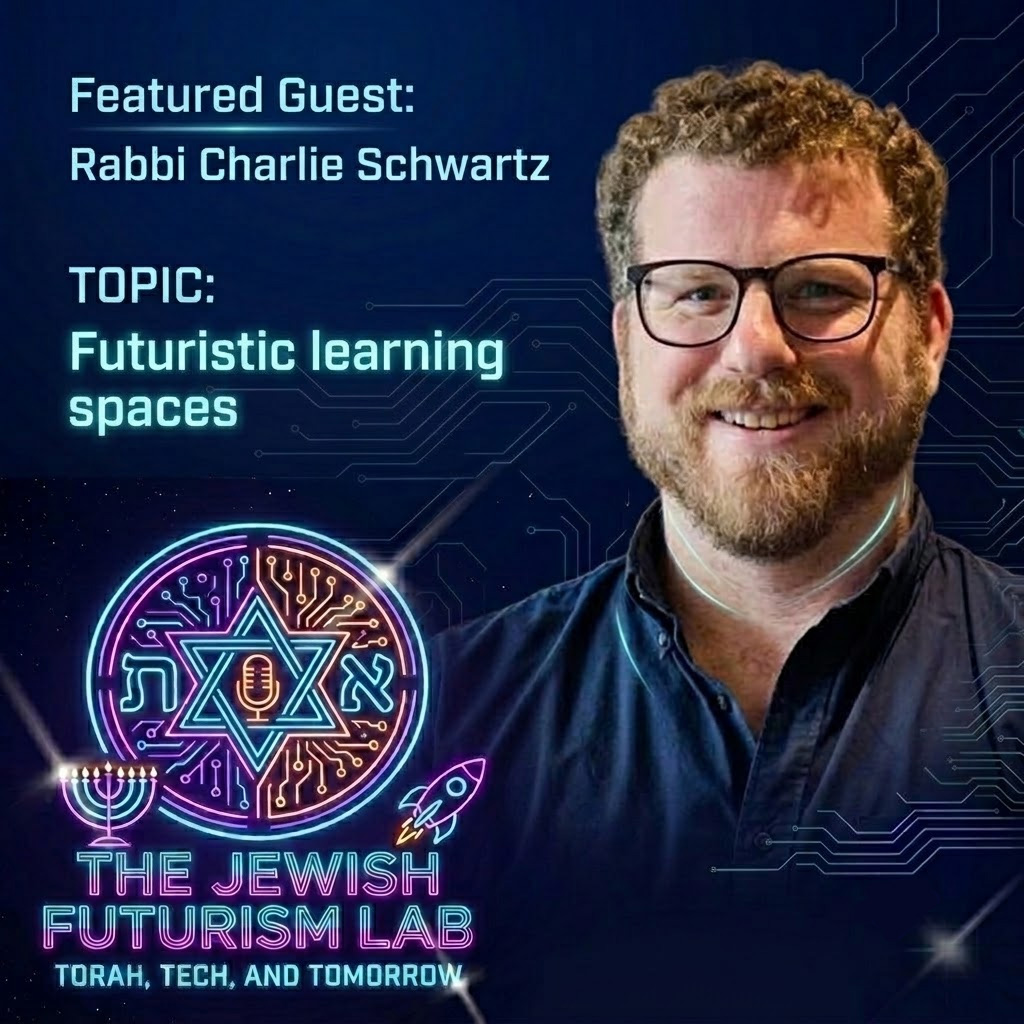
    In this episode, we sit on the patio at Lehrhaus, a Jewish tavern and house of learning in Somerville, in front of a mural by Boston based Jewish artist Chloe Rubinstein, and explore the story behind this unusual space. Rabbi Charlie Schwartz shares his Jewish origin story, how he and cofounder Joshua Foer first imagined Lehrhaus, and why they designed it so that every drink, dish, piece of wall art, book, classroom, and interaction can be a form of learning. We talk about his background in digital Jewish education, his passion for media and spaces, and how Lehrhaus aims to send people home with new habits, new ideas, and a sense of Jewish “third space” they can return to for a refuel. The conversation looks toward the future of Jewish life and asks what it means for a tavern to become both a beit midrash and how I plan to use Lehrhaus as my laboratory for Jewish ritual design.

    If you are in the Somerville,MA area, stop into Lehrhaus and have a drink, food, and learning. Lehrhaus is located at:

    425 Washington Street Somerville, MA 02143

  • Episode 22: Future Judaism on Campus with Rabbi Daniel Levine

    Episode 22: Future Judaism on Campus with Rabbi Daniel Levine

    The Jewish futurism Lab
    The Jewish futurism Lab
    Episode 22: Future Judaism on Campus with Rabbi Daniel Levine
    Loading
    /

    In this episode, Rabbi Daniel Levine, Hillel rabbi, podcast host, and Jewish history professor at UC Irvine, joins us for a wide ranging conversation about the future of Jewish life on campus and beyond. We talk about how October 7 has reshaped the emotional and spiritual landscape for students, the tensions he feels between pastoral care and intellectual honesty, and how his roles as rabbi, educator, and dad pull him in different directions.

    We move into the classroom to revisit moments when a student’s question permanently shifted how he understands Judaism and Jewish history. From there, we step into his home life to explore what his kids have taught him about God, practice, and the limits of inherited ideology. Along the way, we dig into the evolution of ritual, from Judah Halevi to Kabbalat Shabbat to modern siddur changes, and ask what it means to innovate responsibly in a community where many American Jews arrive with low Jewish literacy.

    We also touch on Ashkenazi and Sephardi experiences, denominational fluidity, and whether Jews can move beyond a Christian framing of “religion” toward a richer, more indigenous sense of peoplehood and diaspora culture. If you care about Jewish students, campus debates, or how to pass down a thick, living Judaism to the next generation, this conversation will give you a lot to think about.

    Follow Rabbi Daniel on Instagram

    Watch the Fifth Question Podcast

  • Episode 21: Psychology of the future with Shely Rachel Esses

    Episode 21: Psychology of the future with Shely Rachel Esses

    The Jewish futurism Lab
    The Jewish futurism Lab
    Episode 21: Psychology of the future with Shely Rachel Esses
    Loading
    /

    In this episode of The Jewish futurism Lab, host Mike Wirth sits down with therapist Shely Rachel Esses, LMFT, to explore the psychology of the future self and what it takes to imagine a life beyond survival mode. Shely brings together clinical psychology, nervous system science, embodied healing, and Jewish spiritual wisdom to show how trauma and chronic stress can shrink our sense of possibility, and how healing can reopen it.

    They talk about future thinking, how we project ourselves into the future, and what happens when we start to care not only about our own lives, but also about our impact on our descendants. Along the way, they connect these ideas to teshuvah as an ongoing process of transformation, and to the very practical question of how we begin building better futures in the present, in our relationships, communities, and inner lives.

    Check out Shely’s website.

  • Episode 17- Recoding the Lehrhaus: Jewish Learning in the Future Tense

    Episode 17- Recoding the Lehrhaus: Jewish Learning in the Future Tense

    The Jewish futurism Lab
    The Jewish futurism Lab
    Episode 17- Recoding the Lehrhaus: Jewish Learning in the Future Tense
    Loading
    /

    This episode explores Franz Rosenzweig’s radical vision for Jewish education through the Frankfurt Lehrhaus (1920) and traces its influence into contemporary experiments in creative, future-oriented learning. Rosenzweig rejected passive transmission of knowledge and instead cultivated dialogical, participatory study rooted in lived experience. His Lehrhaus was not simply a school. It was a reorientation of how Jewish life could be learned, practiced, and renewed in modernity.

    That same impulse appears in emerging frameworks like Jewish futurism and the Hiddur Olam creative learning system, which treat tradition as a living medium rather than a fixed archive. The episode draws a line between Rosenzweig’s early 20th century intervention and present-day efforts to design learning environments that are adaptive, imaginative, and relational.

    The episode also highlights the Lehrhaus in Boston as a contemporary expression of this lineage. On June 24, 2026, an in-person course on Jewish futurism will take place there, offering a practical extension of these ideas. The session invites participants to move beyond preservation toward creative responsibility, asking not only what has been inherited, but what must be built.

    Along the way, the episode examines what might be missed when Rosenzweig is reduced to philosophy alone. His educational project was infrastructural. It reshaped who teaches, how learning happens, and what counts as participation. That shift remains unfinished.

  • Episode 16: The Digital Worlds of Erez Cohen

    Episode 16: The Digital Worlds of Erez Cohen

    The Jewish futurism Lab
    The Jewish futurism Lab
    Episode 16: The Digital Worlds of Erez Cohen
    Loading
    /

    In this episode of The Jewish futurism Lab: Torah, Tech, Tomorrow, host Mike Wirth sits down with his friend, Israeli digital artist and projection‑mapping creator Erez Cohen. Mike first encountered Erez’s work through a projection‑mapping piece called Metamorphosis, where veins and fungi slowly overtake a Jerusalem building and turn the city itself into a living, speculative Jewish landscape. You can explore more of Erez’s video mapping, sound, and interactive pieces in the My Works section of his portfolio at erezcohen.art.

    The conversation traces Erez’s journey from hacking video games and running private servers to building immersive environments with tools like Visual Studio, TouchDesigner, and 3D animation. Together they dig into how that background in world‑building feeds directly into his practice of Jewish futurism, why his art is Jewish simply because he is Jewish, and what it means to design custom, generative experiences for a generation raised on platforms like Roblox and Minecraft.

    Mike and Erez also reflect on collaborating on a digital projection project for Israel after October 7, the impact of war and canceled exhibitions on an artist’s plans, and the tension between staying present to crisis and still imagining the futures our kids might inhabit. It is a grounded, personal look at how one artist is using projection, sound, and code to explore Jewish identity, memory, and possibility in real time.

    (more…)
  • EP 14- Papayas on the Moon- My Chat with Alejandro Glatt

    EP 14- Papayas on the Moon- My Chat with Alejandro Glatt

    The Jewish futurism Lab
    The Jewish futurism Lab
    EP 14- Papayas on the Moon- My Chat with Alejandro Glatt
    Loading
    /

    In this episode of The Jewish futurism Lab, I sit down with Mexican artist and papaya visionary Alejandro Glatt, the first Mexican artist to send a papaya to the Moon as part of the Lunaprise art museum project connected to NASA’s Artemis missions. Recorded on the day of the Artemis II launch, our conversation weaves together Jewish futurism, space exploration, and the surprising holiness of fruit in my own evolving sense of contemporary Jewish life.

    Alejandro and I first met at the Jerusalem Biennale, and in this interview I explore how his “Papayas to the Moon” work merges art, ritual, and space technology, turning a simple papaya into a cosmic symbol of life, diaspora, and connection. I ask him about his “Feel the Fruit” experiences, his role as a community builder and trip leader to Israel, and how he imagines Jewish civilization carrying its stories, symbols, and sacred objects into orbit and beyond.

    As you listen, you’ll hear me probing how Alejandro’s art on the Artemis missions reshapes my own questions about Jewish presence in space, how beauty and tiferet might travel with us off‑planet, and why sending a papaya to the Moon could be a kind of blueprint for future Jewish creativity among the stars. You can explore more of Alejandro’s work at alejandroglatt.com and see how his papayas are expanding the conversation about Judaism, ecology, and interstellar imagination.

  • Episode 13: How a Jewish Immigrant Named Hugo Created Sci-Fi

    Episode 13: How a Jewish Immigrant Named Hugo Created Sci-Fi

    The Jewish futurism Lab
    The Jewish futurism Lab
    Episode 13: How a Jewish Immigrant Named Hugo Created Sci-Fi
    Loading
    /

    Before science fiction was a genre, Hugo Gernsback was already building the infrastructure for it: radio magazines, hobbyist communities, wild speculative stories, and the first publication devoted entirely to imagining tomorrow. A Jewish immigrant from Luxembourg, he launched Amazing Stories in 1926 and quietly trained a generation of readers and writers to think in futures, long timelines, and unintended consequences. His magazines hosted women in leadership roles, predicted computer dating, video calling, and the social costs of new technology, while also carrying the casual racism and sexism of their era. We place him alongside Einstein, the artists of Vitebsk, and Fritz Lang’s Metropolis to ask what it meant for Jewish creators to be building the future from the cultural margins. And we end with the question he would have loved most: who is building that kind of futures literacy today?

    (more…)
  • Episode 12:  Professors, Dads, and the Jewish future with Shai Davidai

    Episode 12: Professors, Dads, and the Jewish future with Shai Davidai

    The Jewish futurism Lab
    The Jewish futurism Lab
    Episode 12: Professors, Dads, and the Jewish future with Shai Davidai
    Loading
    /

    In this episode of The Jewish Futurism Lab, Mike Wirth sits down with Shai Davidai, the Israeli‑born social psychologist and former Columbia Business School professor who became a prominent voice for Jewish students after October 7. Together they trace Shai’s journey from secular Israeli kid to public Jewish advocate, unpack what really happened for him on campus, and explore how his training as a social psychologist shapes the way he reads our power, our responsibility today, and the continuity of our legacies tomorrow. They talk about fatherhood, professorship, and podcasting, and ask what kinds of institutions, communities, and narratives the Jewish future will need.

    (more…)
  • Episode 11: Jews, AI, and the Real Meaning of “Creative”

    Episode 11: Jews, AI, and the Real Meaning of “Creative”

    The Jewish futurism Lab
    The Jewish futurism Lab
    Episode 11: Jews, AI, and the Real Meaning of “Creative”
    Loading
    /

    In this episode of The Jewish futurism Lab, Mike Wirth uses the 4C model of creativity to map out what we really mean by “creative” in an age of AI art and endless images. He traces his own journey from parametric code experiments to Jewish futurist murals, then layers in Jewish history, exile, and the long tension around graven images as a lived curriculum in world‑building.

    Along the way, Mike explores flow, aura, and authorship, asking who holds intention and responsibility when AI enters the studio. The conversation lands in Jewish futurism as an ethical frame, inviting listeners to treat narrative and technology as tools for building livable futures.

    (more…)
  • Episode 10 – From Utopia to Conspiracy: The Secret Battle Over Jewish Futures

    Episode 10 – From Utopia to Conspiracy: The Secret Battle Over Jewish Futures

    The Jewish futurism Lab
    The Jewish futurism Lab
    Episode 10 – From Utopia to Conspiracy: The Secret Battle Over Jewish Futures
    Loading
    /

    In this episode of The Jewish futurism Lab, Jewish futurist and we’ll explore early Jewish futurism, Zionist art, and media history through Theodor Herzl’s Altneuland, Ephraim Moses Lilien’s Zionist Art Nouveau, and Boris Schatz’s Bezalel School in Jerusalem. He contrasts these utopian blueprints and design prototypes with the antisemitic hoax The Protocols of the Elders of Zion, showing how Jewish artists, writers, and educators used print, ritual objects, and visual culture to claim Jewish agency and design a different future.