Episode 13: How a Jewish Immigrant Named Hugo Created Sci-Fi
/
RSS Feed
Share
Link
Embed
Before science fiction was a genre, Hugo Gernsback was already building the infrastructure for it: radio magazines, hobbyist communities, wild speculative stories, and the first publication devoted entirely to imagining tomorrow. A Jewish immigrant from Luxembourg, he launched Amazing Stories in 1926 and quietly trained a generation of readers and writers to think in futures, long timelines, and unintended consequences. His magazines hosted women in leadership roles, predicted computer dating, video calling, and the social costs of new technology, while also carrying the casual racism and sexism of their era. We place him alongside Einstein, the artists of Vitebsk, and Fritz Lang’s Metropolis to ask what it meant for Jewish creators to be building the future from the cultural margins. And we end with the question he would have loved most: who is building that kind of futures literacy today?
Episode 11: Jews, AI, and the Real Meaning of “Creative”
/
RSS Feed
Share
Link
Embed
In this episode of The Jewish futurism Lab, Mike Wirth uses the 4C model of creativity to map out what we really mean by “creative” in an age of AI art and endless images. He traces his own journey from parametric code experiments to Jewish futurist murals, then layers in Jewish history, exile, and the long tension around graven images as a lived curriculum in world‑building.
Along the way, Mike explores flow, aura, and authorship, asking who holds intention and responsibility when AI enters the studio. The conversation lands in Jewish futurism as an ethical frame, inviting listeners to treat narrative and technology as tools for building livable futures.
Episode 10 – From Utopia to Conspiracy: The Secret Battle Over Jewish Futures
/
RSS Feed
Share
Link
Embed
In this episode of The Jewish futurism Lab, Jewish futurist and we’ll explore early Jewish futurism, Zionist art, and media history through Theodor Herzl’s Altneuland, Ephraim Moses Lilien’s Zionist Art Nouveau, and Boris Schatz’s Bezalel School in Jerusalem. He contrasts these utopian blueprints and design prototypes with the antisemitic hoax The Protocols of the Elders of Zion, showing how Jewish artists, writers, and educators used print, ritual objects, and visual culture to claim Jewish agency and design a different future.
Episode 9: From Cult to Code: Tracing the History of the Aura in Art
/
RSS Feed
Share
Link
Embed
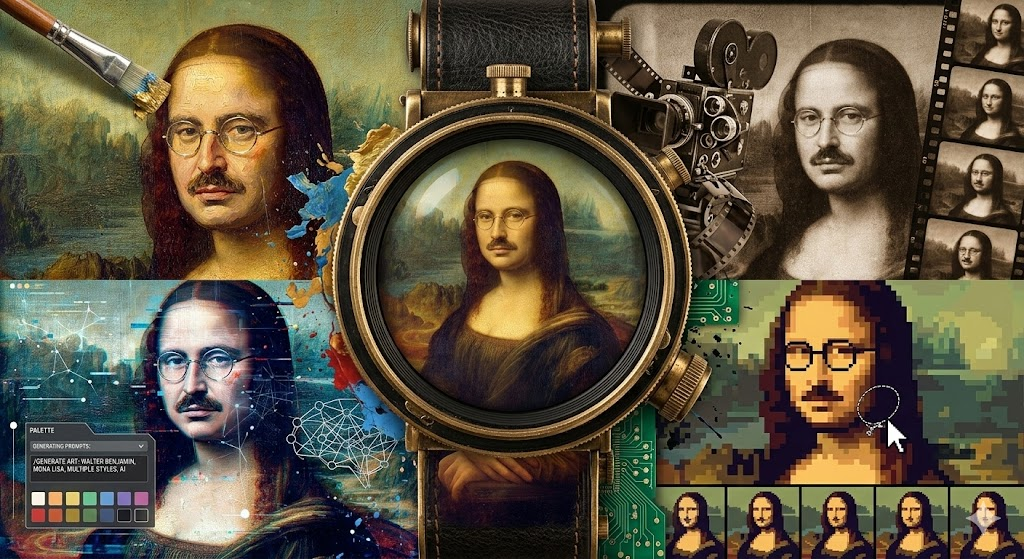
Walter Benjamin, AI, & the Aura of Art: In this episode of The Jewish futurism Lab, host Mike Wirth unpacks Walter Benjamin’s “aura” of art and asks what presence means when every image can be copied, remixed, and generated on demand. Moving from Byzantine icons and ritual objects to photography, social media, NFTs, and AI image models trained on his own work, Mike maps six value eras of art, from cult value and exhibition value to digital manipulation, circulation, synthetic scarcity, and generative value.
Along the way, he explores why a family Hanukkiah, a live performance, or a handmade painting still feel different from a viral post or a blockchain-certified NFT, and how Jewish ritual and textual tradition offer a counter-story to purely market-driven ideas of originality and authenticity.
The episode lands on a haunting, guiding question for our AI age: when you stand in front of an image, an object, or an artwork today, was anyone present when this was made?
Walter Benjamin is not a household name. But he should be.
In 1936, this German philosopher and cultural critic wrote an essay that predicted, with startling precision, almost everything that has happened to art since. He described what it would feel like when images became infinitely copyable. He anticipated the strange hollowness of standing in front of a famous painting you have already seen a thousand times on a screen. He named the feeling you get in front of a great original that no photograph ever quite captures. And he called it, simply, the aura.
“Even the most perfect reproduction of a work of art is lacking in one element: its presence in time and space, its unique existence at the place where it happens to be.” — Walter Benjamin, Illuminations (214)
You already know what aura is. You have felt it. It is the difference between seeing a photo of the Grand Canyon and standing at its edge. It is why people still cry in front of paintings in museums. It is why a vinyl record from a musician you love feels different from the same album on a streaming service. It is why your grandmother’s ring means something her ring’s photograph does not. Benjamin just gave it a name and asked what happens to it when technology makes everything reproducible.
I have been asking that same question for most of my adult life. The answer, it turns out, is complicated. And beautiful. And a little devastating.
What Benjamin Actually Said
Benjamin’s core argument is simple enough to fit on a Post-it note: every original artwork has a presence tied to the specific place and moment it occupies in history. He called this its “here and now” (Benjamin 214). A painting carries the weight of every hand that ever touched it, every room it ever hung in, every century it survived. That accumulated presence is its aura. And the moment you photograph it, print it, digitize it, or copy it in any way, something essential leaks out. The copy is everywhere. The original is still only here.
I remember reading this in college and thinking it sounded romantic, maybe even a little precious. It took years of making things, and years of watching how people relate to things I made, before I understood he was not being romantic at all. He was being precise.
He was writing at a moment when photography and film were brand new cultural forces, and he watched them doing something no previous technology had managed: not just reproducing art, but changing what people expected from it. The museum poster, the art history textbook, the film still. Suddenly the image of the artwork was more familiar than the artwork itself.
“That which withers in the age of mechanical reproduction is the aura of the work of art.” — Walter Benjamin, Illuminations (221)
What makes Benjamin so prescient is that he was not simply mourning this loss. He saw something potentially liberating in it too. If art was no longer locked inside churches and palaces and the reverence of the elite, maybe it could become something more democratic. Maybe it could be politically alive in ways sacred objects never were. I find that tension in his thinking genuinely useful. He does not give you a clean answer because there is not one. He holds the grief and the possibility at the same time, which is, I think, the only honest way to engage with what technology does to culture.
The Six Lives of Aura
What Benjamin could not have predicted was how many more transformations were coming. Aura did not simply wane and disappear. It kept reinventing itself, finding new containers, mutating into new forms of value with each new technology. When I map these transformations out, what strikes me most is not how much has changed but how consistent the underlying human longing remains. Every era destroys one version of presence and immediately starts trying to rebuild it.
“The desire for authenticity, for the unrepeatable, for the original: this is what drives the market’s endless attempts to reconstruct aura under new conditions.” — Jos de Mul, Cyberspace Odyssey
Here is how that history maps across six eras.
Before the camera, art had cult value. It existed in one place, for one community, embedded in ritual (Benjamin 217). You had to travel to it. The gap between you and the object was not an obstacle. It was the point. Think of a Byzantine icon, a cathedral fresco, a Torah scroll passed down through generations. These things were not primarily decorative. They were alive with the weight of where they had been and who had held them.
I think about this constantly in my work with Jewish material culture. A Hanukkiah that has been in a family for four generations is not the same object as an identical one bought last year. It carries a history in its scratches and its dents and its smell. That is cult value. And I want to be clear about something that often gets lost in discussions of Benjamin: cult value has not disappeared from contemporary practice. Studio artists working in slow, material-intensive disciplines, oil painting, ceramics, hand-pulled printmaking, still generate genuine aura through the ritual of making. The visible trace of time, the irreproducible encounter with an original surface: these conditions still produce something real. I have stood in front of works that stopped me cold in ways I could not explain, and I believe that experience is not nostalgia. It is recognition.
Photography gave us exhibition value. Art could now travel to you, flattened and portable (Benjamin 225). More people than ever could access it, which was genuinely democratic and genuinely good. But the form of that access had changed fundamentally. The Mona Lisa on a postcard belongs to no place and no moment. It has been liberated from its context and, in that liberation, hollowed out a little. I do not say this with contempt for the postcard. I own plenty of them. I say it because the hollowing is real, and pretending otherwise does not serve anyone.
“The technique of reproduction detaches the reproduced object from the domain of tradition.” — Walter Benjamin, Illuminations (221)
The market fought back almost immediately: signed editions, numbered prints, certificates of authenticity. I find this reflex fascinating and a little poignant. The demand for aura did not disappear when the technology changed. It went underground and started looking for new containers. That pattern repeats in every era that follows, and once you see it you cannot unsee it.
The digital age brought manipulation value. Theorist Lev Manovich argued in 1998 that the database had replaced narrative as the dominant logic of new media culture (Manovich, “Database”). In a database, nothing has a fixed place or hierarchy. Everything is a node, waiting to be queried, remixed, and recombined. Art became raw material. Its worth shifted from what it was to how generative it could be.
“The database represents the world as a list of items, and it refuses to order this list.” — Lev Manovich, “Database as a Symbolic Form”
Hip-hop producers understood this intuitively before any theorist named it. Joseph Schloss establishes in Making Beats that producers sample not because it is convenient but because it is aesthetically beautiful, governed by a strict ethics of creativity and reverence for the source (Schloss 60–61). I find this argument genuinely moving. A Madlib record is built from hundreds of samples, each one carrying the aura of its source: a 1972 soul session, a Brazilian jazz recording, a forgotten film score, all folded into something new. The manipulation is also an act of love. He knew what he was taking. He was accountable to it.
“Sampling itself is an embodiment of this active process of engaging with history.” — Jeff Chang, Can’t Stop Won’t Stop (qtd. in DiCola and McLeod 74)
That accountability is everything. It is what separates sampling from mere recombination, and it becomes the critical distinction when we get to AI.
Social media created circulation value. In the age of Instagram, TikTok, and viral sharing, what an artwork is worth is inseparable from how far and fast it moves (Eryani). I remember when this shift started to feel real to me, not as a theoretical idea but as something I was actually living. Works I made that circulated widely took on a kind of social weight I had not anticipated. Works I made that did not circulate felt invisible regardless of how much they meant to me. That asymmetry disturbed me. It still does.
“In the digital age, the aura of an artwork is no longer tied to its physical uniqueness but to its cultural resonance and the collective experience it generates.” — Rulla Eryani, “Aura Reimagined”
A work now risks losing significance not by being too widely reproduced but by not being reproduced widely enough. Obscurity, not ubiquity, is the threat. Benjamin would have found this deeply strange. I find it both funny and genuinely disorienting.
NFTs tried to engineer scarcity value. When digital technology made reproduction totally free and infinite, the market did not accept the loss of aura gracefully. It built a financial instrument to simulate it. A blockchain certificate acted as a surrogate original, a unique claim of ownership over an infinitely copyable file (Jin). I watched this happen in real time and felt something like recognition mixed with exhaustion. Of course the market did this. It always does.
“NFTs don’t reinvent the aura — they show us what it always was: a structure of power, hierarchy, and exclusivity dressed in spiritual language.” — Laurie Rojas, Caesura Magazine
What NFTs revealed, more nakedly than anything in recent art history, is that the desire for aura was never purely spiritual. It was always also about property, exclusivity, and the economics of being the one person who owns the real thing. The container was synthetic. The longing was genuine. I think that distinction matters enormously.
AI generation has brought us to generative value. This is the strangest and most unsettled territory of all, and I say that as someone who is inside it. AI does not reproduce existing works. It generates entirely new ones, trained on millions of images, producing outputs that look like art, circulate like art, and affect people the way art does, but which were made by no one in particular, in no specific moment, with no hand, no resistance, no decision under pressure.
“AI systems trained on cultural databases continue the database logic of new media, generating new narratives and images from accumulated cultural archives.” — Lev Manovich and Emanuele Arielli, Artificial Aesthetics
I have fine-tuned my own image models on my own work. I fed them my visual language, my aesthetic history, my accumulated decisions as an artist, and watched them generate images that look, in some meaningful way, like me. I want to be honest about how strange that experience is. The outputs are genuinely useful. I use them for ideation, for unlocking directions I might not have found otherwise, for seeing my own sensibility reflected back at unexpected angles. But I have never used AI output in a final work. Something stops me every time. I have spent a lot of time trying to name what that something is, and I think Benjamin finally gives me the language: the generated image carries the shape of my aura but not its weight. The model learned from objects I made in specific moments. It was not there when I made them.
This is also where collage becomes a useful and genuinely complicated contrast. Hannah Höch, Kurt Schwitters, Romare Bearden built entire practices on the deliberate rupture of aura in source materials. And yet their works carry unmistakable aura of their own. The cut is a decision. The placement is a decision. The tension between fragments is authored, lived, physically enacted in a specific moment by a specific person. AI image generation looks like collage from the outside but the difference is exactly what Benjamin would have identified: there is no hand, no moment, no resistance.
“A work of art produced by a human hand communicates something of the artist’s presence, their struggle with materials, their decision-making under pressure — none of which a machine can replicate.” — Eva Cetinic and James She, Leonardo (Cetinic)
A collage artist ruptures aura intentionally and then reconstructs something from the rupture. An AI model has no relationship to rupture because it was never present to the wholeness of what it borrowed from. Collage and hip-hop sampling both taught me that context can be destroyed and meaning can still be made. AI is asking me whether that is still true when the displacement is total and no one was accountable to the source. I genuinely do not know the answer yet.
Why This Matters Now
Here is the thing about Benjamin’s argument that keeps bringing me back to it after all these years: the desire for aura never disappears. Every technological shift triggers an almost immediate cultural attempt to reconstruct what was just lost. Signed prints, authentication certificates, blockchain tokens, the slow craft revival, the vinyl resurgence, the return to film photography among young artists. These are not nostalgic accidents. They are symptoms of a persistent human need for the irreplaceable encounter, for the object or experience that cannot be anywhere else because it is only here.
I see this in my students. I see it in collectors. I see it in myself every time I walk into a room with an object that stops me. The need is real. What changes is only the form it takes and how honestly we reckon with whether the form is delivering what we actually hunger for.
“The authenticity of a thing is the essence of all that is transmissible from its beginning, ranging from its substantive duration to its testimony to the history which it has experienced.” — Walter Benjamin, Illuminations (221)
The question Benjamin leaves us with, and the one I find most urgent right now, is not whether aura survives. It clearly does, in some form, in every era. The question is what conditions make genuine aura possible and what conditions produce only its simulation. The handmade object, the live performance, the face-to-face encounter: these still generate something real. The blockchain certificate, the AI output, the viral image: these generate something that rhymes with aura but plays by different rules. Knowing the difference, and caring about the difference, might be the most important thing an artist, a designer, or a thoughtful consumer of culture can do right now.
Walter Benjamin died in 1940, at the Spanish border, fleeing the Nazis, carrying a manuscript no one has ever found. He did not live to see television, the internet, the smartphone, or the AI image generator. But he understood the essential dynamic that drives all of them: every new technology promises to bring art closer to everyone, and every new technology changes what art is in the process of doing so. The question he asked in 1936 is the same one I keep asking.
Was anyone present when this was made?
This essay is part of an ongoing exploration of Jewish Futurism, design thinking, and the cultural stakes of emerging technology.
Works Cited
Benjamin, Walter. “The Work of Art in the Age of Mechanical Reproduction.” Illuminations: Essays and Reflections, edited by Hannah Arendt, translated by Harry Zohn, Schocken Books, 1969, pp. 214–240.
Cetinic, Eva, and James She. “The ‘Aura’ of Artworks in the Era of Artificial Intelligence.” Leonardo, vol. 58, no. 4, MIT Press, 2025, pp. 352–360.
Chang, Jeff. Can’t Stop Won’t Stop: A History of the Hip-Hop Generation. St. Martin’s Press, 2005.
de Mul, Jos. Cyberspace Odyssey: Towards a Virtual Ontology and Anthropology. Cambridge Scholars Publishing, 2010.
DiCola, Peter, and Kembrew McLeod. Creative License: The Law and Culture of Digital Sampling. Duke University Press, 2011.
Episode 8: Speed Kills : Why Every futurist must confront the past
/
RSS Feed
Share
Link
Embed
In this episode, we confront the rise and collapse of Italian Futurism, the avant garde movement that worshiped speed, technology, youth, and rupture at any cost. What began as radical artistic rebellion under Filippo Tommaso Marinetti quickly blurred into nationalism and ultimately aligned itself with fascism.
So what went wrong?
We examine how aesthetic obsession with acceleration became political extremism, and how the rhetoric of disruption can mask ethical blind spots. For today’s futurists working in AI, design, and innovation, the lesson is clear: progress without moral grounding is dangerous. If you build the future, you are responsible for its consequences.
What does it mean to build a Jewish future through scissors, glue, and pixels? In this episode, I sit down with collage artist Alex Woz, who I met at the Jerusalem Biennale. We talk about the graphic design industry, swap stories about our favorite Jewish artists, and get honest about why we make what we make.
Alex grew up in an antisemitic city and turned that experience into an artistic mission. We explore the weird parallels between cutting and pasting found images and prompting AI, what makes art original, and how we’re both in conversation with Jewish creative lineage from Moritz Daniel Oppenheim to today.
This conversation goes deep on legacy: What are we leaving behind for our descendants? What does Jewish creativity look like when it refuses to disappear? And why is Alex a practitioner of Jewish futurism, even if he works with analog and digital hand tools instead of code ?
What happens when flow has no boundaries? In Episode 4 of The Jewish Futurism Lab, I explore how creativity without limits turns into exhaustion, addiction, or production without reflection. This episode introduces Shabbat not just as religious practice, but as a design principle: a refusal built into time that prevents work from consuming the people inside it.
Drawing connections between Mussar ethics, inclusive design, and systems thinking, I examine how Jewish tradition offers practical frameworks for sustainable creativity. From classroom constraints that sharpen student focus to the Golem story’s “erase key,” this episode asks: Where is your pause? Where do you step back before momentum takes over?
Join me as I unpack why limits aren’t the enemy of creativity. They’re what make creativity sustainable and accountable.
This is the working glossary for Jewish futurism, the terms, frameworks, and coined vocabulary that give the field its shape. Some entries are old words redirected toward new use, midbar, mesorah, aggadah. Others are new terms I’ve coined outright, each one dated and marked as such.
Every entry has its own anchor link. If you’re writing about Jewish futurism and need a term with a clear definition and a clear source, link directly to the specific entry rather than the page as a whole, that’s what the anchors are for. This glossary is updated as the practice grows, so check back for new terms.
Core Concepts
Jewish futurism: A creative and philosophical framework suggesting that Jewish civilization is closer to its beginning than its end, using Jewish ideas, symbols, stories, and values to imagine and design ethical futures. It resists nostalgia that freezes the past while rejecting futures that erase identity or ethics.
Judeofuturism: An alternative term emphasizing the honoring of infinite bounds of Jewishness while imagining desired Jewish futures. Often used interchangeably with Jewish futurism in artistic and cultural contexts.
Metamodernism: A cultural discourse and paradigm that emerged after postmodernism, characterized by oscillation between modernist sincerity and postmodernalist irony, hope and melancholy, naivety and knowingness. It integrates aspects of both modernism and postmodernism, accepting progress, spirituality, and grand narratives while maintaining critical self-awareness. [Inference] This framework aligns with Jewish futurism’s simultaneous engagement with tradition and radical future-building.
Areyvut (mutual responsibility): A foundational middah (ethical quality) in Jewish futurism, emphasizing that future-building is a collective project rather than an individual quest. This principle grounds innovation in communal accountability.
Avodah (sacred service): The practice of treating innovation and creative work as sacred service. In Jewish futurism, this reframes technological and artistic creation as spiritual practice.
Creative middot: [Inference] Ethical qualities or character traits applied to creative and design practice within Jewish futurism. This extends the traditional concept of middot (virtues) into the realm of innovation and making.
Hiddur olam: [Inference] A term combining hiddur (beautification, enhancement) with olam (world), suggesting the beautification or enhancement of the world. [Inference] In Jewish futurism, this concept may relate to world-building and the ethical imperative to make beautiful, livable futures.
Liminal space: From the Latin limen (threshold), the quality of ambiguity or disorientation that occurs in the middle stage of a rite of passage, when participants no longer hold their pre-ritual status but have not yet begun the transition to their new status. Liminal spaces are characterized by ambiguity, potentiality for transformation, and often create a sense of communitas (deep togetherness). In Judaism, the mikvah (ritual bath) serves as a quintessential liminal space, marking transitions from unmarried to married, non-Jew to Jew, and symbolizing moments of profound transformation and renewal. The mezuzah on doorposts also marks liminal space, acknowledging thresholds as sacred transition points between outside and inside, public and private.
Temporal Concepts
Short-termism: The practice of prioritizing immediate results and quick rewards over long-term consequences and far-seeing action. Jewish futurism explicitly resists short-termism by emphasizing multi-generational responsibility and ethical planning that extends beyond a single lifetime.
Backcasting: A planning method that begins by defining a desirable future and then works backward to identify the steps needed to achieve it. Unlike forecasting (which projects from the present forward), backcasting starts with a vision and maps pathways from that future goal back to current actions.
Forestalgia: A yearning for an idealized future, as opposed to nostalgia’s longing for the past. [Inference] This concept resonates with Jewish futurism’s forward-looking orientation while maintaining connection to tradition.
Forward-looking responsibility: The ethical obligation rooted in ancient texts and lived memory to ask “What kind of world are we building next?”. This reflects Judaism’s historical orientation toward future generations.
Long-term thinking: An exercise that Jewish futurism frames not as escapism or frivolity but as a core calling.
Creative and Methodological Framework
Flow state: A psychological state of complete absorption in an activity where nothing else seems to matter, described by psychologist Mihaly Csikszentmihalyi as optimal experience. In flow, skills seamlessly meet challenges, self-consciousness disappears, and action and awareness merge. [Inference] Flow states are central to creative practice in Jewish futurism.
Experiential learning: A learning approach that emphasizes hands-on activities, concrete experience, and reflective observation. [Inference] This method supports the embodied, practice-based nature of Jewish futurist work.
Divergent thinking: A mental process that generates multiple creative solutions to a single problem by exploring various possibilities, brainstorming, and taking unconventional paths. It encourages thinking outside conventional boundaries and considering different perspectives without immediately worrying about feasibility.
Systems thinking: An approach that analyzes problems by understanding the broader context and examining relationships and interactions between components. Rather than focusing on isolated elements, systems thinking reveals how all parts connect and influence one another, helping designers anticipate unintended consequences and solve root causes.
Design thinking: [Inference] A human-centered problem-solving methodology that emphasizes empathy, ideation, prototyping, and iteration. [Inference] In Jewish futurism, this approach is integrated with design methods to prototype Jewish ethical frameworks and values.
UX Design (User Experience Design): An approach that focuses on optimizing user interactions with products and services. When combined with systems thinking, UX design considers how all parts of a product, user, and environment connect rather than isolated touchpoints.
Ethical and Creative Framework
Creation as systems design: One of two foundational coordinates of Jewish futurism, derived from the Zohar’s vision of divine networks. This approach views creative work through the lens of interconnected systems.
Ethics as boundary of holiness: The second coordinate defining Jewish futurist practice, informed by warnings about unintegrated revelation and the Golem narrative’s lessons about ethical creation.
Ritual innovation: The practice of adapting and transforming Jewish rituals for contemporary contexts. This includes AI-integrated rituals and speculative narratives exploring modern Jewish spirituality.
Hitpashtut ha-gashmiyyut (stripping of corporeality): A Hasidic concept meaning liberation from the material to make room for the spiritual. In Jewish futurism, this can inform approaches to technology and embodiment.
Artistic and Design Terms
Neon-infused aesthetics: Contemporary visual language in Jewish Futurist art that uses bright, technological imagery to explore Jewish themes. This aesthetic bridges traditional symbolism with speculative design.
Speculative chronology: The use of speculative fiction, alternate histories, and future narratives to explore Jewish identity and possibilities. This encompasses literature, art, design, architecture, music, and technology.
Tel Atid (Hill of the Future): A symbolic concept in Jewish futurism representing future-building sites. The term combines archaeological connotations with forward orientation.
Practice and Play
Ludic midrash. Game design as a form of midrash. You’re not just decorating a lesson with a game, you’re using the rules, the win conditions, the stupid little penalty cards, as the actual interpretive act, the same way a rabbi uses a wordplay to crack open a verse. A good mechanic is just a very well disguised drash.
Prototyping peoplehood. The habit of building small, playable, breakable versions of a possible Jewish future instead of only writing or lecturing about it. A scavenger hunt on Padlet, an AR layer over a sanctuary, a ritual you invent on a Tuesday and throw out by Thursday. Design thinking already lives in Mike’s glossary. This is what happens when you scale that instinct up to the level of a whole community instead of one designer’s sketchbook.
Diaspora futurism. Not just Jewish futurism that happens to be aware of the diaspora, but futurism built with no geographic or institutional center at all as its starting assumption. Most speculative Jewish design still quietly imagines some anchor point out there, a synagogue, a homeland, a movement office. Diaspora futurism strips that anchor out on purpose and asks what Jewish practice, ritual, and worldbuilding look like when portability is the whole design brief, not a workaround. [Inference]
Galut/ Off-grid Judaism. The lived condition of practicing Jewishly in total institutional isolation. No synagogue, no community, no rabbi, nothing. Just you, whatever you remember or carry with you, and however much you’re willing to invent on the spot. This already has a real history behind it, nineteenth century Jews who moved west with the frontier and built religious life out of nothing but memory and improvisation, without any of the machinery we now assume Judaism needs to function. Galut/ Off-grid Judaism names that same condition whenever it shows up again, a Jew stationed alone somewhere remote, a family that’s the only Jewish household for two hundred miles, anyone doing this completely unsupervised. It’s the sharpest possible test case for diaspora futurism, since it asks the question with zero cushion. The phrase “Galut Judaism” comes from Jacob Hasse Albino’s Tales from Galut Jewish futurist short stories. “Off-grid” is an additional synonym from Mike Wirth
Yiddish futurism. A real historical movement, not a synonym for Jewish futurism, and worth keeping those two separate in your own head before anyone else’s. In the 1910s and 20s, Yiddish poets like Peretz Markish, Dovid Hofshteyn, and Leyb Kvitko were reading Marinetti and the Russian Futurists and German Expressionists, then running their own little magazines out of Lodz and Warsaw, Yung-idish, Albatros, that kind of thing. Scholars studying it now are careful to say it wasn’t a copy of Russian Futurism dropped into Yiddish, it was a distillation, remade to fit a specifically Jewish, specifically Yiddish, political and cultural moment. So Yiddish futurism is a language and a generation. Jewish futurism, the thing we’re actually building this glossary around, is a stance and a method, aimed forward instead of describing something that already closed a hundred years ago.
Aggadic interface. An interactive experience built on story rather than law. Halacha tells you what to do, aggadah tells you a story about why it might matter, and an aggadic interface is the game or AR layer or hunt that lives entirely in that second lane.
Mesorah mechanics. The actual rules and feedback loops you design so a game transmits something, not just entertains for forty minutes and evaporates. Mesorah means the chain of transmission. A mesorah mechanic is a rule built so the chain doesn’t drop when you hand it to a fourteen year old with a phone.
Augmented aggadah. My personal obsession lately, and probably the reason I keep opening my AR development tools at midnight instead of sleeping. Layering speculative narrative directly onto a real physical or textual Jewish space, a sanctuary, a scroll, a street, so the story becomes something you walk through instead of just read.
Speculative minhag(im). A Jewish custom invented inside a workshop, tested for one afternoon, and then either kept or thrown in the bin. A minhag is a custom. The speculative kind is provisional by design, a prototype of a practice rather than a pitch for one as a tradition.
Chevruta prototyping. Two people arguing over a half built design the way two people traditionally argue over a half understood verse. Same intensity, same back and forth, just pointed at a Figma file or a cardboard mockup instead of a page of Gemara. This practice is akin to a design charrette, where design teams work in collaborative bursts to yield greater creativity by exposing all designers to all problems and solutions.
Playable prophecy. The whole argument in three words: if you want people to believe in a Jewish future, let them play it before you make them read about it. Vision should get playtested, not just delivered from a podium, and honestly most of my best workshop ideas only became real once a room full of skeptical sixteen year olds tried to break them, found the loophole, and then fixed it themselves without me saying a word.
Camp scale futurism. Jewish futurist thinking, exercises, and project builds designed for the size and chaos of an actual summer camp cohort, sixty plus kids, a schedule that will absolutely fall apart, and exactly one working walkie talkie. Logistics is not the boring part of this work, logistics is where the actual design thinking happens.
Diasporic worldbuilding. Sci fi worldbuilding vocabulary, borrowed and rerooted in diaspora instead of a nation state or a messianic arrival date. Building out the systems, lore, and texture of a future that assumes we are still scattered, still building, still here. A diasporic cousin to Mike’s own Tel Atid.
Let me start by saying what Jewish futurism is not, at least for me.
It is not putting a Star of David on a sleek sci-fi object and calling it a day. It is not “Jewish, but make it cyberpunk.” And it is definitely not about predicting the future like some kind of techno-prophet.
For me, Jewish futurism feels more like a reunion of kindred spirits.
A pulling back together of a long, messy line of prophets, mystics, cartoonists, coders, muralists, and weird uncles who stayed up too late arguing midrash. A line that runs from Torah and golems to comics and game engines. Not to escape history, but to carry it forward with intention.
When I build something under this banner, I try to remember that I am plugging into that line. And I need a way to check myself while I’m doing it.
So think of this not as a manifesto, but as a conversation. Something you can keep open next to your sketchbook, your code editor, or your half-finished ritual prototype.
Before you make anything, pause
Before the fancy shaders. Before the slick prompts. Before the paint flies.
Ask a simple question: What am I actually doing here, and who does it impact?
I come back again and again to this tension.
Am I sanctifying technology, or am I just showing off?
Tech is a utensil. It is not the main character. So I ask myself: what am I trying to elevate? Where is the kavannah? Where is the hiddur mitzvah, the moment where something becomes more beautiful, more meaningful, more reachable for someone else?
If the honest answer is “it’s just cool,” that’s not a failure. But it is a cue to slow down and look again.
Every golem needs an off switch
This part matters more than we like to admit.
The Golem story is our original dev-ops parable. The impressive part is not that the creature walks or lifts heavy things. The Jewish part is the letter you can erase to stop it.
When you’re working with powerful systems, AI, networks, social platforms, feedback loops, you have to ask:
What is the kill switch?
What are the limits, the norms, the literal or metaphorical buttons that stop this if it starts causing harm?
If there is no answer, you may be building the wrong kind of golem. Or at least one that needs more thought before it leaves the workshop.
And while we’re here, I try to be suspicious of the word “disruption.” Disruption is easy. Repair is harder.
So I ask: what does this actually repair? A dead corner of ritual? A missing story? A lack of joy? A pattern of exclusion?
If I cannot name the repair, I might just be speeding up something that was already broken.
The future does not work without memory
Jewish futurism is obsessed with what comes next, but it refuses to get there by burning the archive.
I try to ask myself: am I innovating with memory, or without it?
Innovation without memory is another version of a golem. Powerful, impressive, and hollow.
So I name my sources. Texts, stories, communities, teachers. I try to let at least one move in the work be a reply to someone who is not in the room anymore.
And I think about time differently.
Jewish time loops. We return to the same holidays, the same readings, the same traumas, but never in quite the same way. There is always another layer.
Does my work do that? Does it circle, repeat, echo, or sync to rhythms larger than me? Or is it just a straight rocket out of history?
I think of this as visual midrash
Midrash is not commentary. It is argument. It is wrestling.
Visual midrash just uses different tools.
Pixels. Lines. Sound. Code. Motion.
So I ask: which story am I arguing with? Which verse am I stretching, healing, poking at, or refusing to let go of?
If I am using generative systems or futuristic aesthetics, can I actually point to the Torah, prophet, or folktale that is in the room with me while I work?
If I cannot, that is information worth listening to.
If it costs nothing, it might not be finished yet
This is the uncomfortable part.
Good Jewish futurist work usually carries some tension. Between me and my community. Between hope and fear. Between what feels safe and what feels honest.
I think about Asher Lev painting the crucifixion. Not because I want to shock anyone, but because he showed what it looks like to take your tradition seriously enough to struggle with it in public.
If everything in the work feels pleasant and agreeable, I pause. I ask what I am avoiding.
And I try to practice anavah, humility, especially when working with big ideas and powerful tools.
Where do I admit I do not know? Where do I invite critique? Where do I let uncertainty live inside the work instead of editing it out?
Jewish stories are full of vessels that shatter when they hold too much light. That warning is still relevant.
Speed is not the same thing as light
Early Futurism loved speed for its own sake. Jewish futurism is more interested in illumination.
So I ask: does this actually help someone see something? A wound. An injustice. A joy. A strange truth that needed a frame.
If I am accelerating things, is it in service of understanding and empathy, or just adrenaline?
That distinction matters.
This is not a solo practice
Jewish futurism is a team sport. No lone techno-messiahs.
I try to ask: who is the “we” in this project?
Every healthy Jewish creative space I admire, from the Bezalel workshop to Vitebsk to the beit midrash, includes peers, elders, skeptics, and students. If I am making in a vacuum, I want to know what that protects me from, and what it costs the work.
This is where areyvut, mutual responsibility, shows up.
Does the project open doors for others? Share tools? Offer access or visibility? Leave the landscape more generous than it found it?
And when I step away, can anyone carry something forward? A format. A method. A story. A set of instructions.
Jewish futurism often moves like a relay baton. If everything ends with me, I might be breaking the chain.
Finally, I listen to the feel of it
Jewish futurism has a particular emotional texture.
Not “does it include a Jewish symbol,” but does it feel like it belongs to our long, strange story?
Could it sit next to a page of Talmud? A Chagall window? A Jack Kirby spread? A poem written in exile?
Is there any trace of the desert, the shtetl, the city, the bus stop, the protest, the beit midrash?
And is there a move here that only I could have made?
The future is full of generic chrome. Jewish futurism gets specific. It brings in accents, neighborhoods, family stories, and uncomfortable details. That specificity is what makes the work feel like a real chapter in the Jewish story, not a reskinned sci-fi asset pack.
I keep this list nearby when I work. Sometimes taped to the wall. Sometimes scribbled in the margins.
I do not try to hit every point every time. That would freeze the process.
But if I cannot hit any of them, that is usually a sign. What I am making might be about the future, just not yet operating in the Jewish futurist key.