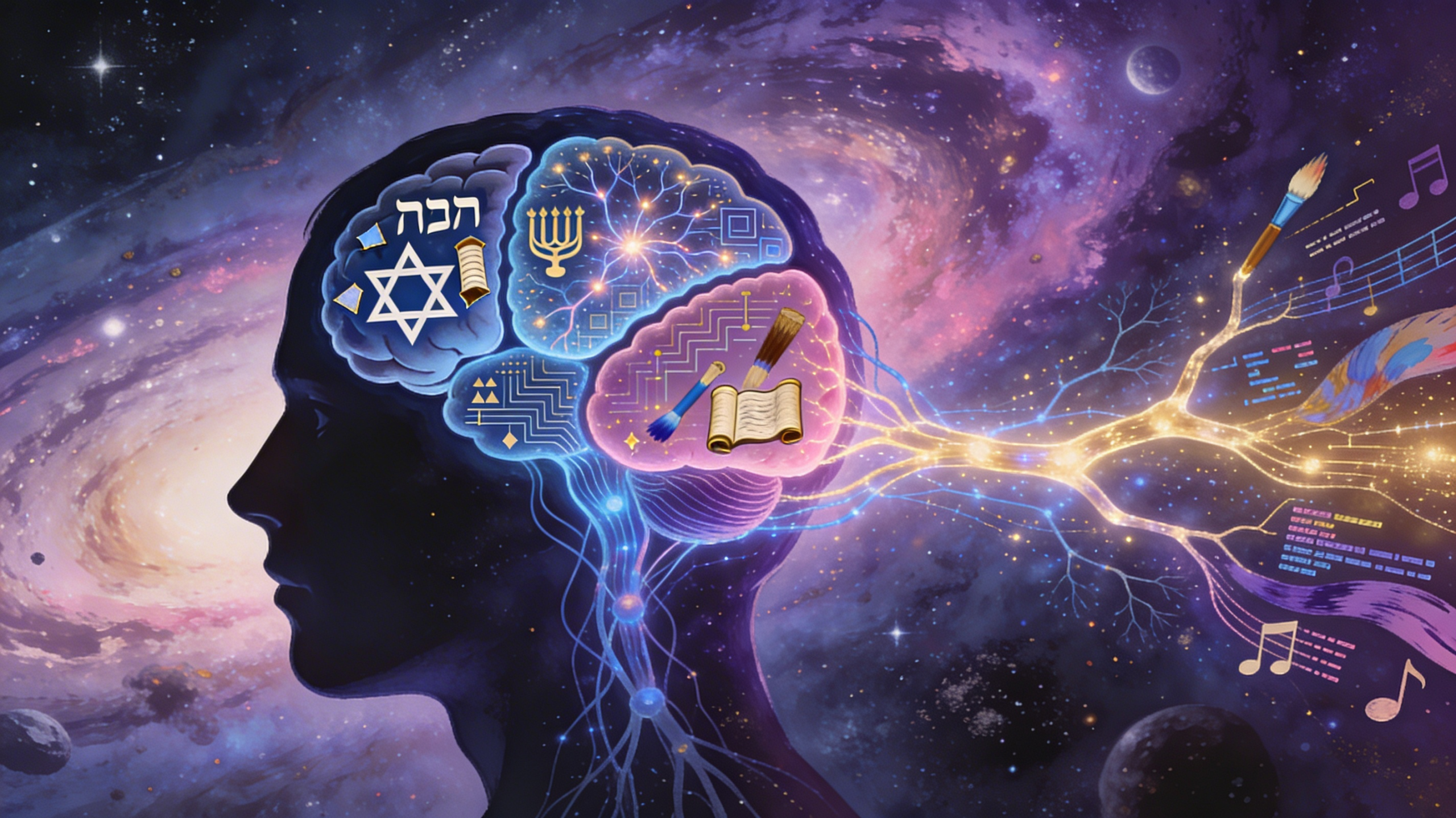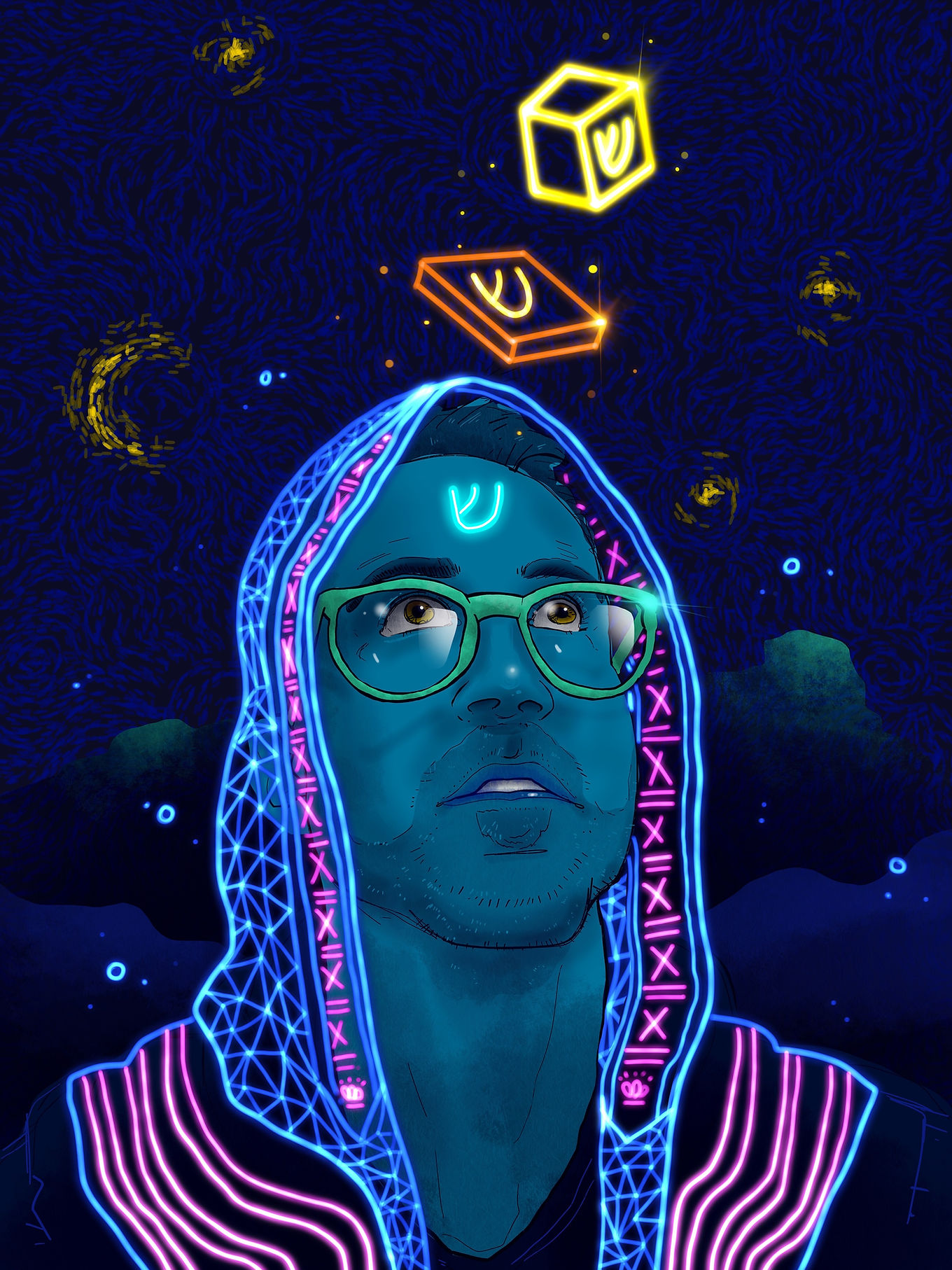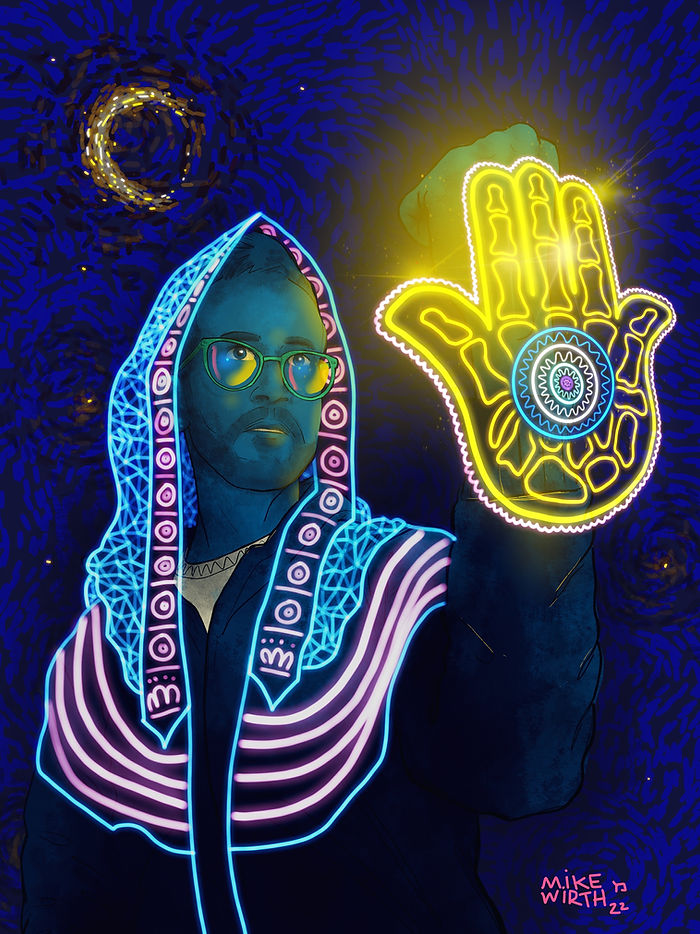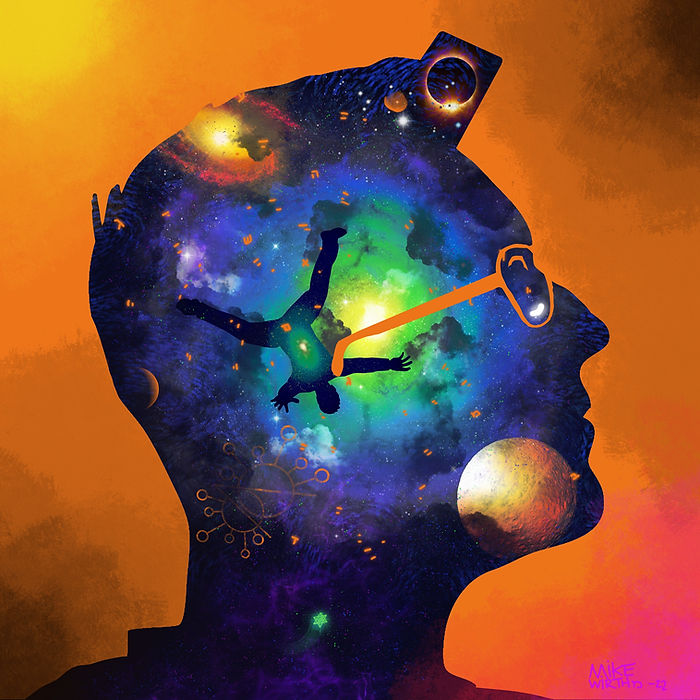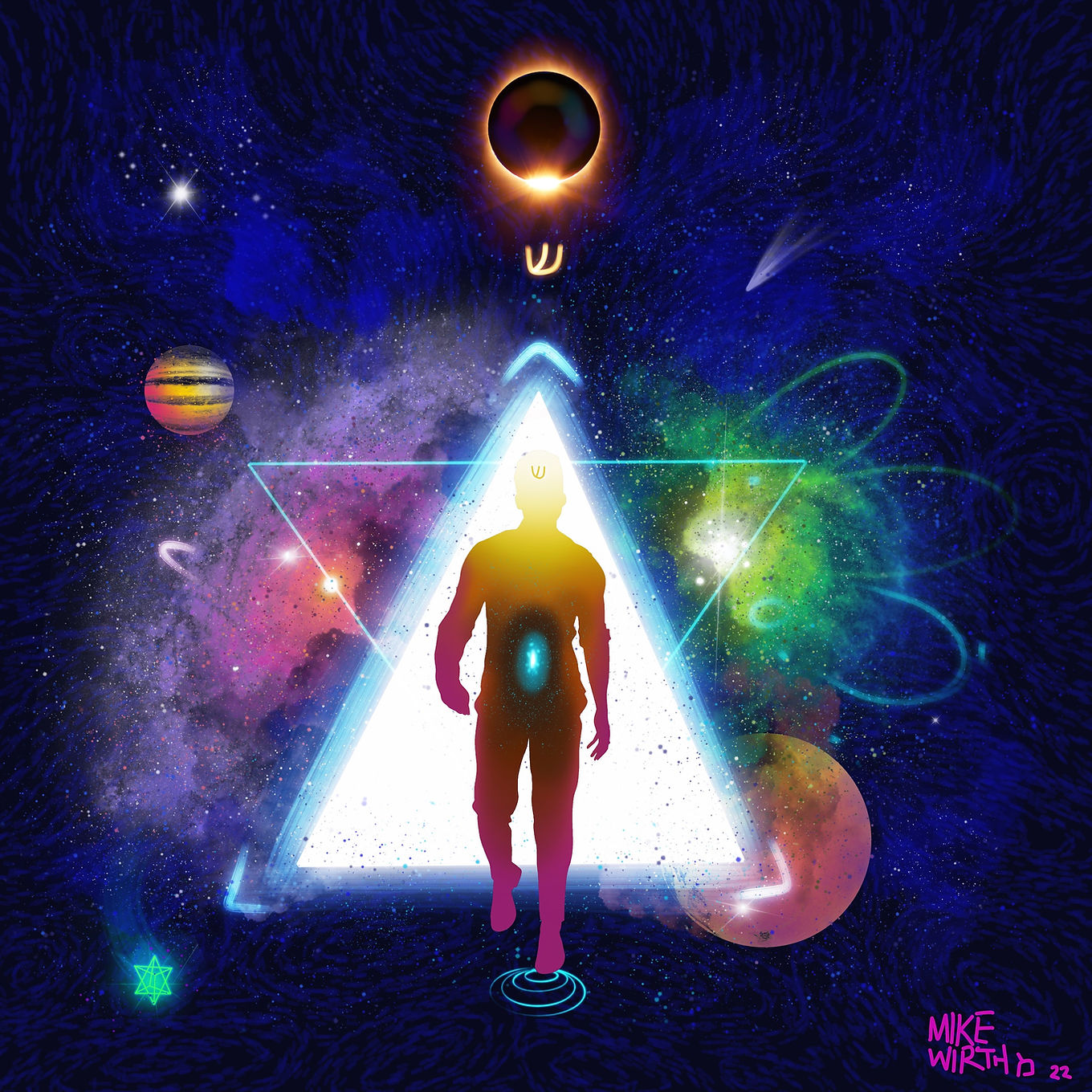
Back in 2014, when I first started to create my Jewish futurist art and stories, I thought that my character, the Wanderer should live a few hundred years into the future, so my spiritual technology objects could just “work” as he travels through time to different Jewish moments in history. But not everything in the Jewish cannon of stories are historical, so that became a narrative issue for my characters extraterrestrial abilities to be believable. I shifted to think about what if the character existed not in the “future” based on time, but in a liminal space built entirely out of the Jewish cannon of stories. This is the first thing to understand when thinking about Jewish futurism as a creative practice. We’ve learned to think of thresholds as thin lines, transitional moments you pass through quickly on your way from one stable state to another. But Jewish textual tradition suggests something different: the threshold itself can be a world, a zone of variable width where multiple versions of the same story coexist without resolution.
This is where Jewish futurism lives and works.
The Wilderness Prototype
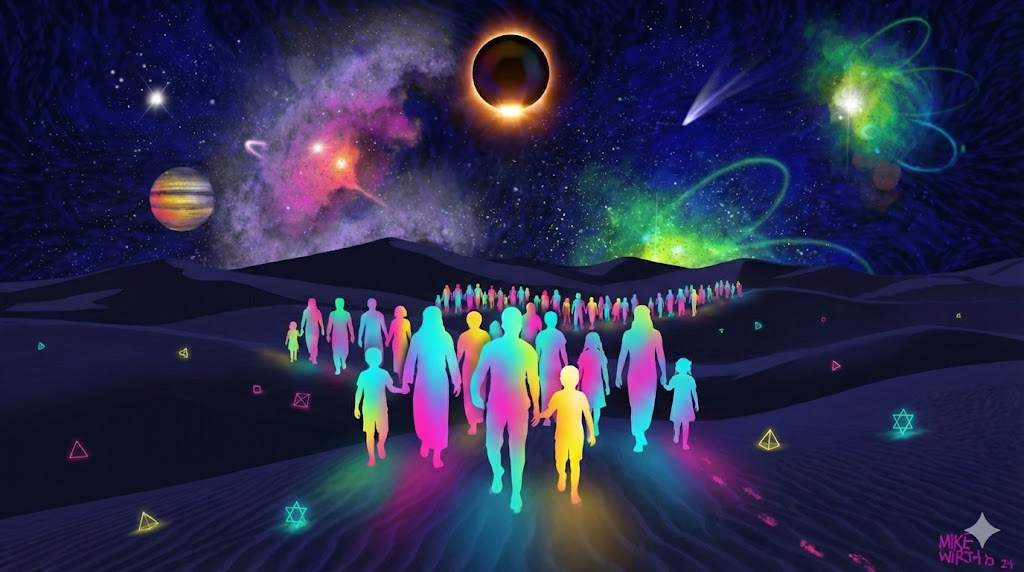
The Book of Numbers, Bamidbar in Hebrew, literally means “in the wilderness.” Rabbi Jonathan Sacks identified this wilderness period as Israel’s formative liminal experience, a space “between Egypt and the Promised Land” where the people transformed from “escaping slaves” into “a kingdom of priests and a holy nation”. The wilderness wasn’t just a route to somewhere else. It was the place where identity formed, where law was given, where the impossible work of becoming happened.
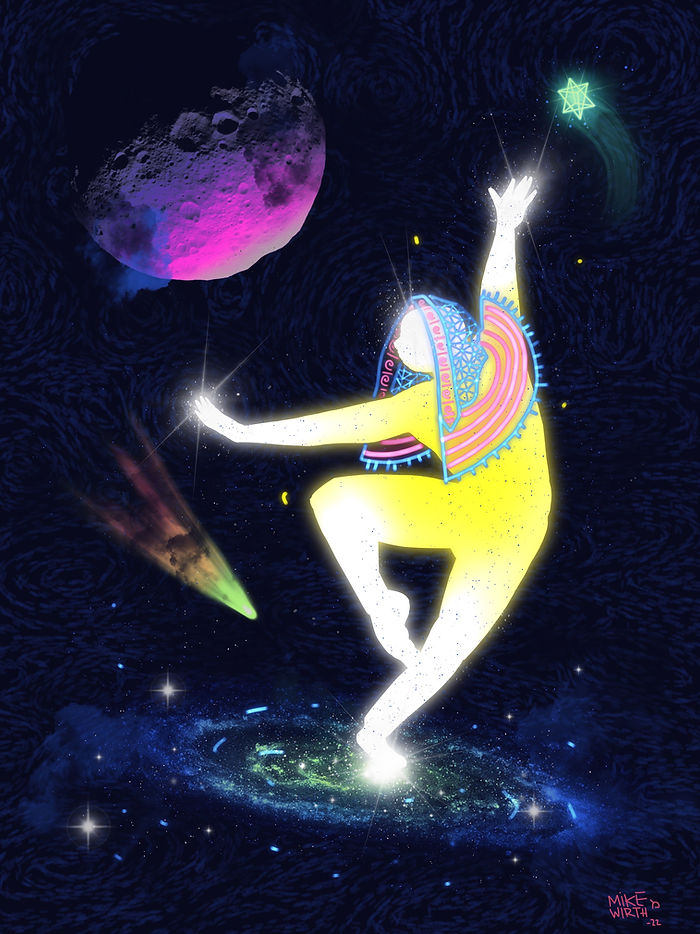
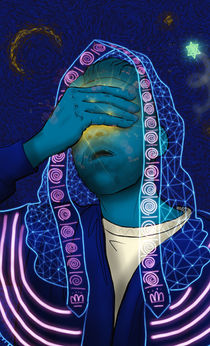
Wandering Israelites 2024, Digital Illustration, By Mike Wirth
Jewish futurism inherits this structure. It positions itself in a wilderness between deep tradition and speculative futures, refusing to resolve that tension into either pure preservation or pure innovation. The creative power comes from staying in the threshold.
Multiformity: When Stories Refuse to Collapse
Jewish textual tradition demonstrates something unusual: it preserves multiple versions of the same story without declaring one correct and the others false. The Talmud includes the story of how Jewish children survived Pharaoh’s decree in two different midrashim, Exodus Rabba 1:12 and Exodus Rabba 23:8, telling “essentially the same story” with different details and emphases. Both remain authoritative. Both are studied. Neither cancels the other out.
This happens again with the creation narratives in Genesis, which offer two distinct accounts that the rabbis never harmonized. When Genesis 2:23 has Adam declare “this time (zot hapa’am) bone of my bone,” the rabbis read the phrase “this time” as evidence there must have been a first time, another woman before Eve. This reading generates the Lilith tradition, which itself exists in radically different versions across texts. Sometimes she’s a Mesopotamian demon, sometimes Adam’s first wife who refused subordination, sometimes multiple Liliths entirely (the Matron Lilith mated with Samael, the Lesser Lilith with Asmodeus). The tradition never consolidates these into one coherent mythology.
This is what I mean by calling liminal space a “storehouse of options.” All these versions exist together, not as rough drafts leading to a final text, but as a permanent multiplicity. The creative work happens in the space between versions, where meaning emerges from juxtaposition and contradiction rather than resolution.
Metamodernism and the Jewish futurist Oscillation
Jewish futurism operates through what contemporary theory calls metamodernism, an approach that “oscillates between a modern enthusiasm and a postmodern irony, between hope and melancholy, between naivete and knowingness, empathy and apathy, unity and plurality, totality and fragmentation”. This isn’t confusion or inconsistency. It’s a deliberate method of holding contradictions in productive tension.
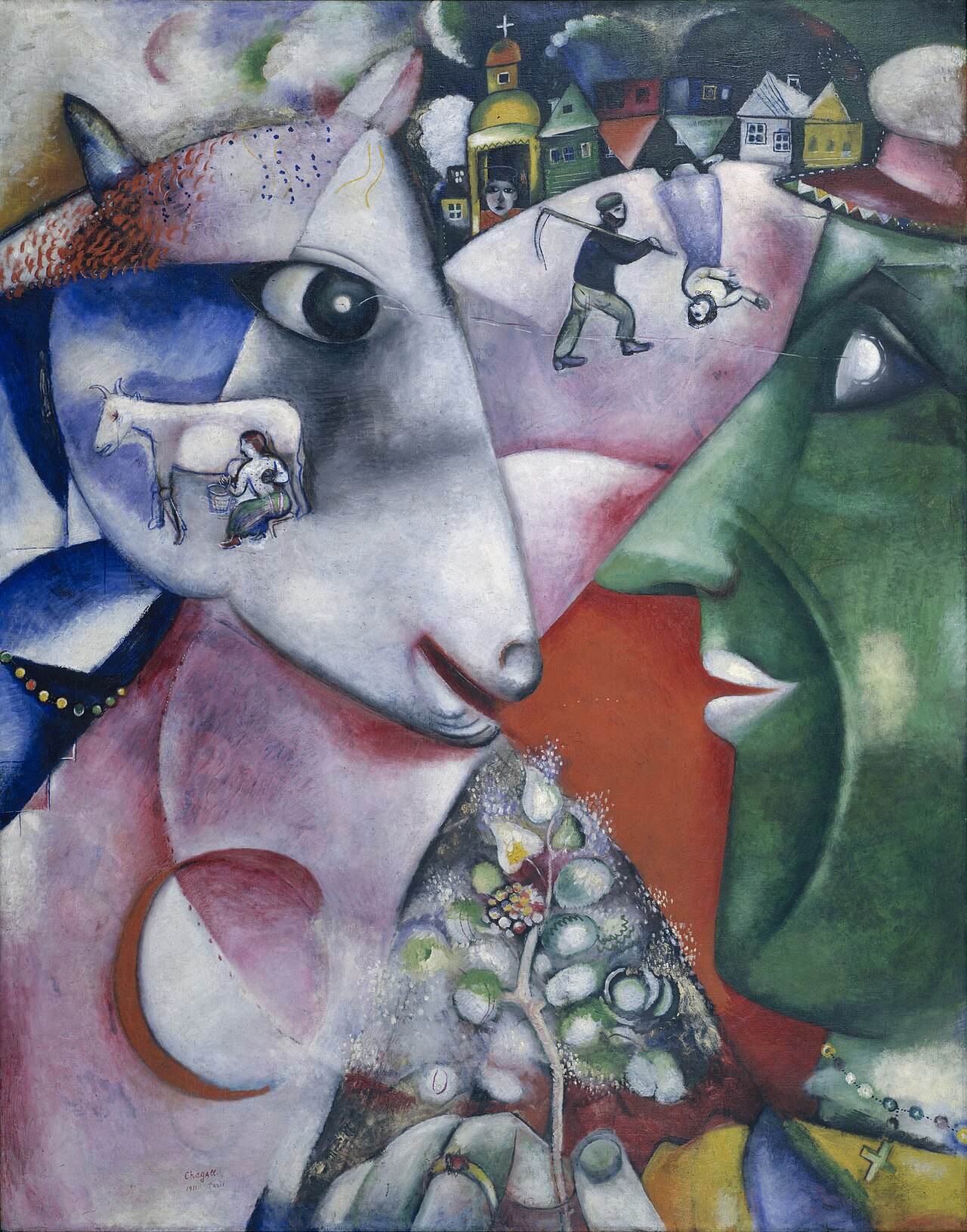
Marc Chagall’s I and the Village (1911)
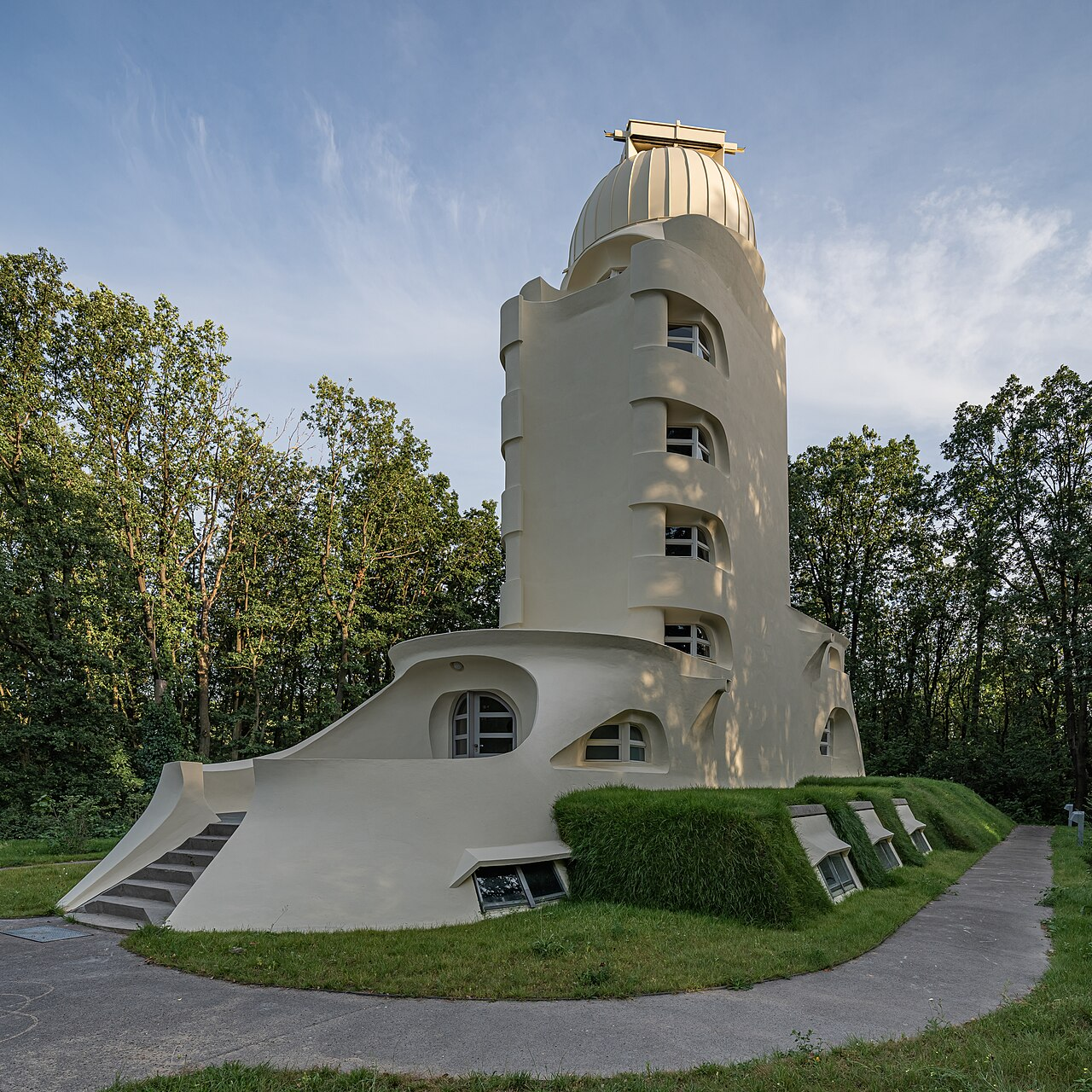
Consider Marc Chagall’s I and the Village (1911), which projected “mystical futures” while remaining rooted in shtetl imagery, or Erich Mendelsohn’s Einstein Tower (1921), which used “dynamic, visionary architecture” to anticipate “new Jewish identities” while drawing on Jewish cultural memory. Both works refuse to choose between past and future. They exist in the oscillation itself.
Erich Mendelsohn’s Einstein Tower (1921)
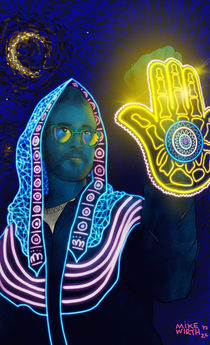
My own practice with neon aesthetics, AI-integrated rituals, and speculative spiritual objects tries to inhabit this same oscillating space. The work is simultaneously reverent toward tradition and radically speculative about Jewish futures. It takes the midrashic impulse (interpreting and expanding upon existing texts) and applies it to material culture, visual art, and interactive experience. The question isn’t whether to look backward or forward, but how to create in the charged space where both directions exist at once.
The Danger of Over-Explanation
Here’s where methodology becomes crucial. The liminal space has power precisely because it resists total systematization. When you map everything, explain all the connections, resolve all the contradictions into a coherent world, you destroy the liminal quality you were trying to work with.
The internet phenomenon of The Backrooms demonstrates this perfectly. In 2019, someone posted a single unsettling image on 4chan: an empty office space with yellowed lighting that evoked uncanny familiarity and wrongness. Its power came from mystery and minimalism. You could project your own dread onto that space. It remained undefined.
But as one analysis explains, “the internet tends to reject simplicity. A mere image cannot suffice; it demands depth, a narrative, characters, and intricate worldbuilding”. Within months, The Backrooms “transformed from a strange setting into an entire alternate dimension, complete with its own physical laws and terrifying creatures. There are countless levels, each featuring unique themes, ecosystems, backstories, and factions”. A commenter captured what was lost: “Modern Fandom kills that feeling of liminality and making up your own interpretations. You’re never just ‘alone’ with a game or story giving you fractured information”.
The lesson for Jewish futurism is clear. The moment you turn the “storehouse of options” into a fully mapped shared universe (like the Marvel Cinematic Universe or an RPG sourcebook), you’ve left liminal space behind. You’re no longer working with multiformity but with a single systematized world that happens to contain variety.
Dwelling in the Threshold
Jewish futurism as creative practice means learning to dwell in the threshold rather than passing through it. It means producing work that operates like midrash, creating new versions that coexist with rather than replace existing ones. It means embracing the metamodern oscillation between tradition and speculation, between melancholy and hope, between the archive and the unknown.
Most importantly, it means resisting the urge to explain everything, to make it all cohere. The wilderness between Egypt and the Promised Land was where transformation happened precisely because it was undefined space, liminal territory where old certainties no longer held but new ones hadn’t yet solidified. That’s the space where Jewish futurism works.
The magic is in the mystery. Once the mystery is gone, so is the magic.
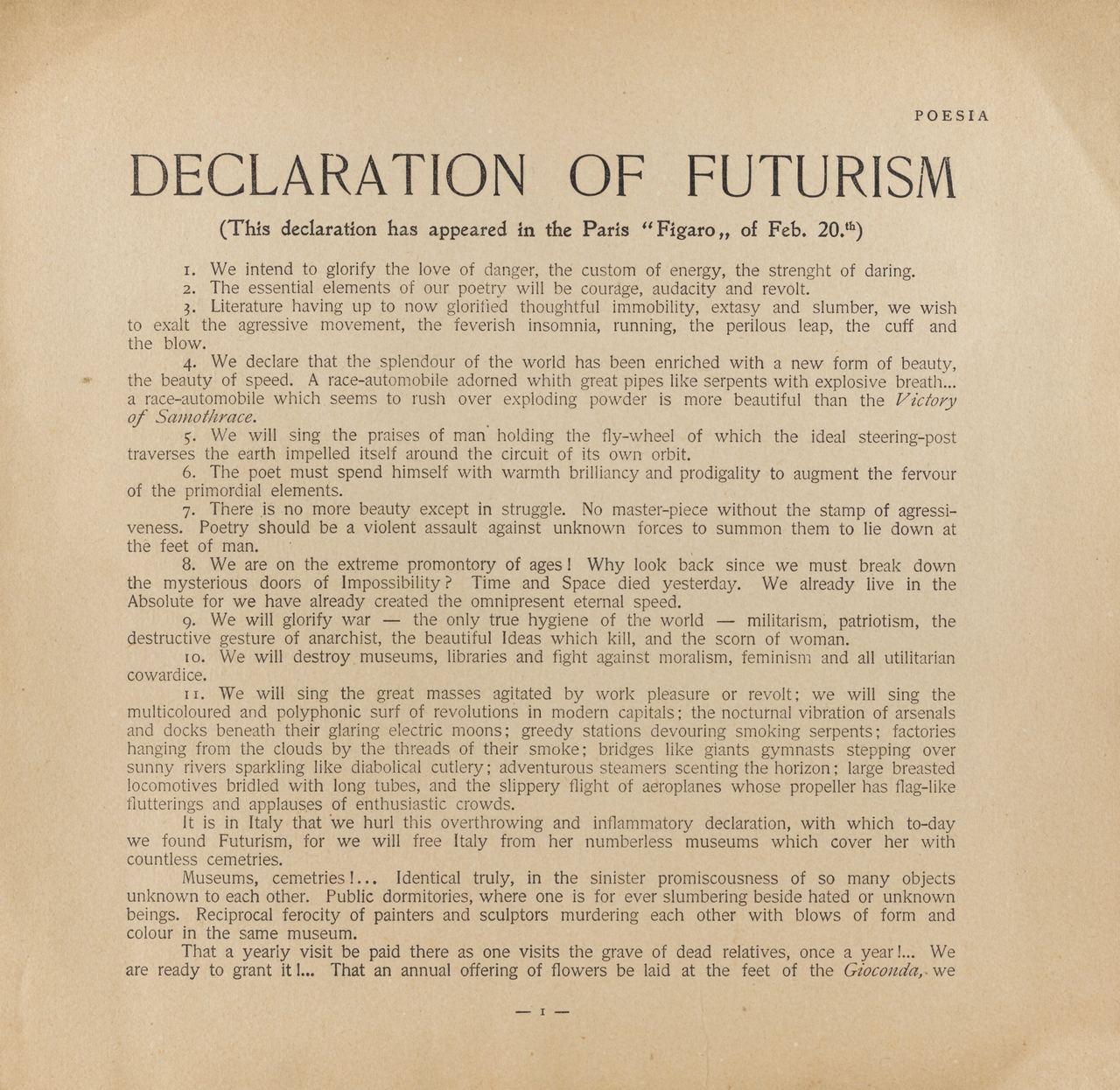
When I teach graphic design history at Queens University of Charlotte, we hit a point in the semester that always makes me a little uncomfortable, because I know it’s coming before the students do. We’re talking about Italian Futurism, those bold typographic posters, a visionary sounding manifesto bursting with energy, those declarations about speed and machines and destroying museums. At first, students lean forward and feel like the work looks alive and feels thrilling. And then we read more deeply into the Marinetti’s words and we see that this movement became a propaganda apparatus for Mussolini’s fascist regime.
The first page of the manifesto of Il Futurismo by FT Marinetti 1909
Those promising-sounding ideas about breaking with the past? They’re loaded with fascist and racist intentions. That gorgeous energy? It was weaponized.
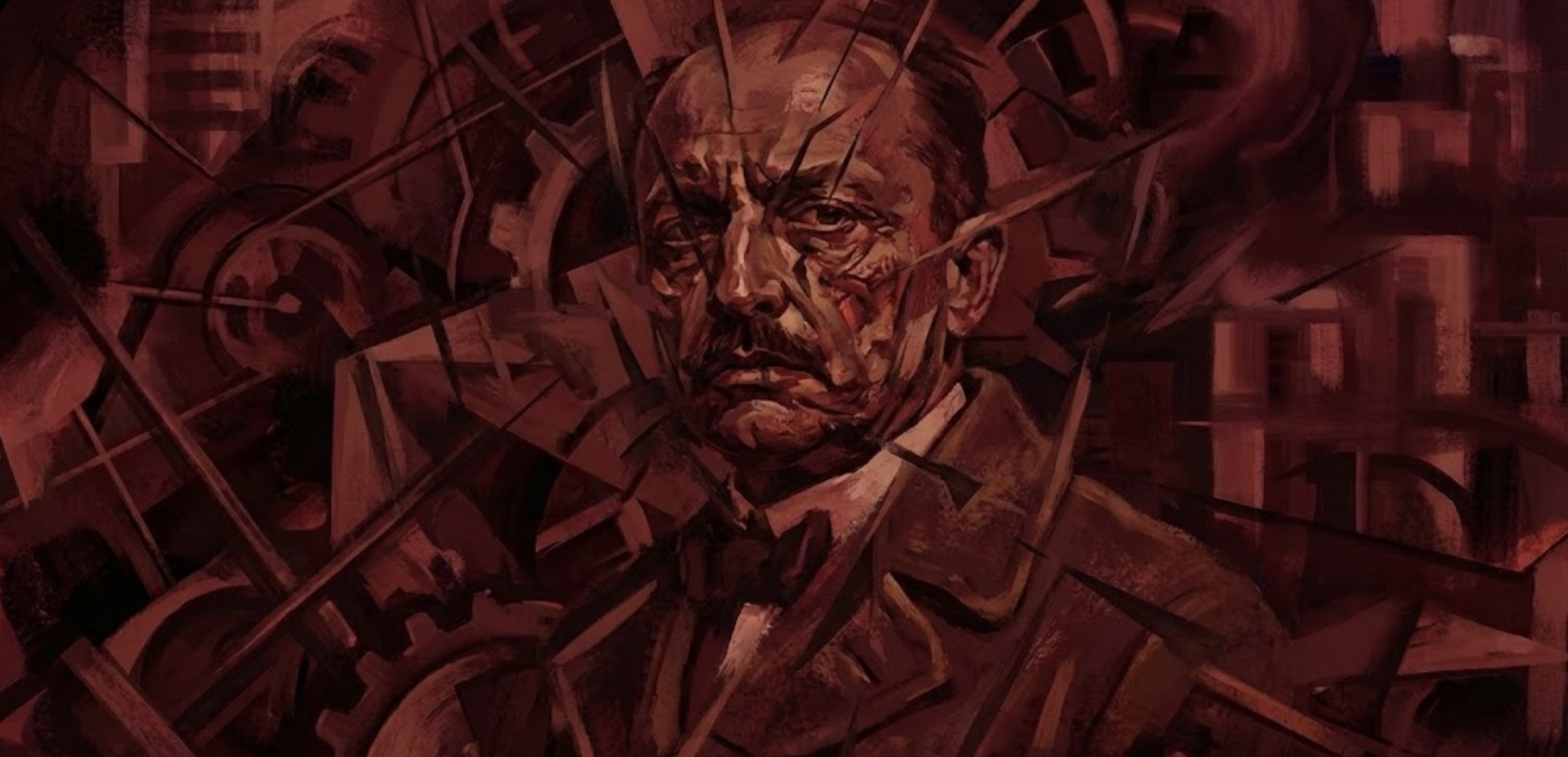
FT Marinetti 1909
This is the pedagogical tightrope I walk every semester, and it’s the same tightrope I’m walking in my work on Jewish futurism.
I’m trying to rescue the core impulse of futurism, the bold, beautiful desire to imagine and design better futures, from what Italian Futurism did to it.
Because here’s the thing: Italian Futurism started with legitimate, even utopian desires, and it still became a cautionary tale. If you’re going to study any kind of futurism seriously, you need to meet Italian Futurism early, not to emulate it, but to understand exactly what can go wrong when speed replaces wisdom and aesthetics trump ethics.
Futurism vs futurism: Why the Capital Letter Matters
I’ve started being very careful about capital F versus lowercase f. Futurism with a capital F names a specific historical movement: Marinetti’s Italian avant-garde, with all its inherited baggage. It’s bound up with nationalism, misogyny, the glorification of war as “the world’s only hygiene,” and an eventual merger with Mussolini’s Fascist Party in 1920. When I write “Futurism,” I’m signaling: we’re talking about that movement, that history, those consequences.
Futurism with a lowercase “f” names something broader and more perennial: the human impulse to imagine, prototype, and design what comes next. It’s the practice of speculating about futures, whether through art, spirituality, technology, or politics. Lowercase futurism is a method and a desire, not an ideology. It’s the thing Jewish futurism, Afrofuturism, Queerfuturism, Sinofuturism, and Gulf futurism all share: the courage to ask what could be, and the willingness to build toward it.
This distinction isn’t just academic. It gives us critical vocabulary. Capital-F Futurism becomes an object of analysis and caution, the ancestor we study to avoid repeating. Lowercase futurism becomes a space for repair, reinvention, and new ethical commitments. Jewish futurism inherits the impulse without inheriting the violence.
How Futurist Movements Emerge: What They All Want at First
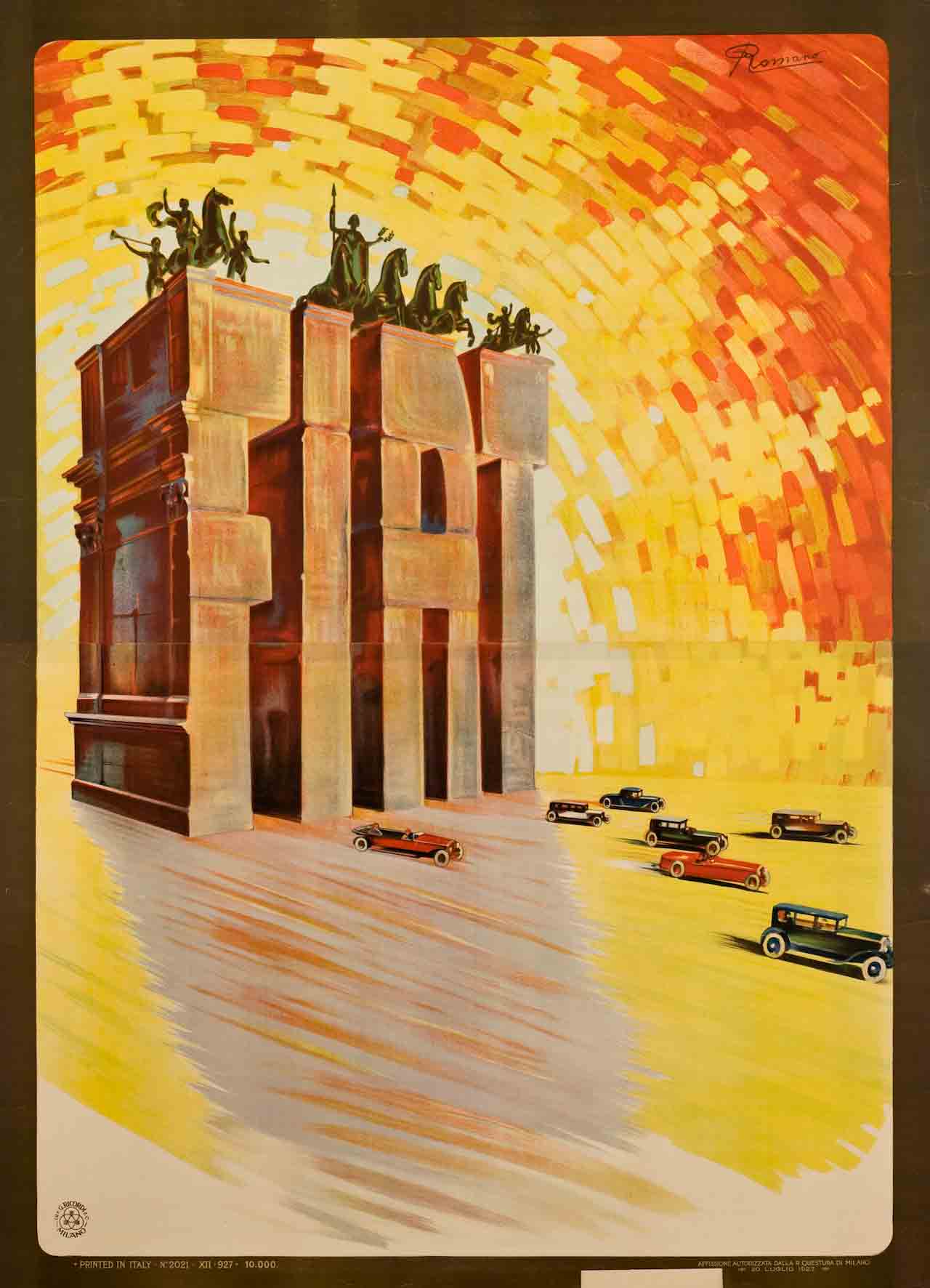
Futurist movements consistently arise during periods of dramatic technological transformation and cultural rupture. Italian Futurism emerged from a very specific crisis. Turn-of-the-century Italy was struggling in ways that made the country feel stuck in the past. The government was weak and unstable. There was no real national identity binding the regions together. Industrial development lagged decades behind other European powers. Poverty was widespread, modernization faced fierce resistance, crime and corruption were endemic, and millions of Italians were emigrating in search of better lives.
FIAT, 1927 Giuseppe Romano (1905–67) Fondazione Massimo e Sonia Cirulli Collection, Bologna
Meanwhile, foreign tourists flooded Italy to gaze at ancient ruins and Renaissance masterpieces, treating the country like a beautiful museum, a relic of what it once was. For young Italian intellectuals like Marinetti, this was humiliating. People came to see what Italy was, not what it is or could become. The weight of the past felt suffocating.
This pattern repeats across other futurist movements. Afrofuturism developed in response to the ongoing trauma of the transatlantic slave trade and systemic oppression, seeking to reclaim narratives and imagine liberation. Gulf futurism arose from the rapid, oil-driven transformation of the Arab Gulf states. Sinofuturism responds to China’s technological rise and Western anxieties about shifting global power.
Despite their different contexts, these movements share foundational patterns. They reject traditions they perceive as inadequate or stifling. They embrace technology as a catalyst for radical cultural change. Most importantly, they assert the right to imagine and define their own futures rather than accepting externally imposed visions.
Futurist movements emerge from communities experiencing rupture, whether from rapid modernization, colonialism, diaspora, or globalization. They often adopt manifesto culture, broadcasting bold visions to gather followers. They’re youth-driven, appealing to younger generations eager to break free from what they see as the constraints of older orders.
At their inception, futurist movements typically seek cultural sovereignty, the synthesis of heritage and innovation, celebration of dynamism and transformation, radical breaks from oppressive pasts, and social change through technology. These are legitimate, even beautiful desires. The critical question is: what values guide those transformative visions? Italian Futurism demonstrates what happens when the desire to destroy the past overwhelms the responsibility to build just futures.
Filippo Tommaso Marinetti launched Italian Futurism with his 1909 manifesto, and it crackled with revolutionary energy. He declared the racing car more beautiful than the Winged Victory of Samothrace and announced war on museums, libraries, and academies. The movement promised total cultural transformation through speed, machines, violence, and youth.
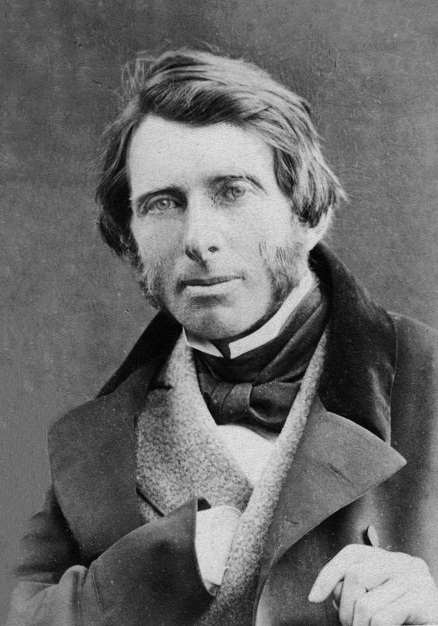
But Marinetti wasn’t speaking metaphorically. He made actual political proposals to sell off Italy’s art heritage in bulk to other countries. Museums were “graveyards,” he argued, places that paralyzed Italy and prevented it from joining the modern world. Venice, beloved by foreign tourists, was dismissed as “Europe’s brothel”. Art critic John Ruskin, who had celebrated Italian cultural heritage, became an enemy figure.
John Ruskin, 29 June 1863, Photo by William Downey (1829-1915)
The Futurist manifesto even contained a self-consuming logic. It declared that when Marinetti himself turned 40, younger futurists should throw him “into the trash can, like useless manuscripts”. The movement advocated not just destroying museums once, but periodic cleansing of cultural memory. Nothing could be allowed to accumulate tradition or meaning.
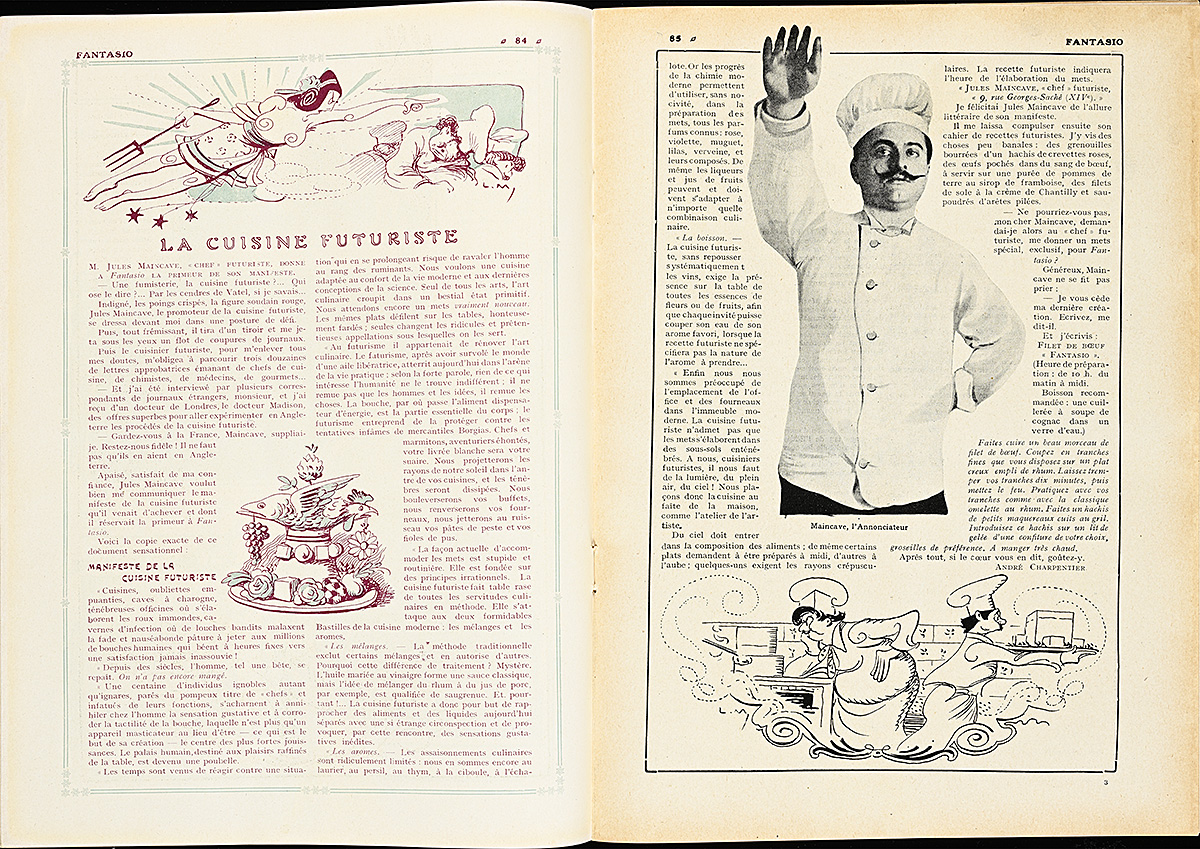
FT Marinetti’s Futurist Cook book- where he calls for the ban of pasta form the Italian diet, 1913 Posterhaus
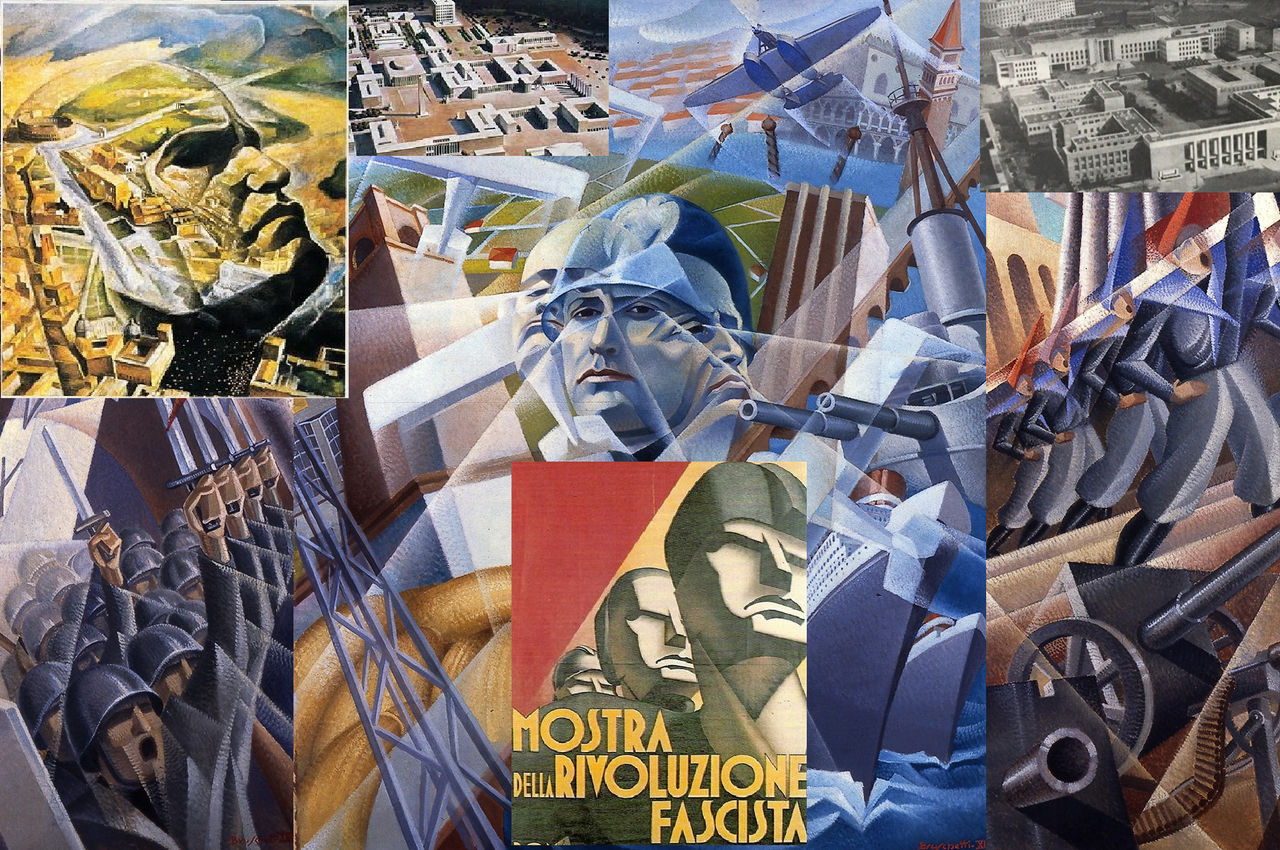
The seeds of destruction were there from the beginning. Marinetti glorified war as “the world’s only hygiene” and promoted aggressive Italian nationalism. When the Futurist Political Party merged with Mussolini’s Fascist movement in 1920, artistic vision was subordinated to political power. The philosophical contradictions, celebrating individual creative genius while demanding conformity to nationalist ideology, created tensions that made the movement culturally irrelevant even as it gained political influence.
Aeroritratto di Mussolini aviatore, Alfredo Ambrosi, 1930
Five Things That Went Catastrophically Wrong
1. Glorification of Violence and Destruction
Italian Futurism didn’t just accept violence as a historical reality. It actively celebrated war, aggression, and destruction as aesthetic and moral goods. The movement embraced Italian expansionism and cultural supremacy, making technological progress inseparable from domination. Rather than synthesizing past and future, Italian Futurism sought to obliterate history entirely, creating a vacuum that fascist ideology eagerly filled.
This pattern wasn’t unique to Italy. The source material connects Futurism to similar state-sponsored iconoclasm in revolutionary France, Soviet Russia, and Maoist China. When modernization ideology justifies cultural destruction, it creates dangerous precedents. The logic always sounds progressive at first: we must destroy the old to make way for the new. But that destruction rarely stops where its advocates promise.
2. Absence of Ethical Guardrails
The movement valued technology and speed for their own sake, with no moral framework to guide their application. Machines were beautiful because they were fast and powerful, not because they served human flourishing. This absence of empathy-centered design principles meant that when political power beckoned, the movement had no philosophical foundation to resist authoritarianism.
Marinetti viewed Italy’s cultural heritage not as something to be honored or reinterpreted, but as a burden to be liquidated. There was no question of what wisdom traditions might offer, no consideration of what future generations might need from the past. Speed was the only value.
3. Authoritarianism Over Democracy
Italian Futurism began with anti-monarchist and anti-clerical positions, challenging established power. These principles were quickly abandoned when Marinetti saw opportunities for influence within Mussolini’s regime. The movement became a propaganda tool, with artistic vision subordinated to the authoritarian state. Individual creative genius, once celebrated, was channeled into serving nationalist ideology.
4. Exclusionary Cultural Supremacy
Italian nationalism and cultural dominance were core tenets from the start. There was no space for pluralism, interfaith dialogue, or universal design principles. The aggressive rejection of tradition created a vacuum where fascist ideology could flourish, as the movement offered speed and violence but no sustaining vision of human connection. Not to mention that the regime implemented Italian Racial Laws in 1938, introducing discrimination and persecution against Jews of Italy.
The humiliation Marinetti felt when tourists treated Italy as a museum of the past was real. But his response, to erase that past entirely rather than build new futures in dialogue with it, became toxic. Cultural sovereignty doesn’t require cultural amnesia.
5. Aesthetic Without Substance
When Mussolini refused to make Futurism the official state art of fascist Italy, the movement collapsed into cultural irrelevance. Decades of manifesto-writing had produced style over philosophical depth. Without a sustainable ethical foundation, Italian Futurism had nothing to offer once political winds shifted.
The movement’s self-consuming logic guaranteed this outcome. If nothing is allowed to accumulate meaning, if every generation must destroy what came before, then no stable cultural foundation can ever form. You can’t build futures on ground you keep setting on fire.
Jewish futurism: Building From Different Ground
This is where my work begins. Jewish futurism emerges from fundamentally different premises, offering a model for how technological optimism can coexist with ancient wisdom and ethical responsibility. Where Italian Futurism glorified destruction, Jewish futurism centers empathy-led innovation, positioning technology as a tool for meaning-making rather than domination.
Jewish history demonstrates millennia of resilience and reinvention without destroying the past. Continuous reinterpretation, of texts, traditions, cultural practices, allows Jewish communities to honor ancestral heritage while embracing modernity. This mirrors Afrofuturism’s Sankofa principle, which emphasizes learning from the past to inform future trajectories. Rather than revolutionary destruction, Jewish futurism practices synthesis and transformation.
In my own practice, Jewish futurism is rooted in Jewish thought: tikkun olam (repair of the world), justice, responsibility. Technology is never valued for its own sake but always in service of deeper moral commitments. This philosophical grounding provides the ethical guardrails that Italian Futurism catastrophically lacked. The question at the heart of my work is: “What kind of ancestor will you be?” That question changes everything.
Where Marinetti wanted to be thrown in the trash at age 40, Jewish futurism asks what we’re building that will outlast us, what we’re passing down that future generations will need. It’s not about preserving everything unchanged. It’s about being in active, creative dialogue with tradition while we build what comes next.
What We Can Learn: Five Lessons for Building Responsible Futurisms
Ethics Must Precede Aesthetics: Beauty and innovation without moral grounding enable atrocity. Technology requires wisdom traditions to guide its use. Speed without wisdom is just velocity. It doesn’t know where it’s going or why. When Marinetti proposed selling Italy’s art heritage in bulk, he showed what happens when aesthetic ideology overrides ethical consideration.
Honor the Past While Building the Future: Synthesis surpasses destruction as a strategy for cultural renewal. Tradition provides foundation for innovation rather than serving as an obstacle to it. Jewish tradition treats time as cyclical rather than linear, where past, present, and future dynamically interact. The humiliation Italy felt at being treated as a museum was real, but erasure isn’t the only response. We can acknowledge what’s broken in our inherited traditions while keeping what sustains us.
Center Human Dignity Over Cultural Supremacy: Universal design principles create futures for all people, not just dominant groups. futurism must be liberatory rather than oppressive, replacing nationalism with empathy and collaboration. Jewish futurism creates shared spaces for collective growth and interfaith collaboration. The pattern of state-sponsored iconoclasm, from revolutionary France to Soviet Russia to Maoist China, shows us what happens when one vision of the future tries to erase all others.
Resist Political Opportunism: Artistic movements must maintain ethical independence even when political power beckons. When survival requires moral compromise, the movement has already failed. Marinetti’s compromises to ensure the movement’s survival hollowed it out from within. The proposals to liquidate cultural heritage weren’t just aesthetic statements. They were political calculations about access to power.
Root Innovation in Community: Collective meaning-making replaces the cult of individual genius. As I’ve learned in my own practice, the future, like design itself, is fundamentally a team sport. It thrives when we create collectively and collaboratively. Collaboration and care supersede competition and domination. The Futurist manifesto’s call to throw Marinetti himself in the trash at 40 reveals a movement with no concept of intergenerational continuity, no way to pass wisdom forward.
The Responsibility of Imagining Futures
Every speculative vision carries political and ethical consequences. Italian Futurism’s trajectory from revolutionary art movement to fascist propaganda machine demonstrates that enthusiasm for the future, absent ethical grounding, can enable profound harm.
When I stand in front of my design students at Queens, looking at those bold Futurist posters, I don’t want to just critique them. I want to show what it looks like to rescue the core impulse, the courage to imagine radically different futures, from what got corrupted. The frustration Marinetti felt was real. Italy was stuck. The weight of the past was crushing. Foreign tourists treating the country as a beautiful corpse was genuinely humiliating. But his solution, to burn it all down and start from nothing, created more problems than it solved.
Jewish futurism offers that alternative model: technological optimism rooted in ancestral wisdom, innovation guided by empathy, futures built through synthesis rather than destruction. We can honor what we’ve inherited while transforming it. We can be critical of traditions that harm while keeping what sustains. We can build futures that acknowledge the past without being imprisoned by it.
The question isn’t whether we’ll imagine futures. In periods of technological transformation, futurist movements will inevitably emerge. The question is what values will guide those visions. Will we learn from history’s warnings about the price of speed without wisdom, aesthetics without ethics, innovation without responsibility? Or will we repeat Italian Futurism’s mistakes with new technologies and new manifestos?
I’m betting we can do better. Jewish futurism, and the broader family of ethical futurisms it’s part of, shows us how. We can be bold and careful. We can embrace transformation and honor memory. We can design futures that are actually livable, not just fast. That’s the work. That’s what I’m trying to build.
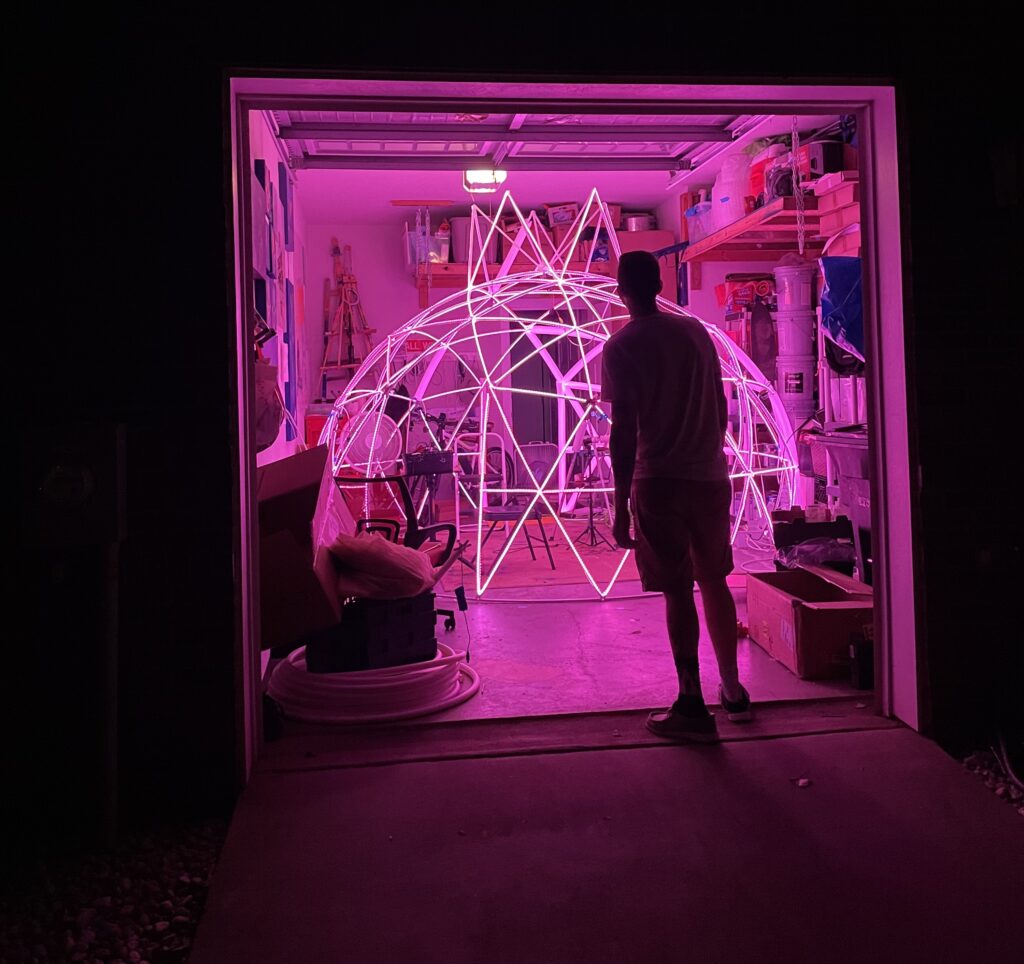
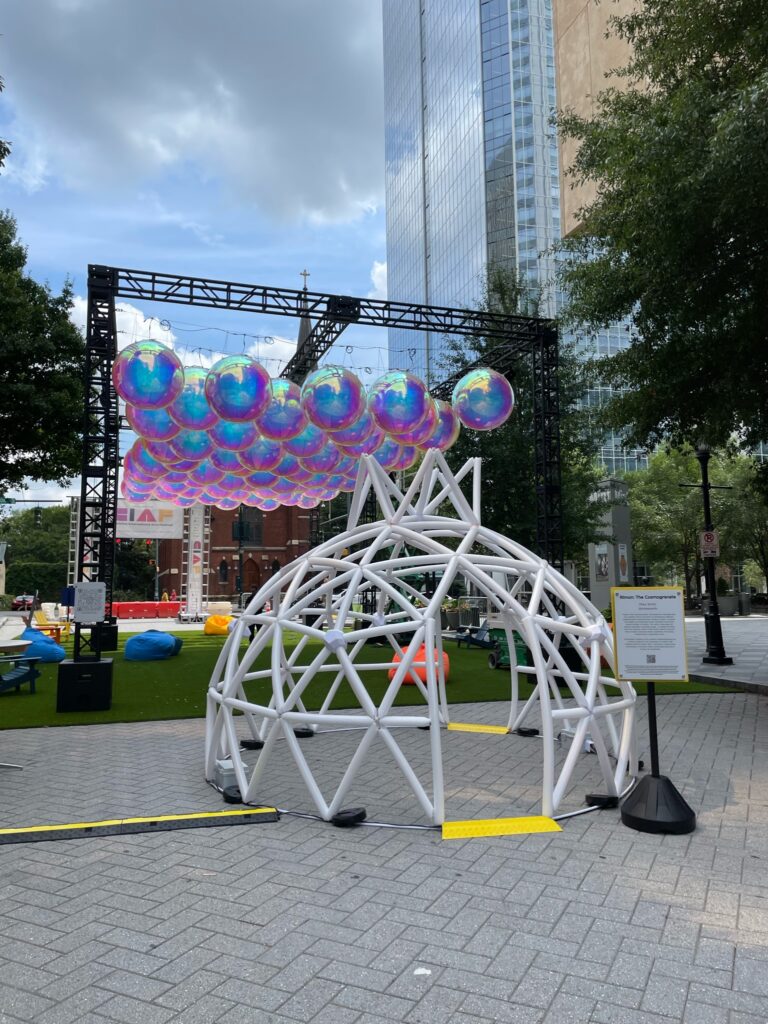
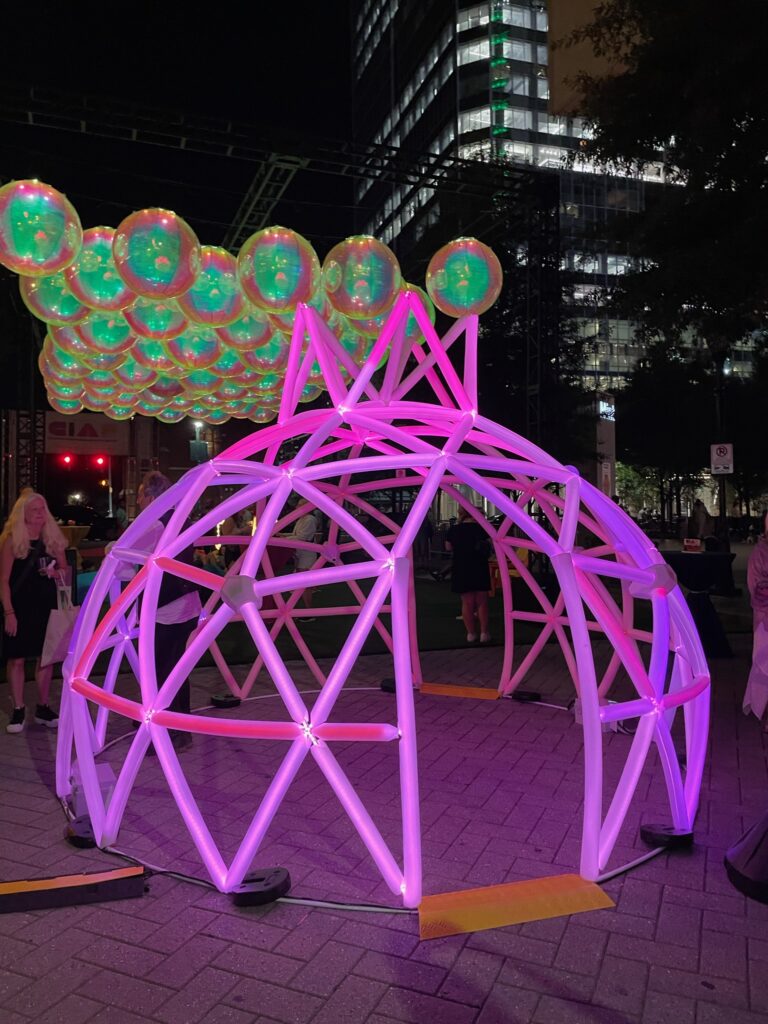
Goal: Create an immersive space that reacts to participants’ audio and motion input.
Awards: 2023 Blumenthal Arts Fellowship Grant Winner
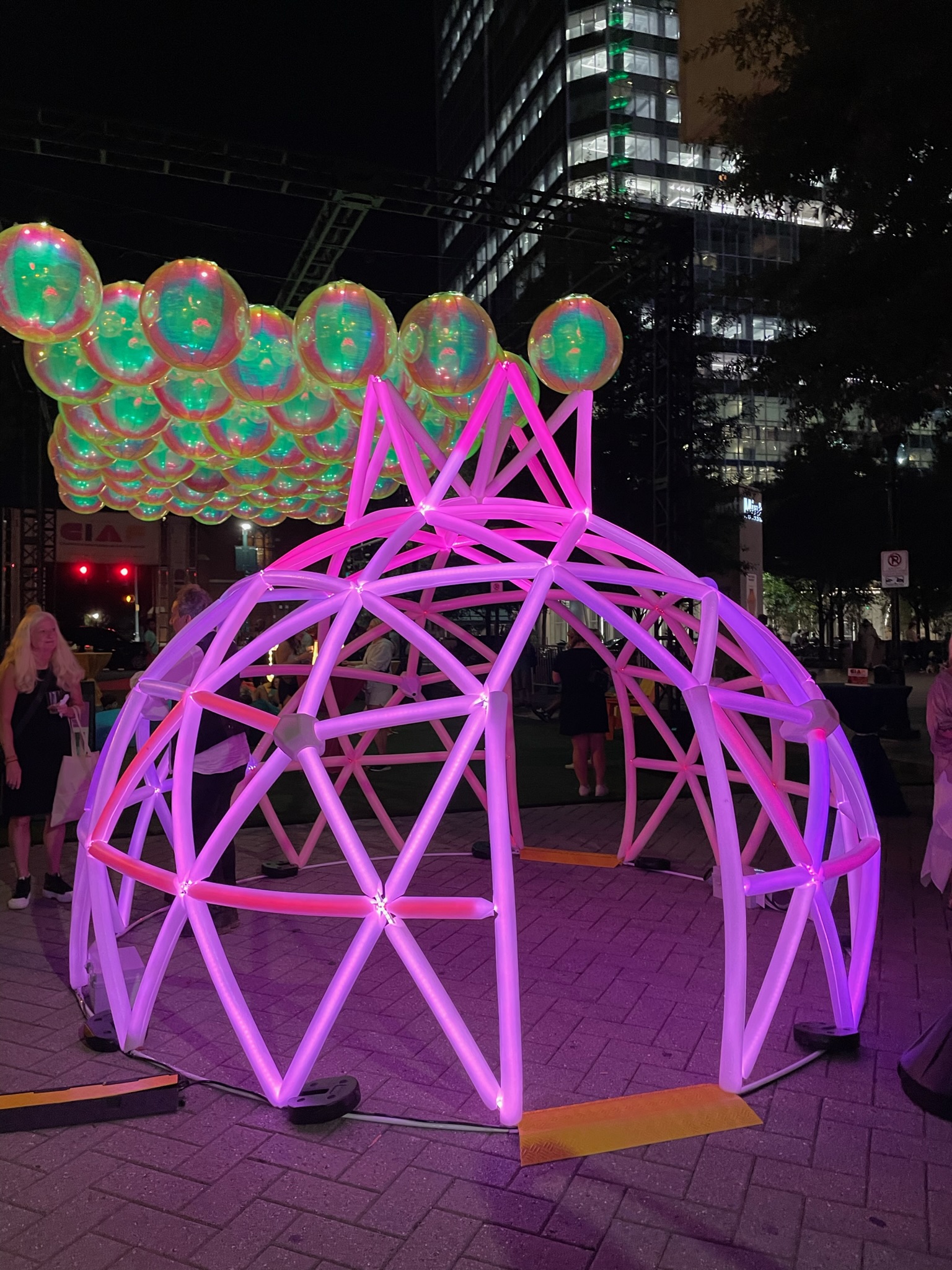
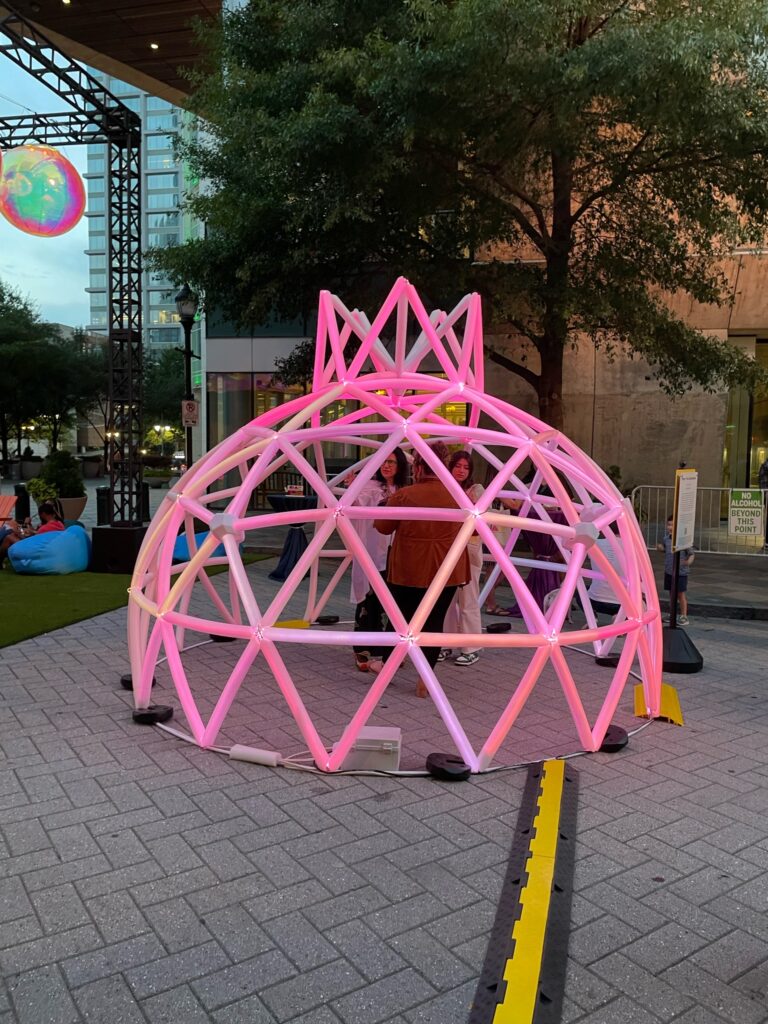
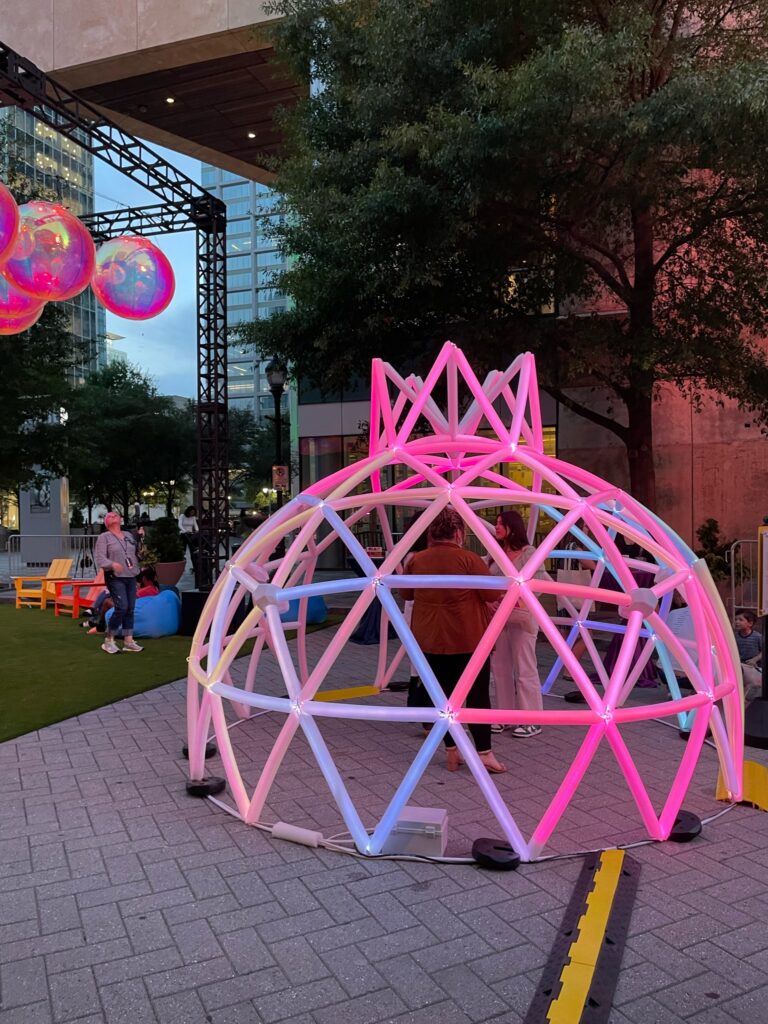
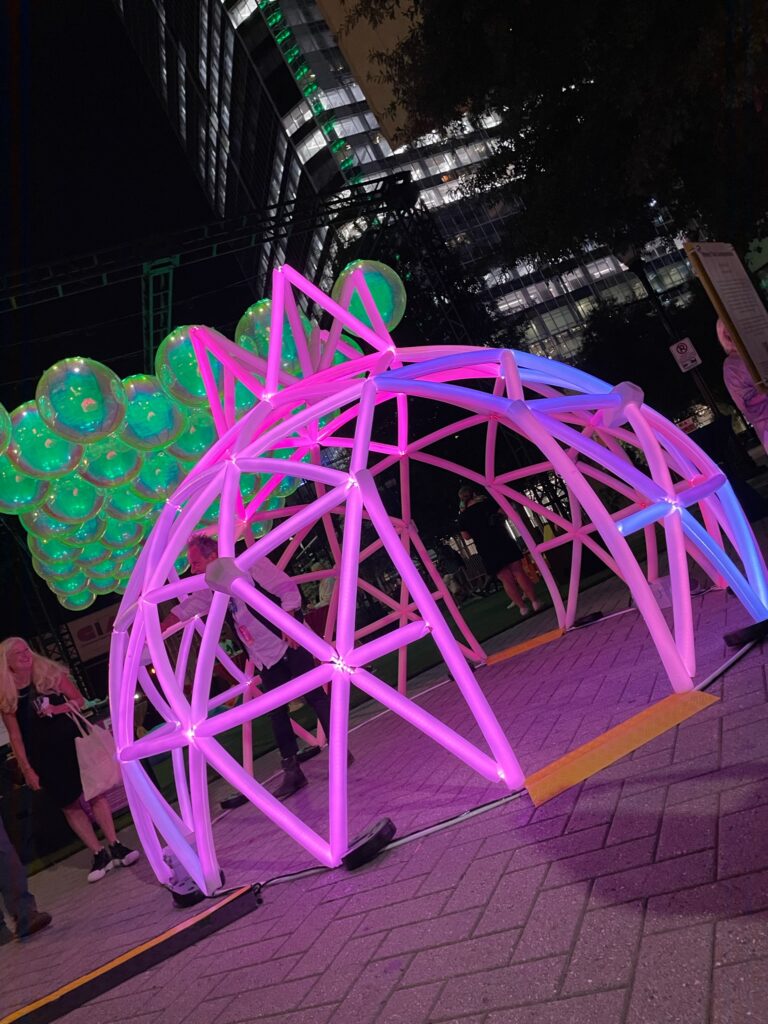
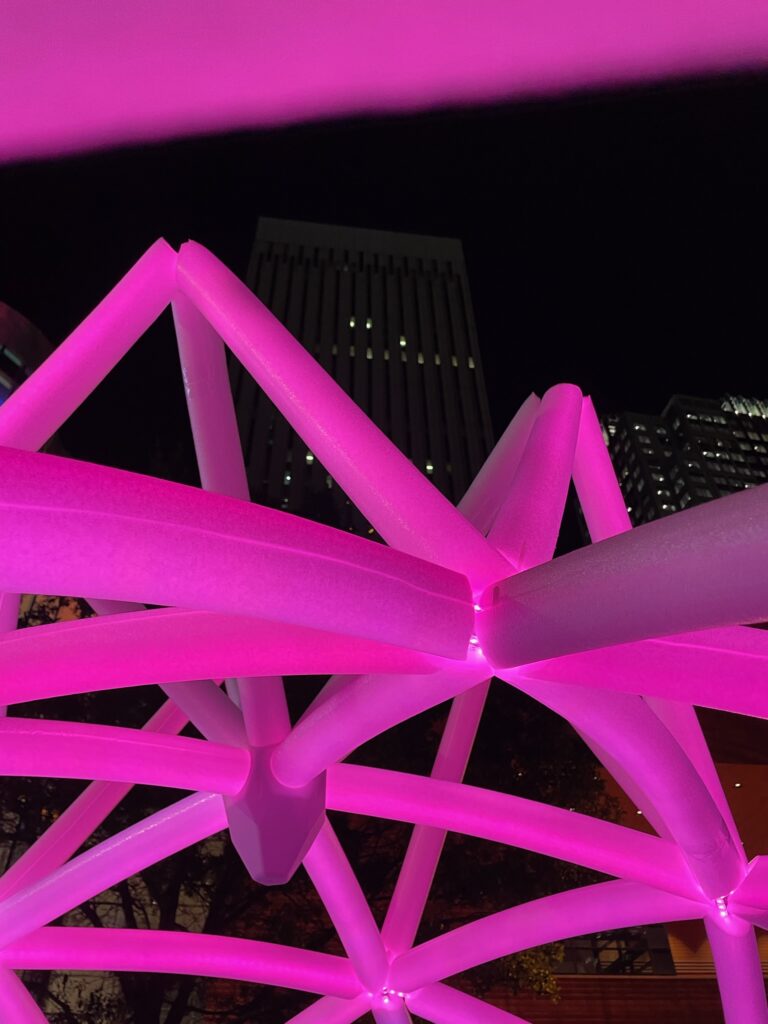
“Rimon: The Cosmogranate” is an immersive art piece, inspired by the Hebrew word ‘rimon,’ meaning pomegranate. Its form mirrors the fruit, emitting a radiant significance. At its core, it merges art with interaction. Inner sensors respond to audience movement and sound input, translating presence and voice into a dynamic interplay of lights and sounds.
This kinetic symphony crafts a unique and captivating experience that boasts shining over 14k LED lights. The project honors a tradition of Jewish ingenuity, echoing the pomegranate’s role in the Torah and the cherished Sukkah during Sukkot. Rooted in Mike Wirth’s Jewish futurism body of work, the project blends ancient wisdom with futuristic visions.
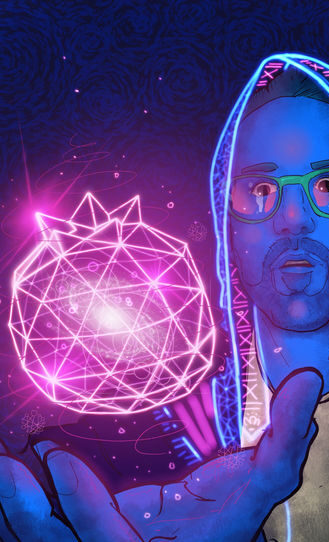
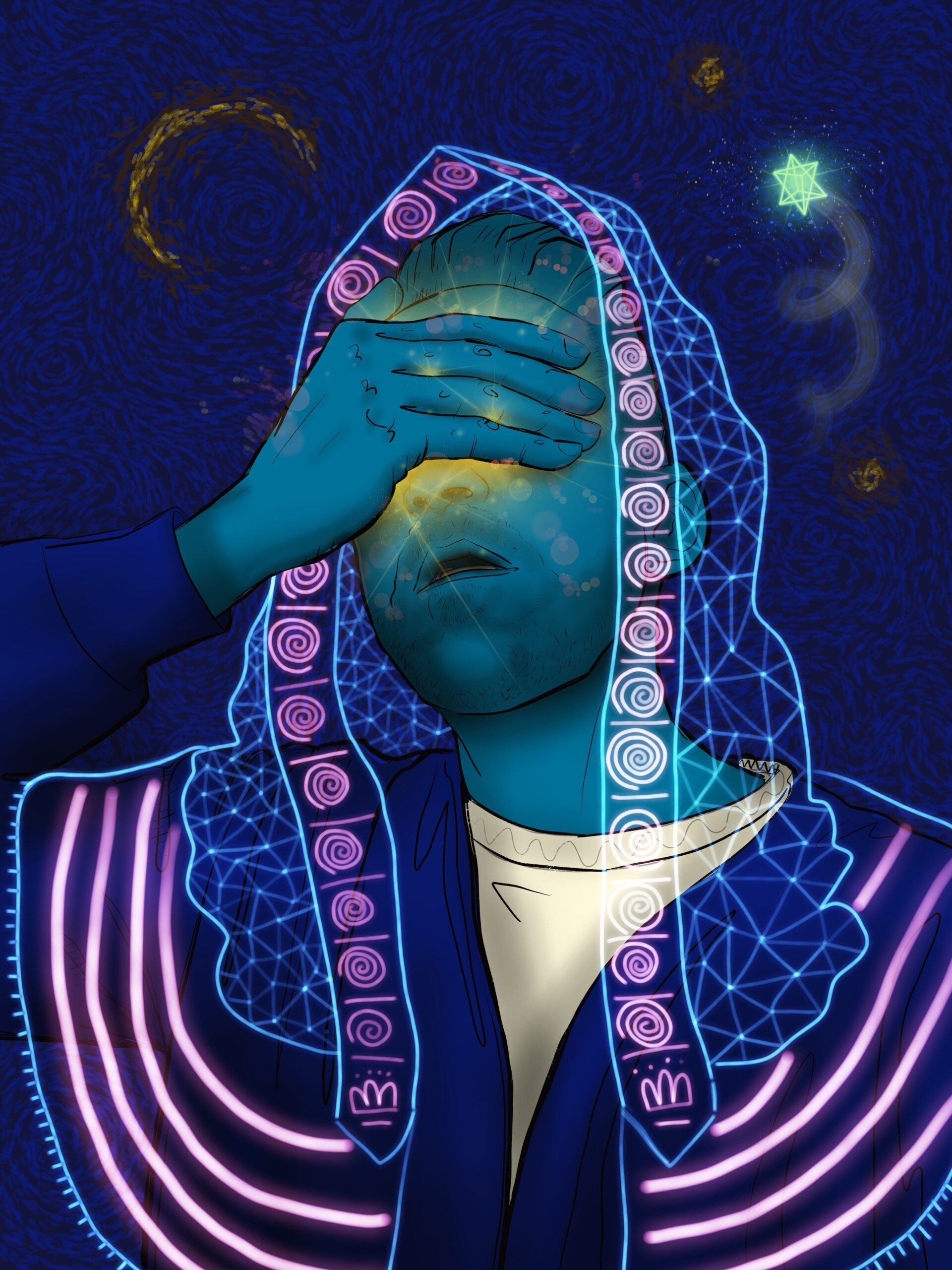
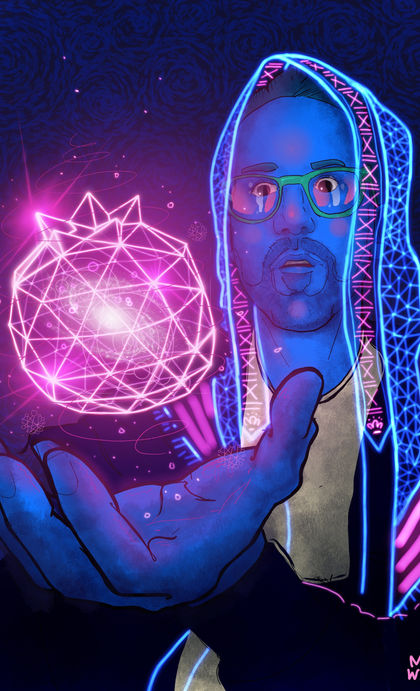
Mike’s original illustration that inspired the installation. (2021)
This resonant symbol, shared across cultures and religions, serves as a unifying emblem. Here, technology, spirituality, and community converge, each light and sound carrying a timeless narrative. Step into this radiant realm, where history’s echoes meld with the pulse of innovation, weaving a tapestry of unity and celebration across generations.
Exporting cultural richness online through the worlds of Torah and NFTs
Originally Published by Challah Magazine.com (2022)
By
Mike Wirth
By now you’ve heard quite a bit about NFTs (non-fungible tokens) and may have jumped into their world yourself. NFTs are a creative financial technology phenomena that arose from the creation of platforms for digital creators and the like to list and value their artwork. The NFT marketplace has grown to a global multibillion-dollar cultural hub in only a few short years. I want to focus on how Jews and Jewish creators are making a niche for themselves in this volatile yet meteorically growing marketplace, and why the future of Jewish NFTs is still something that is shapeable by all of us.
Meditation on Aleph 2022 Digital Print 40″x54″
What is an NFT?
Firstly, NFTs are a part of a larger digital marketplace called cryptocurrency and follow the global digital ledger of transactions called the Blockchain. A lot of new vocabulary, but not overly complicated once you grasp a few simple concepts. I’ll share the way I explained it to my Bubbe.
Like what if I said that an NFT is like a unique stock certificate being issued by a newly public company to public investors. The price is set based on a formula that considers a company’s net worth and its speculated future potential earnings, which becomes the stock’s initial public offering, IPO price. Crypto is the capital that this new marketplace runs on and the Blockchain is a decentralized securely-encrypted version of the daily stock market trading ledger.
With me so far?
Then I explained that we speculate how that company stock is valued based on how “well” traders, investors, and we think it will do. If the company releases an innovative product then its stock will likely go up. Could the same not be applied to artists, and especially Jewish artists? Just like public companies who trade stock, we build brands, produce unique products/services, and contribute to the global economy. NFTs, Crypto, and the Blockchain allow us to participate in a similar financial system that is peer-to-peer-based rather than operated and mediated by private brokerage and or national entities.
Lastly and, in my opinion, the most amazing aspect of NFTs is the utility or the perks attached to the purchase of an NFT. Besides the glory and crypto value of the NFT, utility provides tangible value to the intangible digital media asset. NFT artists may attach real-world artwork, merchandise, or special access to an event or content. Intangibly, the benefits include status in key social circles, connections with other like-minded communities, and the simple joy of the investment in a community or individual.
“But, aren’t we just day-trading jpegs, Mike?”.
Shel Rosh 2021 Digital Print 24″x36″
What Can Be an NFT?
In short, anything that can be represented in digital form can be an NFT. The vast majority of NFTs now are jpeg images, but are also videos, audio recordings, writings, 3D models, interactive experiences in VR, video games, or computer code. Basically, any form of contemporary digital media that’s out there.
But looking at the media side of NFTs is only half the story. Coupled with unique utility, the media representation really serves as a certificate for perks in real life. For example, an artist could sell an NFT of their latest painting and then offer a common utility like a print of the work. Or they could offer something uncommon like a dozen MasterClass painting lessons with the artist. The difference in these kinds of utility perks would greatly influence the value of the NFT in my example. So, if we couple amazing media art with unique utility, then boom – we have a solid NFT to bring to market. This is where great creative questions come into play to decide what is valuable and worth putting on the market.
How Are NFTs Jewish?
Since NFTs are globally-based and community-focused, they mirror global creative financial trends. Simultaneously, there is a current Renaissance-like explosion of both implicit and explicit Jewish creativity and cultural expression which has similar trends globally. By implicit and explicit, I’m referring to the 20th to 21st-century shift in defining what Jewish art is. But more so than ever, we are seeing artwork made by Jewish-identifying artists and the content, aesthetic style, or form is also Jewish. We are at a point where we are rapidly learning about the great intersections of the Jewish story around the world and that we actually share a common future. Creative explorations of the bespoke and sublime of Jewish life have exponential cultural and spiritual implications.
There are a few major ways that Jews are affecting charity and culture in the NFT space by combining acts of Tzedakah with Hiddur Mitzvot to offer unique utility perks to supporters with uniquely-beautified digital objects.
Firstly, by using the real-world tiered fund drive features in their utility offerings with their NFTs to fundraise for their own brick-and-mortar organizations and beneficiaries, the NFTorah project by TechTribe minted a series of 18 (chai) curated Torah portions into NFTs to raise funds to support Torah-studying communities in need. They cite that the “Torah is the oldest unbroken blockchain” and that the utility of the NFTs is tzedakah going to further the completion of a newly-scribed Torah scroll to be donated to a community in need.
Cosmic Key 2021 Digital Print 24″x36″
While this project doesn’t put emphasis on the digital media asset side of the NFT, the 1-to-1 Torah parsha-to-NFT fundraising model is a strong case for why an NFT utility could be a real mitzvah in Tzedakah. Plus, it’s pretty cool to imagine a studious scribe painstakingly handmaking each Hebrew letter moments after receiving your contribution and the attached scripture.
No Weapon Formed Against Me Shall Prosper 2021 Digital Print 24″x36″
Secondly, the visually-dominated platforms of social media and NFT marketplaces have ignited a surge in Judaica and Jewish-themed creative objects. It’s fair to say that this era of Jewish creatives is intentionally making Hiddur Mitzvot quite prolific and are not only pushing the aesthetic boundaries of beautification of our cultural and spiritual objects, but joyfully celebrating the strata of Jewish identities in the world in new and unorthodox spaces. We now see Jewish themes emerging in global pop-cultural arenas of music, art, and fashion. Many contemporary Jewish creatives mine Jewish texts, history, and politics to produce world-class traditional Judaica, fine art, street art, commercial art spaces, and cutting-edge digital experiences.
I observe all of this creative activity as a sublime visual-Midrashic-like expression of the contemporary Jewish experience in action. NFTs provide a greater platform for cataloging this evolving Jewish art and Judaica on the blockchain that has the potential to make a real-world impact on the artist and their communities.
Explicit Cultural Expression
Is Jewish art defined by the Jewish content and themes featured in the work, or is it because it was created by a Jewish artist?
Jewish art was famously hard to define in the 19th and 20th centuries because many Jewish artists expressed themselves implicitly and in encrypted ways, but were very much Jewish people and had Jewish identities. Perhaps the most appropriate of Jewish expressions for the modern and postmodern art eras.
The 21st century has been a unique time for Jewish culture worldwide. Some would say that we’ve rebuilt a digital silk road and have entered an era past postmodernism to what theorists call metamodernism. For the first time in centuries, we can access an incredible amount of our thought-to-be-lost texts and cultural artifacts, a continuously unfolding archeological history, and we can connect and collaborate with other Jewish communities living outside of our own in a global Jewish culture jam.
The simple googling of “Jewish art” will send you down a rabbit hole of wonderful world-class artistry both contemporary and historic. This makes me feel a little less alone in the Diaspora knowing that elsewhere and in Israel there are strong communities of Jews that are actively exporting cultural richness online and in real life. This set of global circumstances has spurred a rise in the amount of explicitly Jewish creativity worldwide which has cascaded into the NFT space. Meaning the art features Jewish content, Jewish cultural experience, and/or is made by a Jewish artist.
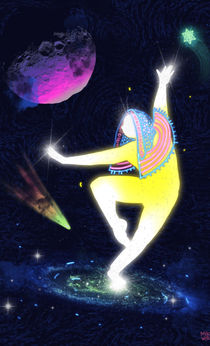
The light body dance 2022 Digital Print 24″x36″
Jewish NFT projects include The Kiddush Club NFT Mensch collection, a JaDa organization NFT event at Miami art week 2021, to independent Jewish artists like MosheArt’s hamsa art becoming NFTs or myself in minting my Jewish Futurism artwork and digital experiences into NFTs. We take existing artwork and add that work as NFTs to our current output channels. Independent artists offer unique and interesting utility options, such as prints of the NFT art, access to exclusive content, or even providing the actual rights to the NFT artwork. These different perks would greatly impact the value of the NFT offered. As digital technology and utility offerings evolve into new spaces and screens, we’ll see this grow and evolve in value and utility.
You better believe how thrilled I am that I get to directly engage my audience with the Jewish art that I am making as original work, prints, merch, and now NFTs.
Where Is It All Going?
In the end, we’ve seen examples that demonstrate the promising qualities of NFTs that appeal to creatives, fundraising communities, and fin-tech communities. The examples I shared and the growing number of Jewish creatives, organizations, and institutions adding their NFT projects to the marketplace daily indicate that working with NFTs does actually extend the representation and creative utility of the Jewish experience into emerging global markets and spaces.
That sounds like a fantastic opportunity for high-tech Hiddur Mitzvot and Tzedaka that puts Jewish culture into the midst of new and innovative spaces and conversations on our own terms.
Mike Wirth is a visual artist, digital experience designer, and muralist, best known for his thoughtful murals, public art installations, and client-driven commercial design work that focus on major social justice issues and his identity as a Southern, Jewish-American.
Over the past 20 years, Wirth’s murals, published design projects, and digital museum exhibits have appeared in New York, Miami, Austin, Charlotte, NC, and internationally in Croatia, Poland, and Germany.
Currently, Wirth is a scholar at the Stan Greenspon Center for Holocaust and Social Justice Education and Professor of Art and Design at Queens University of Charlotte in North Carolina. He’s been investigating NFTs since 2015 and has been creating them for brands and non-profit organizations since 2021.