Tag: art history

  • From Cult to Code: Tracing the History of the Aura in Art

    From Cult to Code: Tracing the History of the Aura in Art

    Walter Benjamin is not a household name. But he should be.

    In 1936, this German philosopher and cultural critic wrote an essay that predicted, with startling precision, almost everything that has happened to art since. He described what it would feel like when images became infinitely copyable. He anticipated the strange hollowness of standing in front of a famous painting you have already seen a thousand times on a screen. He named the feeling you get in front of a great original that no photograph ever quite captures. And he called it, simply, the aura.

    “Even the most perfect reproduction of a work of art is lacking in one element: its presence in time and space, its unique existence at the place where it happens to be.”
    — Walter Benjamin, Illuminations (214)

    You already know what aura is. You have felt it. It is the difference between seeing a photo of the Grand Canyon and standing at its edge. It is why people still cry in front of paintings in museums. It is why a vinyl record from a musician you love feels different from the same album on a streaming service. It is why your grandmother’s ring means something her ring’s photograph does not. Benjamin just gave it a name and asked what happens to it when technology makes everything reproducible.

    I have been asking that same question for most of my adult life. The answer, it turns out, is complicated. And beautiful. And a little devastating.


    What Benjamin Actually Said

    Benjamin’s core argument is simple enough to fit on a Post-it note: every original artwork has a presence tied to the specific place and moment it occupies in history. He called this its “here and now” (Benjamin 214). A painting carries the weight of every hand that ever touched it, every room it ever hung in, every century it survived. That accumulated presence is its aura. And the moment you photograph it, print it, digitize it, or copy it in any way, something essential leaks out. The copy is everywhere. The original is still only here.

    I remember reading this in college and thinking it sounded romantic, maybe even a little precious. It took years of making things, and years of watching how people relate to things I made, before I understood he was not being romantic at all. He was being precise.

    He was writing at a moment when photography and film were brand new cultural forces, and he watched them doing something no previous technology had managed: not just reproducing art, but changing what people expected from it. The museum poster, the art history textbook, the film still. Suddenly the image of the artwork was more familiar than the artwork itself.

    “That which withers in the age of mechanical reproduction is the aura of the work of art.”
    — Walter Benjamin, Illuminations (221)

    What makes Benjamin so prescient is that he was not simply mourning this loss. He saw something potentially liberating in it too. If art was no longer locked inside churches and palaces and the reverence of the elite, maybe it could become something more democratic. Maybe it could be politically alive in ways sacred objects never were. I find that tension in his thinking genuinely useful. He does not give you a clean answer because there is not one. He holds the grief and the possibility at the same time, which is, I think, the only honest way to engage with what technology does to culture.


    The Six Lives of Aura

    What Benjamin could not have predicted was how many more transformations were coming. Aura did not simply wane and disappear. It kept reinventing itself, finding new containers, mutating into new forms of value with each new technology. When I map these transformations out, what strikes me most is not how much has changed but how consistent the underlying human longing remains. Every era destroys one version of presence and immediately starts trying to rebuild it.

    “The desire for authenticity, for the unrepeatable, for the original: this is what drives the market’s endless attempts to reconstruct aura under new conditions.”
    — Jos de Mul, Cyberspace Odyssey

    Here is how that history maps across six eras.

    Before the camera, art had cult value. It existed in one place, for one community, embedded in ritual (Benjamin 217). You had to travel to it. The gap between you and the object was not an obstacle. It was the point. Think of a Byzantine icon, a cathedral fresco, a Torah scroll passed down through generations. These things were not primarily decorative. They were alive with the weight of where they had been and who had held them.

    I think about this constantly in my work with Jewish material culture. A Hanukkiah that has been in a family for four generations is not the same object as an identical one bought last year. It carries a history in its scratches and its dents and its smell. That is cult value. And I want to be clear about something that often gets lost in discussions of Benjamin: cult value has not disappeared from contemporary practice. Studio artists working in slow, material-intensive disciplines, oil painting, ceramics, hand-pulled printmaking, still generate genuine aura through the ritual of making. The visible trace of time, the irreproducible encounter with an original surface: these conditions still produce something real. I have stood in front of works that stopped me cold in ways I could not explain, and I believe that experience is not nostalgia. It is recognition.

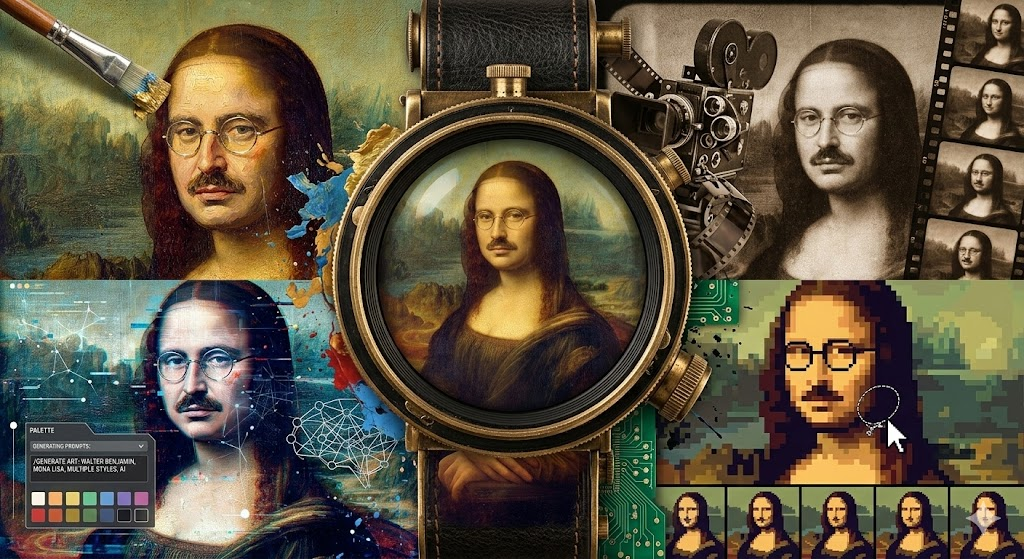
    Photography gave us exhibition value. Art could now travel to you, flattened and portable (Benjamin 225). More people than ever could access it, which was genuinely democratic and genuinely good. But the form of that access had changed fundamentally. The Mona Lisa on a postcard belongs to no place and no moment. It has been liberated from its context and, in that liberation, hollowed out a little. I do not say this with contempt for the postcard. I own plenty of them. I say it because the hollowing is real, and pretending otherwise does not serve anyone.

    “The technique of reproduction detaches the reproduced object from the domain of tradition.”
    — Walter Benjamin, Illuminations (221)

    The market fought back almost immediately: signed editions, numbered prints, certificates of authenticity. I find this reflex fascinating and a little poignant. The demand for aura did not disappear when the technology changed. It went underground and started looking for new containers. That pattern repeats in every era that follows, and once you see it you cannot unsee it.

    The digital age brought manipulation value. Theorist Lev Manovich argued in 1998 that the database had replaced narrative as the dominant logic of new media culture (Manovich, “Database”). In a database, nothing has a fixed place or hierarchy. Everything is a node, waiting to be queried, remixed, and recombined. Art became raw material. Its worth shifted from what it was to how generative it could be.

    “The database represents the world as a list of items, and it refuses to order this list.”
    — Lev Manovich, “Database as a Symbolic Form”

    Hip-hop producers understood this intuitively before any theorist named it. Joseph Schloss establishes in Making Beats that producers sample not because it is convenient but because it is aesthetically beautiful, governed by a strict ethics of creativity and reverence for the source (Schloss 60–61). I find this argument genuinely moving. A Madlib record is built from hundreds of samples, each one carrying the aura of its source: a 1972 soul session, a Brazilian jazz recording, a forgotten film score, all folded into something new. The manipulation is also an act of love. He knew what he was taking. He was accountable to it.

    “Sampling itself is an embodiment of this active process of engaging with history.”
    — Jeff Chang, Can’t Stop Won’t Stop (qtd. in DiCola and McLeod 74)

    That accountability is everything. It is what separates sampling from mere recombination, and it becomes the critical distinction when we get to AI.

    Social media created circulation value. In the age of Instagram, TikTok, and viral sharing, what an artwork is worth is inseparable from how far and fast it moves (Eryani). I remember when this shift started to feel real to me, not as a theoretical idea but as something I was actually living. Works I made that circulated widely took on a kind of social weight I had not anticipated. Works I made that did not circulate felt invisible regardless of how much they meant to me. That asymmetry disturbed me. It still does.

    “In the digital age, the aura of an artwork is no longer tied to its physical uniqueness but to its cultural resonance and the collective experience it generates.”
    — Rulla Eryani, “Aura Reimagined”

    A work now risks losing significance not by being too widely reproduced but by not being reproduced widely enough. Obscurity, not ubiquity, is the threat. Benjamin would have found this deeply strange. I find it both funny and genuinely disorienting.

    NFTs tried to engineer scarcity value. When digital technology made reproduction totally free and infinite, the market did not accept the loss of aura gracefully. It built a financial instrument to simulate it. A blockchain certificate acted as a surrogate original, a unique claim of ownership over an infinitely copyable file (Jin). I watched this happen in real time and felt something like recognition mixed with exhaustion. Of course the market did this. It always does.

    “NFTs don’t reinvent the aura — they show us what it always was: a structure of power, hierarchy, and exclusivity dressed in spiritual language.”
    — Laurie Rojas, Caesura Magazine

    What NFTs revealed, more nakedly than anything in recent art history, is that the desire for aura was never purely spiritual. It was always also about property, exclusivity, and the economics of being the one person who owns the real thing. The container was synthetic. The longing was genuine. I think that distinction matters enormously.

    AI generation has brought us to generative value. This is the strangest and most unsettled territory of all, and I say that as someone who is inside it. AI does not reproduce existing works. It generates entirely new ones, trained on millions of images, producing outputs that look like art, circulate like art, and affect people the way art does, but which were made by no one in particular, in no specific moment, with no hand, no resistance, no decision under pressure.

    “AI systems trained on cultural databases continue the database logic of new media, generating new narratives and images from accumulated cultural archives.”
    — Lev Manovich and Emanuele Arielli, Artificial Aesthetics

    I have fine-tuned my own image models on my own work. I fed them my visual language, my aesthetic history, my accumulated decisions as an artist, and watched them generate images that look, in some meaningful way, like me. I want to be honest about how strange that experience is. The outputs are genuinely useful. I use them for ideation, for unlocking directions I might not have found otherwise, for seeing my own sensibility reflected back at unexpected angles. But I have never used AI output in a final work. Something stops me every time. I have spent a lot of time trying to name what that something is, and I think Benjamin finally gives me the language: the generated image carries the shape of my aura but not its weight. The model learned from objects I made in specific moments. It was not there when I made them.

    This is also where collage becomes a useful and genuinely complicated contrast. Hannah Höch, Kurt Schwitters, Romare Bearden built entire practices on the deliberate rupture of aura in source materials. And yet their works carry unmistakable aura of their own. The cut is a decision. The placement is a decision. The tension between fragments is authored, lived, physically enacted in a specific moment by a specific person. AI image generation looks like collage from the outside but the difference is exactly what Benjamin would have identified: there is no hand, no moment, no resistance.

    “A work of art produced by a human hand communicates something of the artist’s presence, their struggle with materials, their decision-making under pressure — none of which a machine can replicate.”
    — Eva Cetinic and James She, Leonardo (Cetinic)

    A collage artist ruptures aura intentionally and then reconstructs something from the rupture. An AI model has no relationship to rupture because it was never present to the wholeness of what it borrowed from. Collage and hip-hop sampling both taught me that context can be destroyed and meaning can still be made. AI is asking me whether that is still true when the displacement is total and no one was accountable to the source. I genuinely do not know the answer yet.


    Why This Matters Now

    Here is the thing about Benjamin’s argument that keeps bringing me back to it after all these years: the desire for aura never disappears. Every technological shift triggers an almost immediate cultural attempt to reconstruct what was just lost. Signed prints, authentication certificates, blockchain tokens, the slow craft revival, the vinyl resurgence, the return to film photography among young artists. These are not nostalgic accidents. They are symptoms of a persistent human need for the irreplaceable encounter, for the object or experience that cannot be anywhere else because it is only here.

    I see this in my students. I see it in collectors. I see it in myself every time I walk into a room with an object that stops me. The need is real. What changes is only the form it takes and how honestly we reckon with whether the form is delivering what we actually hunger for.

    “The authenticity of a thing is the essence of all that is transmissible from its beginning, ranging from its substantive duration to its testimony to the history which it has experienced.”
    — Walter Benjamin, Illuminations (221)

    The question Benjamin leaves us with, and the one I find most urgent right now, is not whether aura survives. It clearly does, in some form, in every era. The question is what conditions make genuine aura possible and what conditions produce only its simulation. The handmade object, the live performance, the face-to-face encounter: these still generate something real. The blockchain certificate, the AI output, the viral image: these generate something that rhymes with aura but plays by different rules. Knowing the difference, and caring about the difference, might be the most important thing an artist, a designer, or a thoughtful consumer of culture can do right now.

    Walter Benjamin died in 1940, at the Spanish border, fleeing the Nazis, carrying a manuscript no one has ever found. He did not live to see television, the internet, the smartphone, or the AI image generator. But he understood the essential dynamic that drives all of them: every new technology promises to bring art closer to everyone, and every new technology changes what art is in the process of doing so. The question he asked in 1936 is the same one I keep asking.

    Was anyone present when this was made?


    This essay is part of an ongoing exploration of Jewish Futurism, design thinking, and the cultural stakes of emerging technology.


    Works Cited

    Benjamin, Walter. “The Work of Art in the Age of Mechanical Reproduction.” Illuminations: Essays and Reflections, edited by Hannah Arendt, translated by Harry Zohn, Schocken Books, 1969, pp. 214–240.

    Cetinic, Eva, and James She. “The ‘Aura’ of Artworks in the Era of Artificial Intelligence.” Leonardo, vol. 58, no. 4, MIT Press, 2025, pp. 352–360.

    Chang, Jeff. Can’t Stop Won’t Stop: A History of the Hip-Hop Generation. St. Martin’s Press, 2005.

    de Mul, Jos. Cyberspace Odyssey: Towards a Virtual Ontology and Anthropology. Cambridge Scholars Publishing, 2010.

    DiCola, Peter, and Kembrew McLeod. Creative License: The Law and Culture of Digital Sampling. Duke University Press, 2011.

    Eryani, Rulla. “Aura Reimagined: Walter Benjamin’s Legacy in the Digital Age.” LinkedIn, 8 Apr. 2025, www.linkedin.com/pulse/aura-reimagined-walter-benjamins-legacy-digital-age-rulla-eryani-aa4cf.

    Jin, Li. “Art in the Age of Crypto Reproduction.” Li’s Newsletter, 16 Apr. 2024, www.lisnewsletter.com/p/art-in-the-age-of-crypto-reproduction.

    Lund, Niels Windfeld. “The Aura of the Artwork in the Digitalization Age.” Diva Portal, 2017, www.diva-portal.org/smash/get/diva2:1115789/FULLTEXT01.pdf.

    Manovich, Lev. “Database as a Symbolic Form.” October, vol. 77, 1997, pp. 1–15.

    Manovich, Lev, and Emanuele Arielli. Artificial Aesthetics: A Critical Guide to AI, Media and Design. 2nd ed., 2025, manovich.net.

    Rojas, Laurie. “Why There Is No Good NFT Art (Yet?).” Caesura Magazine, 11 Jan. 2022, www.caesuramag.org/posts/laurie-rojas-why-no-good-nft-yet.

    Schloss, Joseph G. Making Beats: The Art of Sample-Based Hip-Hop. Wesleyan University Press, 2004.

    EraValue TypeWhere Value Lives
    Pre-camera fine artCult valueRitual, place, singular presence
    Mechanical reproductionExhibition valueDisplay, access, circulation of copies
    Digital / database ageManipulation valueRemixability, recombination, intentional use as raw material
    Social media ageCirculation valueNetwork reach, social resonance, shared encounter
    NFT / blockchain ageScarcity valueArtificially engineered uniqueness via protocol
    AI generation ageGenerative valuePotential, variation, promissory futures
  • What Went Wrong with Italian Futurism and Why Every futurist Needs to Know More About It

    What Went Wrong with Italian Futurism and Why Every futurist Needs to Know More About It

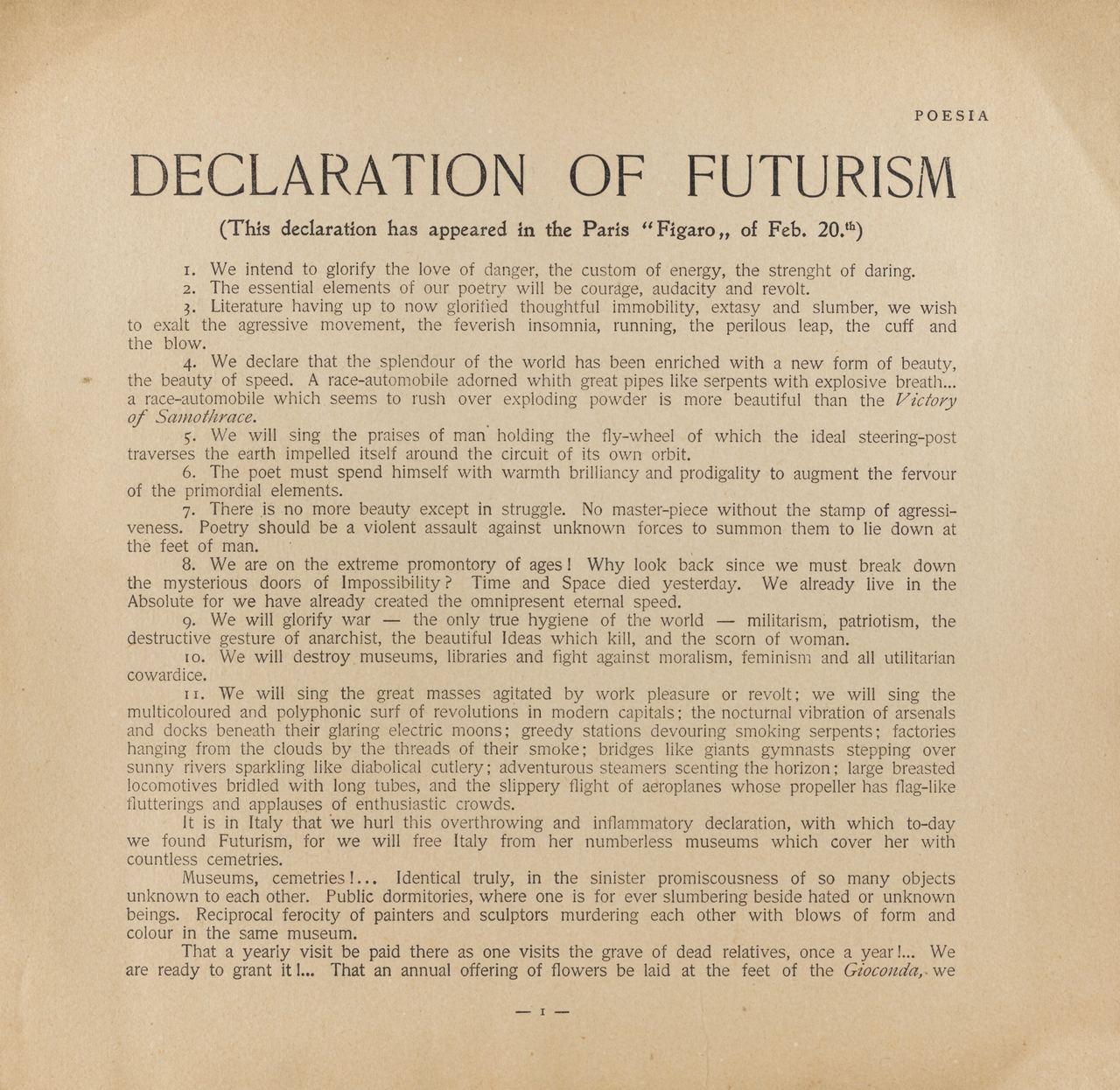
    When I teach graphic design history at Queens University of Charlotte, we hit a point in the semester that always makes me a little uncomfortable, because I know it’s coming before the students do. We’re talking about Italian Futurism, those bold typographic posters, a visionary sounding manifesto bursting with energy, those declarations about speed and machines and destroying museums. At first, students lean forward and feel like the work looks alive and feels thrilling. And then we read more deeply into the Marinetti’s words and we see that this movement became a propaganda apparatus for Mussolini’s fascist regime.

    The first page of the manifesto of Il Futurismo by FT Marinetti 1909

    Those promising-sounding ideas about breaking with the past? They’re loaded with fascist and racist intentions. That gorgeous energy? It was weaponized.

    FT Marinetti 1909

    This is the pedagogical tightrope I walk every semester, and it’s the same tightrope I’m walking in my work on Jewish futurism.

    I’m trying to rescue the core impulse of futurism, the bold, beautiful desire to imagine and design better futures, from what Italian Futurism did to it.

    Because here’s the thing: Italian Futurism started with legitimate, even utopian desires, and it still became a cautionary tale. If you’re going to study any kind of futurism seriously, you need to meet Italian Futurism early, not to emulate it, but to understand exactly what can go wrong when speed replaces wisdom and aesthetics trump ethics.

    Futurism vs futurism: Why the Capital Letter Matters

    I’ve started being very careful about capital F versus lowercase f. Futurism with a capital F names a specific historical movement: Marinetti’s Italian avant-garde, with all its inherited baggage. It’s bound up with nationalism, misogyny, the glorification of war as “the world’s only hygiene,” and an eventual merger with Mussolini’s Fascist Party in 1920. When I write “Futurism,” I’m signaling: we’re talking about that movement, that history, those consequences.

    Futurism with a lowercase “f” names something broader and more perennial: the human impulse to imagine, prototype, and design what comes next. It’s the practice of speculating about futures, whether through art, spirituality, technology, or politics. Lowercase futurism is a method and a desire, not an ideology. It’s the thing Jewish futurism, Afrofuturism, Queerfuturism, Sinofuturism, and Gulf futurism all share: the courage to ask what could be, and the willingness to build toward it.

    This distinction isn’t just academic. It gives us critical vocabulary. Capital-F Futurism becomes an object of analysis and caution, the ancestor we study to avoid repeating. Lowercase futurism becomes a space for repair, reinvention, and new ethical commitments. Jewish futurism inherits the impulse without inheriting the violence.

    How Futurist Movements Emerge: What They All Want at First

    Futurist movements consistently arise during periods of dramatic technological transformation and cultural rupture. Italian Futurism emerged from a very specific crisis. Turn-of-the-century Italy was struggling in ways that made the country feel stuck in the past. The government was weak and unstable. There was no real national identity binding the regions together. Industrial development lagged decades behind other European powers. Poverty was widespread, modernization faced fierce resistance, crime and corruption were endemic, and millions of Italians were emigrating in search of better lives.​

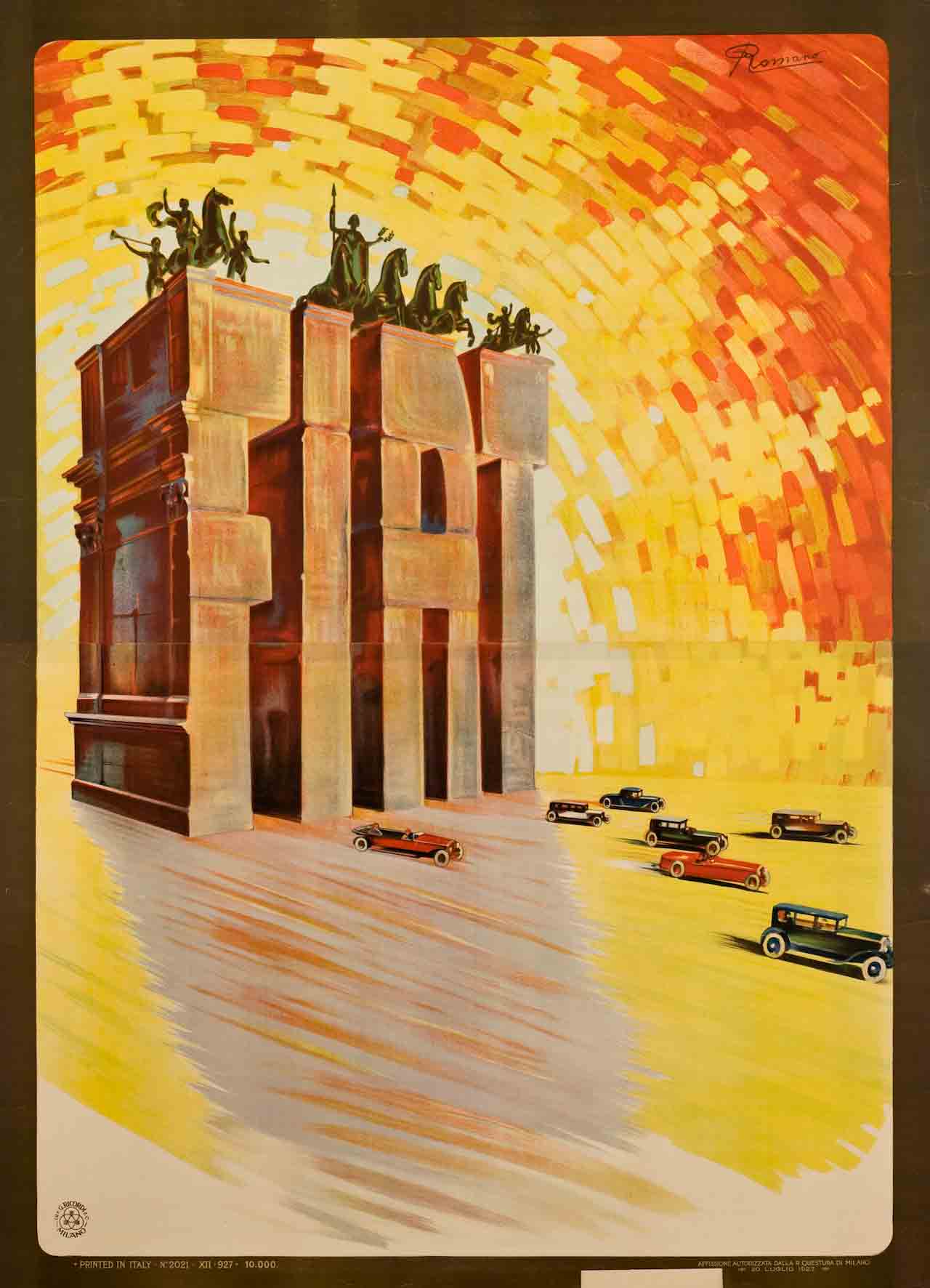
    FIAT, 1927 Giuseppe Romano (1905–67) Fondazione Massimo e Sonia Cirulli Collection, Bologna

    Meanwhile, foreign tourists flooded Italy to gaze at ancient ruins and Renaissance masterpieces, treating the country like a beautiful museum, a relic of what it once was. For young Italian intellectuals like Marinetti, this was humiliating. People came to see what Italy was, not what it is or could become. The weight of the past felt suffocating.

    This pattern repeats across other futurist movements. Afrofuturism developed in response to the ongoing trauma of the transatlantic slave trade and systemic oppression, seeking to reclaim narratives and imagine liberation. Gulf futurism arose from the rapid, oil-driven transformation of the Arab Gulf states. Sinofuturism responds to China’s technological rise and Western anxieties about shifting global power.​

    Despite their different contexts, these movements share foundational patterns. They reject traditions they perceive as inadequate or stifling. They embrace technology as a catalyst for radical cultural change. Most importantly, they assert the right to imagine and define their own futures rather than accepting externally imposed visions.​

    Codognato, Plinio Fiat 520 Optima!, 1928
    Lazzaro, Umberto di Italian Aerial Lines, 1933 ca.

    Futurist movements emerge from communities experiencing rupture, whether from rapid modernization, colonialism, diaspora, or globalization. They often adopt manifesto culture, broadcasting bold visions to gather followers. They’re youth-driven, appealing to younger generations eager to break free from what they see as the constraints of older orders.​

    At their inception, futurist movements typically seek cultural sovereignty, the synthesis of heritage and innovation, celebration of dynamism and transformation, radical breaks from oppressive pasts, and social change through technology. These are legitimate, even beautiful desires. The critical question is: what values guide those transformative visions? Italian Futurism demonstrates what happens when the desire to destroy the past overwhelms the responsibility to build just futures.​

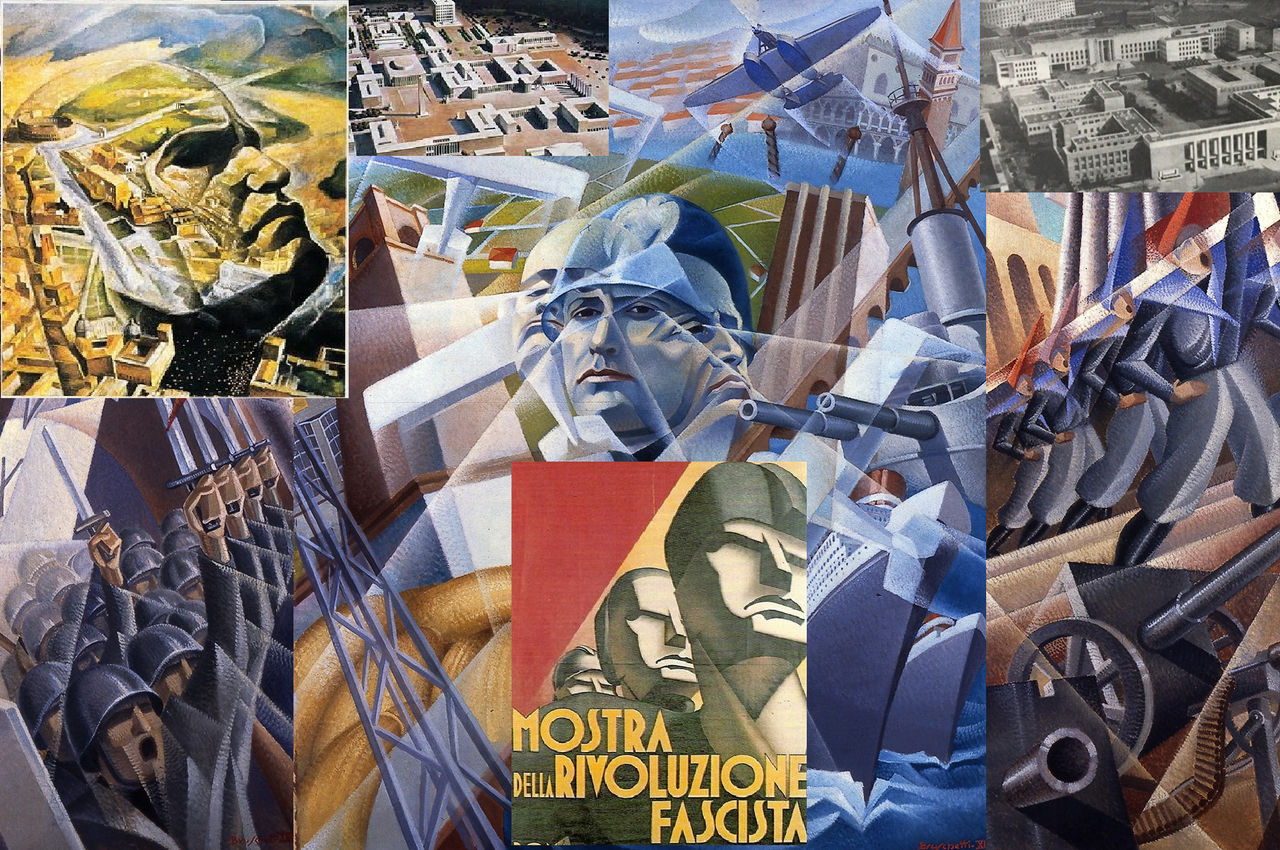
    Collage of Futurismo Fascisto Art By SheldonOswaldLee

    The Promise and Peril of Italian Futurism

    Filippo Tommaso Marinetti launched Italian Futurism with his 1909 manifesto, and it crackled with revolutionary energy. He declared the racing car more beautiful than the Winged Victory of Samothrace and announced war on museums, libraries, and academies. The movement promised total cultural transformation through speed, machines, violence, and youth.​

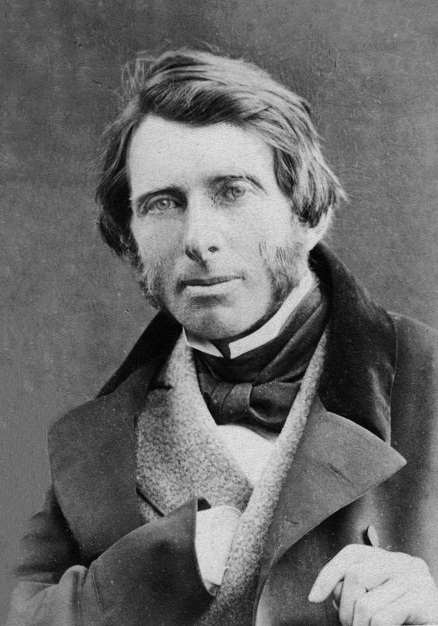
    But Marinetti wasn’t speaking metaphorically. He made actual political proposals to sell off Italy’s art heritage in bulk to other countries. Museums were “graveyards,” he argued, places that paralyzed Italy and prevented it from joining the modern world. Venice, beloved by foreign tourists, was dismissed as “Europe’s brothel”. Art critic John Ruskin, who had celebrated Italian cultural heritage, became an enemy figure.

    John Ruskin, 29 June 1863, Photo by
    William Downey (1829-1915)

    The Futurist manifesto even contained a self-consuming logic. It declared that when Marinetti himself turned 40, younger futurists should throw him “into the trash can, like useless manuscripts”. The movement advocated not just destroying museums once, but periodic cleansing of cultural memory. Nothing could be allowed to accumulate tradition or meaning.

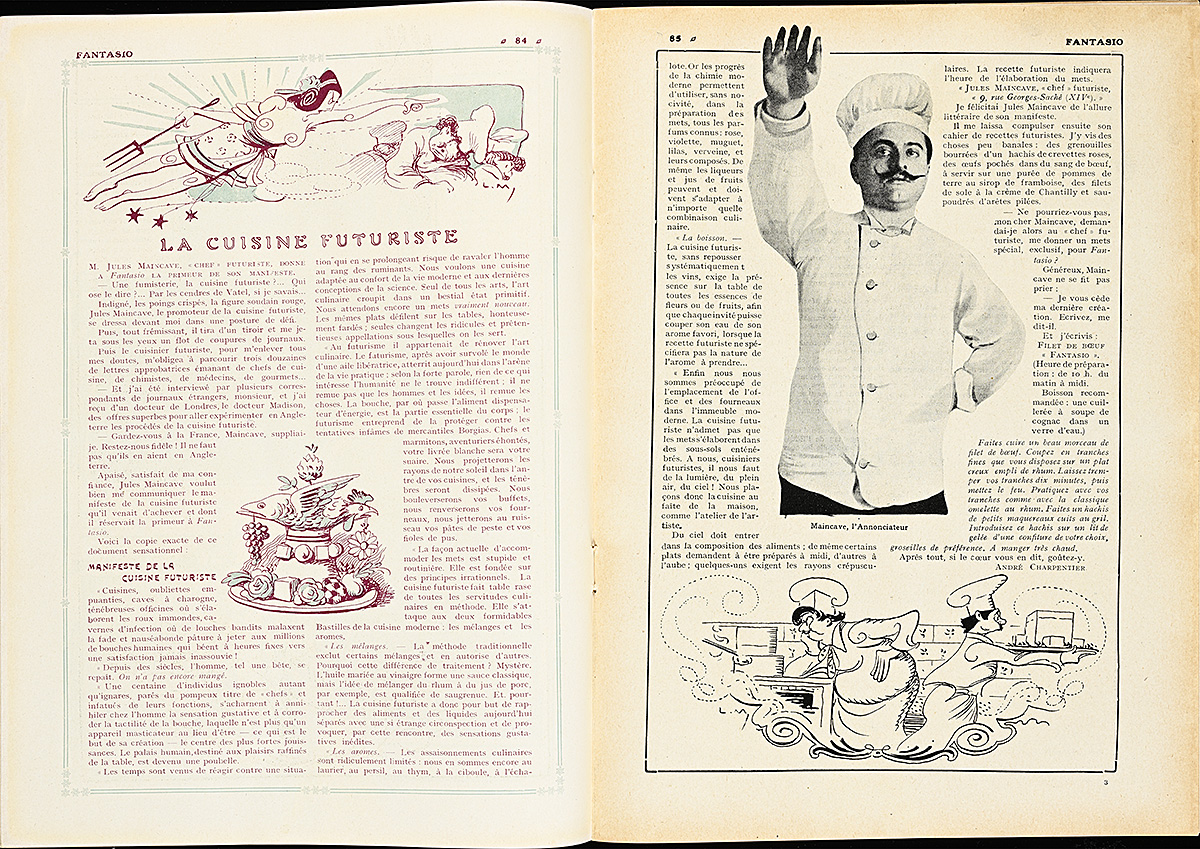
    FT Marinetti’s Futurist Cook book- where he calls for the ban of pasta form the Italian diet, 1913 Posterhaus

    The seeds of destruction were there from the beginning. Marinetti glorified war as “the world’s only hygiene” and promoted aggressive Italian nationalism. When the Futurist Political Party merged with Mussolini’s Fascist movement in 1920, artistic vision was subordinated to political power. The philosophical contradictions, celebrating individual creative genius while demanding conformity to nationalist ideology, created tensions that made the movement culturally irrelevant even as it gained political influence.​

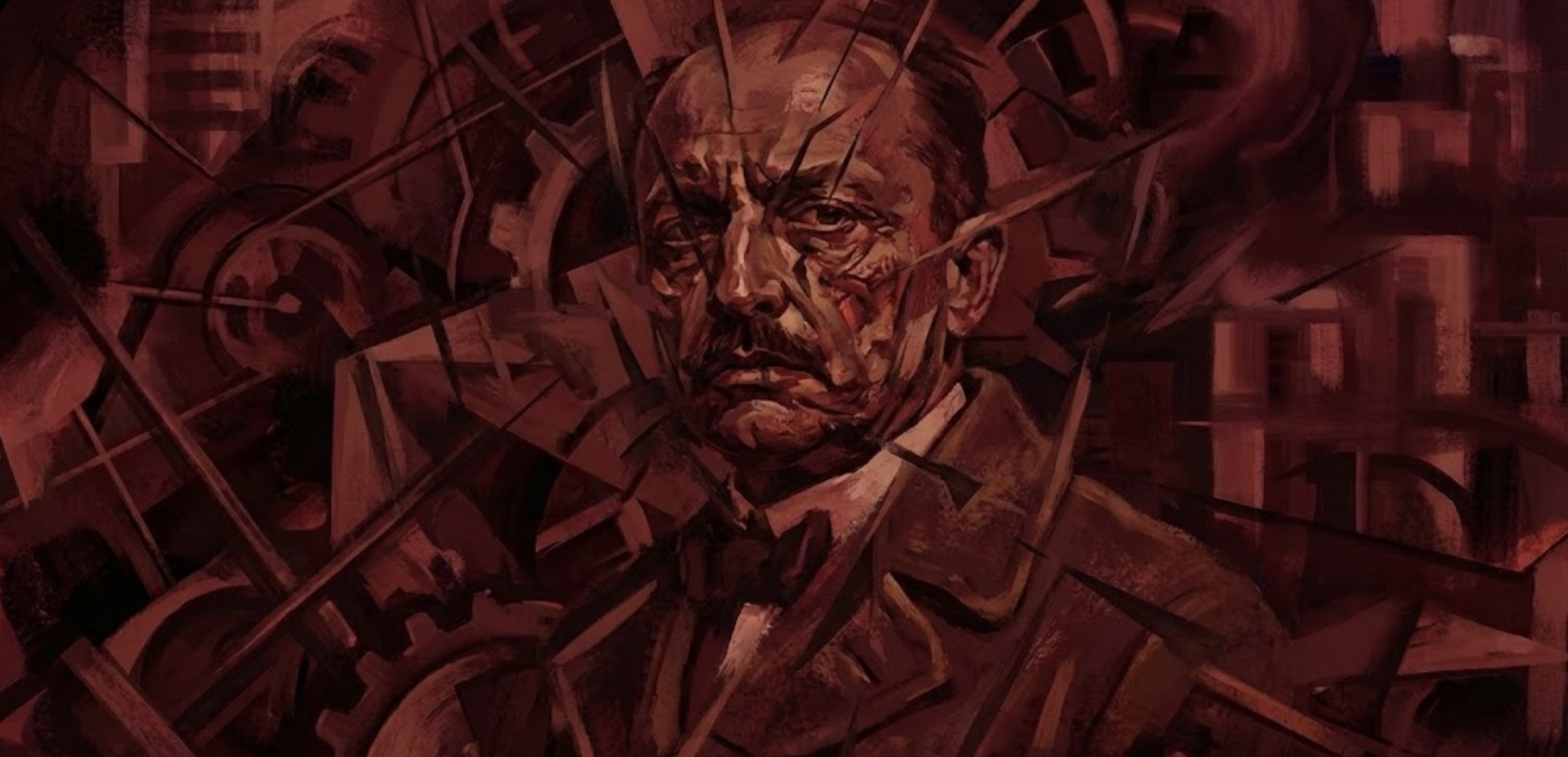
    Aeroritratto di Mussolini aviatore, Alfredo Ambrosi, 1930

    Five Things That Went Catastrophically Wrong

    1. Glorification of Violence and Destruction

    Italian Futurism didn’t just accept violence as a historical reality. It actively celebrated war, aggression, and destruction as aesthetic and moral goods. The movement embraced Italian expansionism and cultural supremacy, making technological progress inseparable from domination. Rather than synthesizing past and future, Italian Futurism sought to obliterate history entirely, creating a vacuum that fascist ideology eagerly filled.​

    This pattern wasn’t unique to Italy. The source material connects Futurism to similar state-sponsored iconoclasm in revolutionary France, Soviet Russia, and Maoist China. When modernization ideology justifies cultural destruction, it creates dangerous precedents. The logic always sounds progressive at first: we must destroy the old to make way for the new. But that destruction rarely stops where its advocates promise.

    2. Absence of Ethical Guardrails

    The movement valued technology and speed for their own sake, with no moral framework to guide their application. Machines were beautiful because they were fast and powerful, not because they served human flourishing. This absence of empathy-centered design principles meant that when political power beckoned, the movement had no philosophical foundation to resist authoritarianism.​

    Marinetti viewed Italy’s cultural heritage not as something to be honored or reinterpreted, but as a burden to be liquidated. There was no question of what wisdom traditions might offer, no consideration of what future generations might need from the past. Speed was the only value.

    3. Authoritarianism Over Democracy

    Italian Futurism began with anti-monarchist and anti-clerical positions, challenging established power. These principles were quickly abandoned when Marinetti saw opportunities for influence within Mussolini’s regime. The movement became a propaganda tool, with artistic vision subordinated to the authoritarian state. Individual creative genius, once celebrated, was channeled into serving nationalist ideology.​

    4. Exclusionary Cultural Supremacy

    Italian nationalism and cultural dominance were core tenets from the start. There was no space for pluralism, interfaith dialogue, or universal design principles. The aggressive rejection of tradition created a vacuum where fascist ideology could flourish, as the movement offered speed and violence but no sustaining vision of human connection.​ Not to mention that the regime implemented Italian Racial Laws in 1938, introducing discrimination and persecution against Jews of Italy. 

    The humiliation Marinetti felt when tourists treated Italy as a museum of the past was real. But his response, to erase that past entirely rather than build new futures in dialogue with it, became toxic. Cultural sovereignty doesn’t require cultural amnesia.

    5. Aesthetic Without Substance

    When Mussolini refused to make Futurism the official state art of fascist Italy, the movement collapsed into cultural irrelevance. Decades of manifesto-writing had produced style over philosophical depth. Without a sustainable ethical foundation, Italian Futurism had nothing to offer once political winds shifted.​

    The movement’s self-consuming logic guaranteed this outcome. If nothing is allowed to accumulate meaning, if every generation must destroy what came before, then no stable cultural foundation can ever form. You can’t build futures on ground you keep setting on fire.

    Jewish futurism: Building From Different Ground

    This is where my work begins. Jewish futurism emerges from fundamentally different premises, offering a model for how technological optimism can coexist with ancient wisdom and ethical responsibility. Where Italian Futurism glorified destruction, Jewish futurism centers empathy-led innovation, positioning technology as a tool for meaning-making rather than domination.​

    Jewish history demonstrates millennia of resilience and reinvention without destroying the past. Continuous reinterpretation, of texts, traditions, cultural practices, allows Jewish communities to honor ancestral heritage while embracing modernity. This mirrors Afrofuturism’s Sankofa principle, which emphasizes learning from the past to inform future trajectories. Rather than revolutionary destruction, Jewish futurism practices synthesis and transformation.​

    In my own practice, Jewish futurism is rooted in Jewish thought: tikkun olam (repair of the world), justice, responsibility. Technology is never valued for its own sake but always in service of deeper moral commitments. This philosophical grounding provides the ethical guardrails that Italian Futurism catastrophically lacked. The question at the heart of my work is: “What kind of ancestor will you be?” That question changes everything.​

    Where Marinetti wanted to be thrown in the trash at age 40, Jewish futurism asks what we’re building that will outlast us, what we’re passing down that future generations will need. It’s not about preserving everything unchanged. It’s about being in active, creative dialogue with tradition while we build what comes next.

    What We Can Learn: Five Lessons for Building Responsible Futurisms

    Ethics Must Precede Aesthetics: Beauty and innovation without moral grounding enable atrocity. Technology requires wisdom traditions to guide its use. Speed without wisdom is just velocity. It doesn’t know where it’s going or why. When Marinetti proposed selling Italy’s art heritage in bulk, he showed what happens when aesthetic ideology overrides ethical consideration.​

    Honor the Past While Building the Future: Synthesis surpasses destruction as a strategy for cultural renewal. Tradition provides foundation for innovation rather than serving as an obstacle to it. Jewish tradition treats time as cyclical rather than linear, where past, present, and future dynamically interact. The humiliation Italy felt at being treated as a museum was real, but erasure isn’t the only response. We can acknowledge what’s broken in our inherited traditions while keeping what sustains us.​

    Center Human Dignity Over Cultural Supremacy: Universal design principles create futures for all people, not just dominant groups. futurism must be liberatory rather than oppressive, replacing nationalism with empathy and collaboration. Jewish futurism creates shared spaces for collective growth and interfaith collaboration. The pattern of state-sponsored iconoclasm, from revolutionary France to Soviet Russia to Maoist China, shows us what happens when one vision of the future tries to erase all others.​

    Resist Political Opportunism: Artistic movements must maintain ethical independence even when political power beckons. When survival requires moral compromise, the movement has already failed. Marinetti’s compromises to ensure the movement’s survival hollowed it out from within. The proposals to liquidate cultural heritage weren’t just aesthetic statements. They were political calculations about access to power.​

    Root Innovation in Community: Collective meaning-making replaces the cult of individual genius. As I’ve learned in my own practice, the future, like design itself, is fundamentally a team sport. It thrives when we create collectively and collaboratively. Collaboration and care supersede competition and domination. The Futurist manifesto’s call to throw Marinetti himself in the trash at 40 reveals a movement with no concept of intergenerational continuity, no way to pass wisdom forward.​

    The Responsibility of Imagining Futures

    Every speculative vision carries political and ethical consequences. Italian Futurism’s trajectory from revolutionary art movement to fascist propaganda machine demonstrates that enthusiasm for the future, absent ethical grounding, can enable profound harm.​

    When I stand in front of my design students at Queens, looking at those bold Futurist posters, I don’t want to just critique them. I want to show what it looks like to rescue the core impulse, the courage to imagine radically different futures, from what got corrupted. The frustration Marinetti felt was real. Italy was stuck. The weight of the past was crushing. Foreign tourists treating the country as a beautiful corpse was genuinely humiliating. But his solution, to burn it all down and start from nothing, created more problems than it solved.

    Jewish futurism offers that alternative model: technological optimism rooted in ancestral wisdom, innovation guided by empathy, futures built through synthesis rather than destruction. We can honor what we’ve inherited while transforming it. We can be critical of traditions that harm while keeping what sustains. We can build futures that acknowledge the past without being imprisoned by it.​

    The question isn’t whether we’ll imagine futures. In periods of technological transformation, futurist movements will inevitably emerge. The question is what values will guide those visions. Will we learn from history’s warnings about the price of speed without wisdom, aesthetics without ethics, innovation without responsibility? Or will we repeat Italian Futurism’s mistakes with new technologies and new manifestos?​

    I’m betting we can do better. Jewish futurism, and the broader family of ethical futurisms it’s part of, shows us how. We can be bold and careful. We can embrace transformation and honor memory. We can design futures that are actually livable, not just fast. That’s the work. That’s what I’m trying to build.