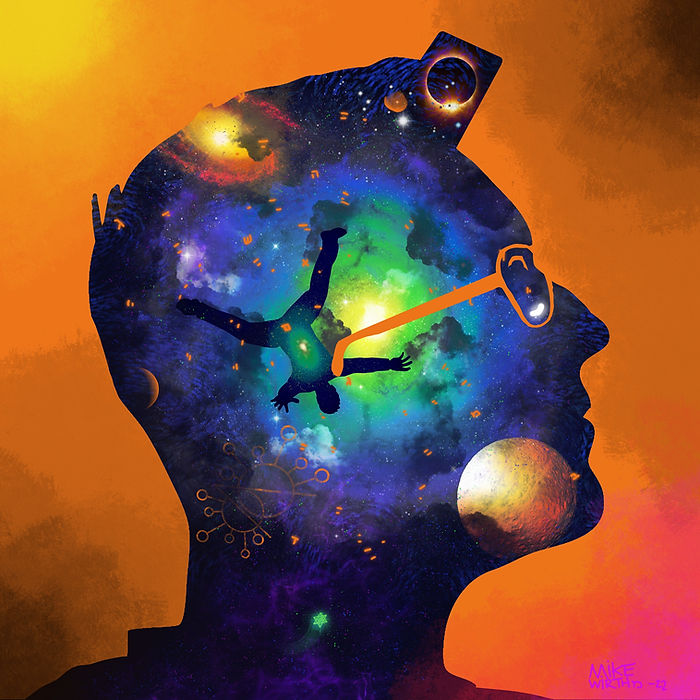
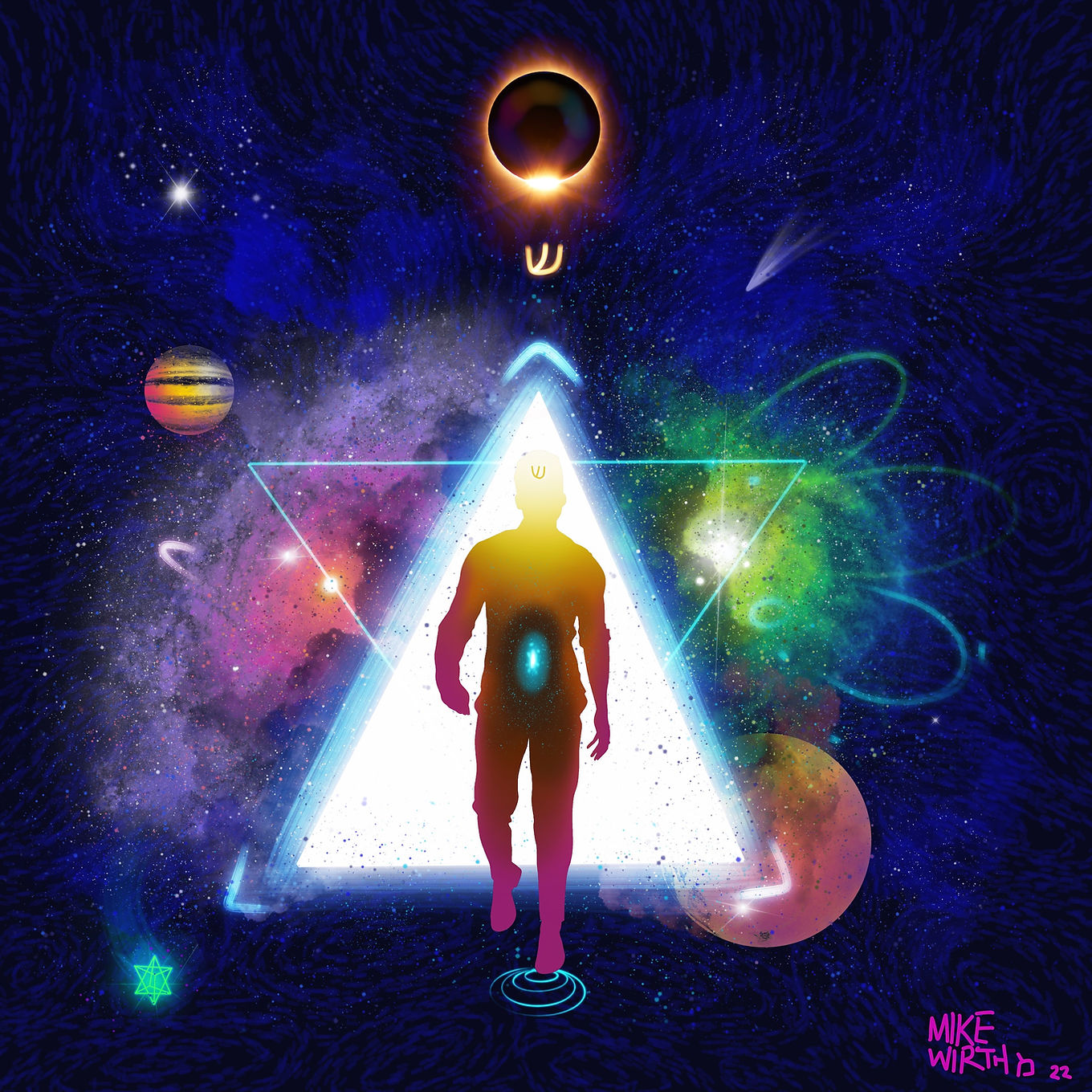
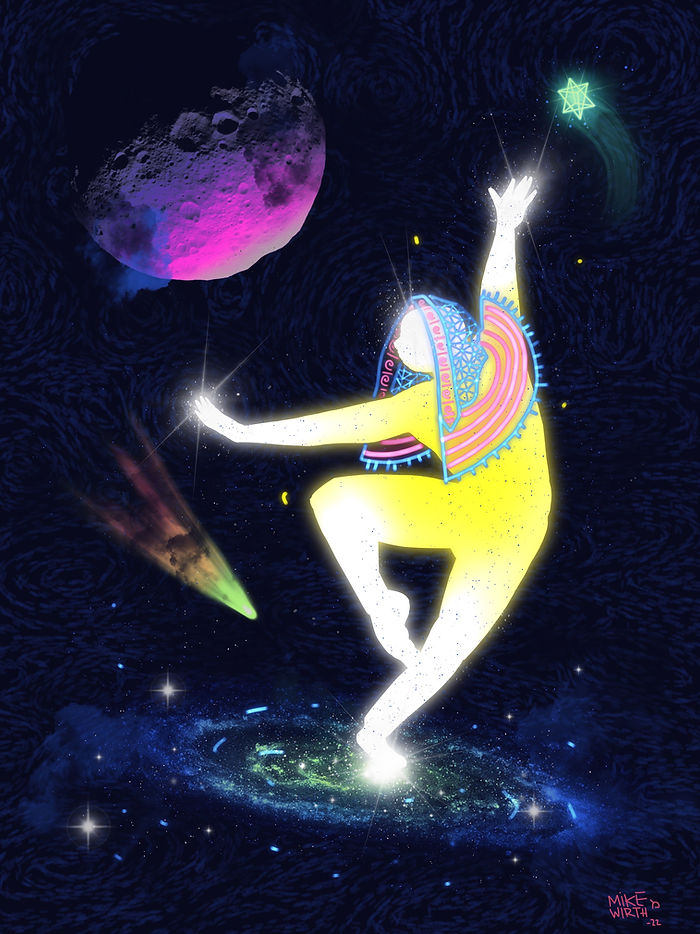
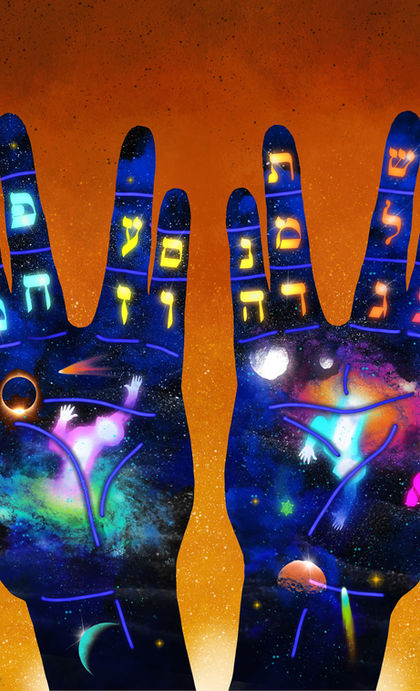
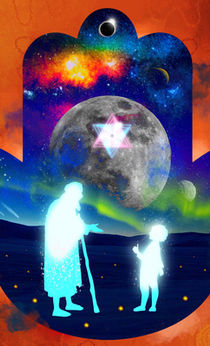
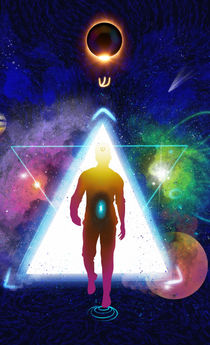
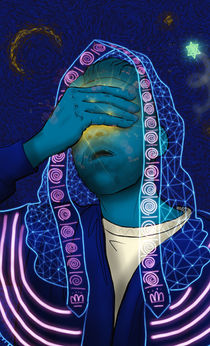
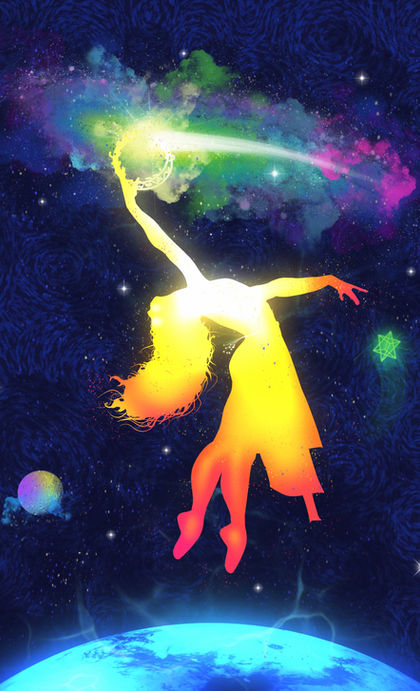
In this episode, I make the case that Jewish futurism isn’t new at all. Long before rockets, algorithms, or AI, Jewish tradition was already asking future-oriented questions about survival, ethics, memory, and change. From Noah and Enoch to Babel, Joseph, exile, and Shabbat, this episode traces how Torah stories are structured around anticipating disruption, redesigning meaning, and passing responsibility forward to people we will never meet. Jewish futurism, I argue, isn’t about predicting the future. It’s about preparing us to meet it awake, accountable, and in relationship.
Episode 1: Welcome to The Jewish futurism Lab: Torah, Tech, Tomorrow
/
RSS Feed
Share
Link
Embed
In this first episode, I’m introducing The Jewish futurism Lab and what this podcast is here to build: a space where Torah learning, creative practice, and emerging technology meet. I’ll share a quick bit about who I am, what Jewish futurism is, and why I’m drawn to Jewish futurism, then lay out what you can expect in future episodes, essays, and projects connected to my work at mikewirthart.com. We’ll start with the foundation, what Jewish futurism is, why it matters right now, and how we can imagine bold, ethical Jewish futures without losing our roots.
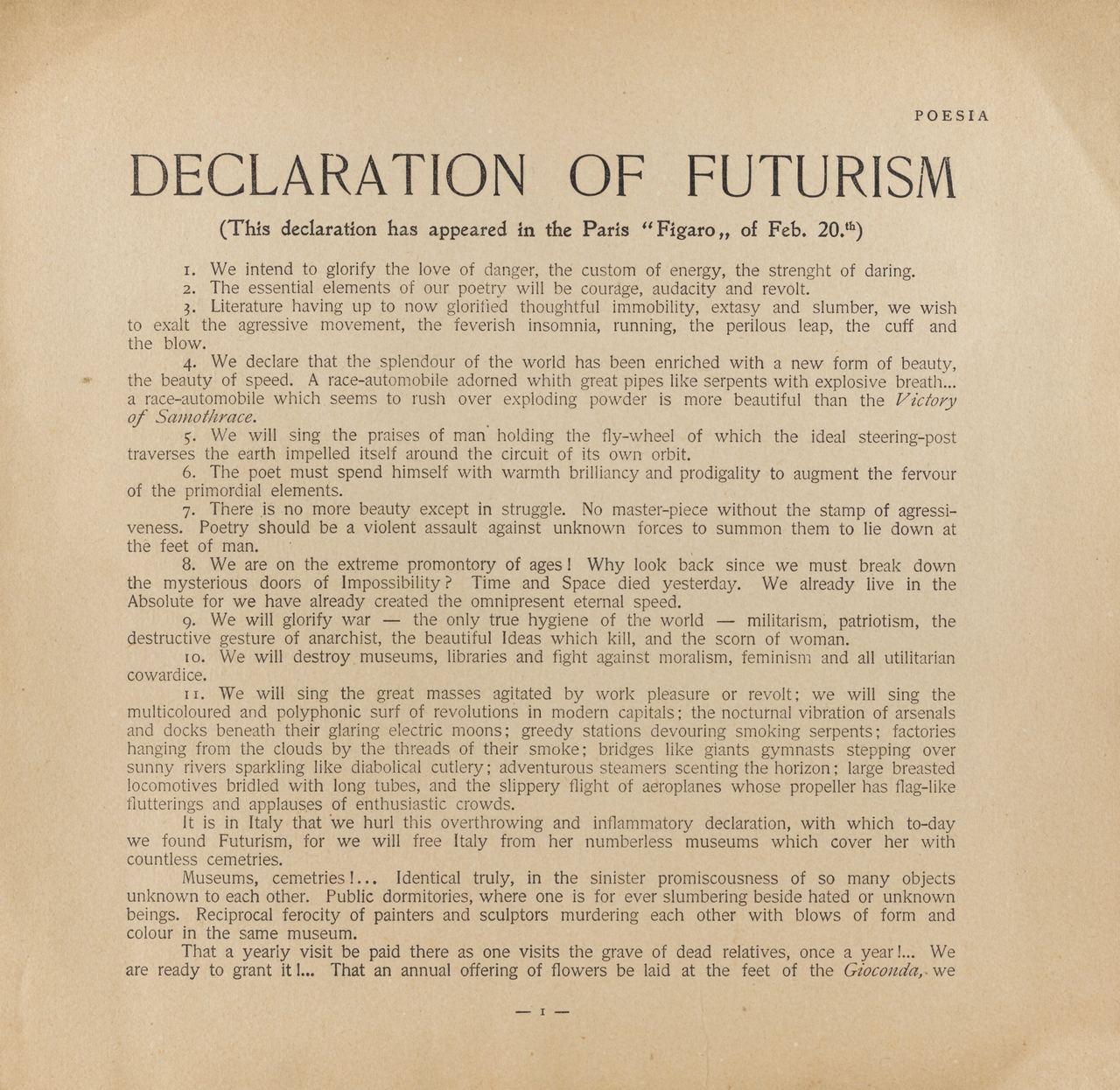
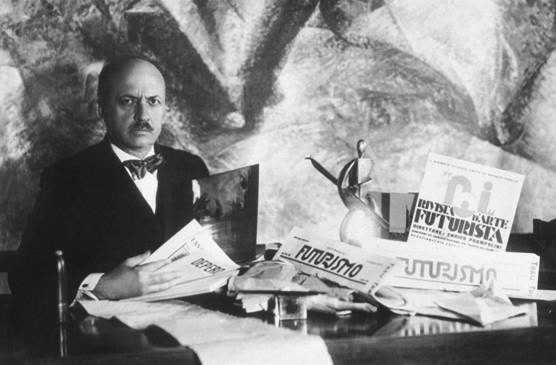
When I teach graphic design history at Queens University of Charlotte, we hit a point in the semester that always makes me a little uncomfortable, because I know it’s coming before the students do. We’re talking about Italian Futurism, those bold typographic posters, a visionary sounding manifesto bursting with energy, those declarations about speed and machines and destroying museums. At first, students lean forward and feel like the work looks alive and feels thrilling. And then we read more deeply into the Marinetti’s words and we see that this movement became a propaganda apparatus for Mussolini’s fascist regime.
The first page of the manifesto of Il Futurismo by FT Marinetti 1909
Those promising-sounding ideas about breaking with the past? They’re loaded with fascist and racist intentions. That gorgeous energy? It was weaponized.
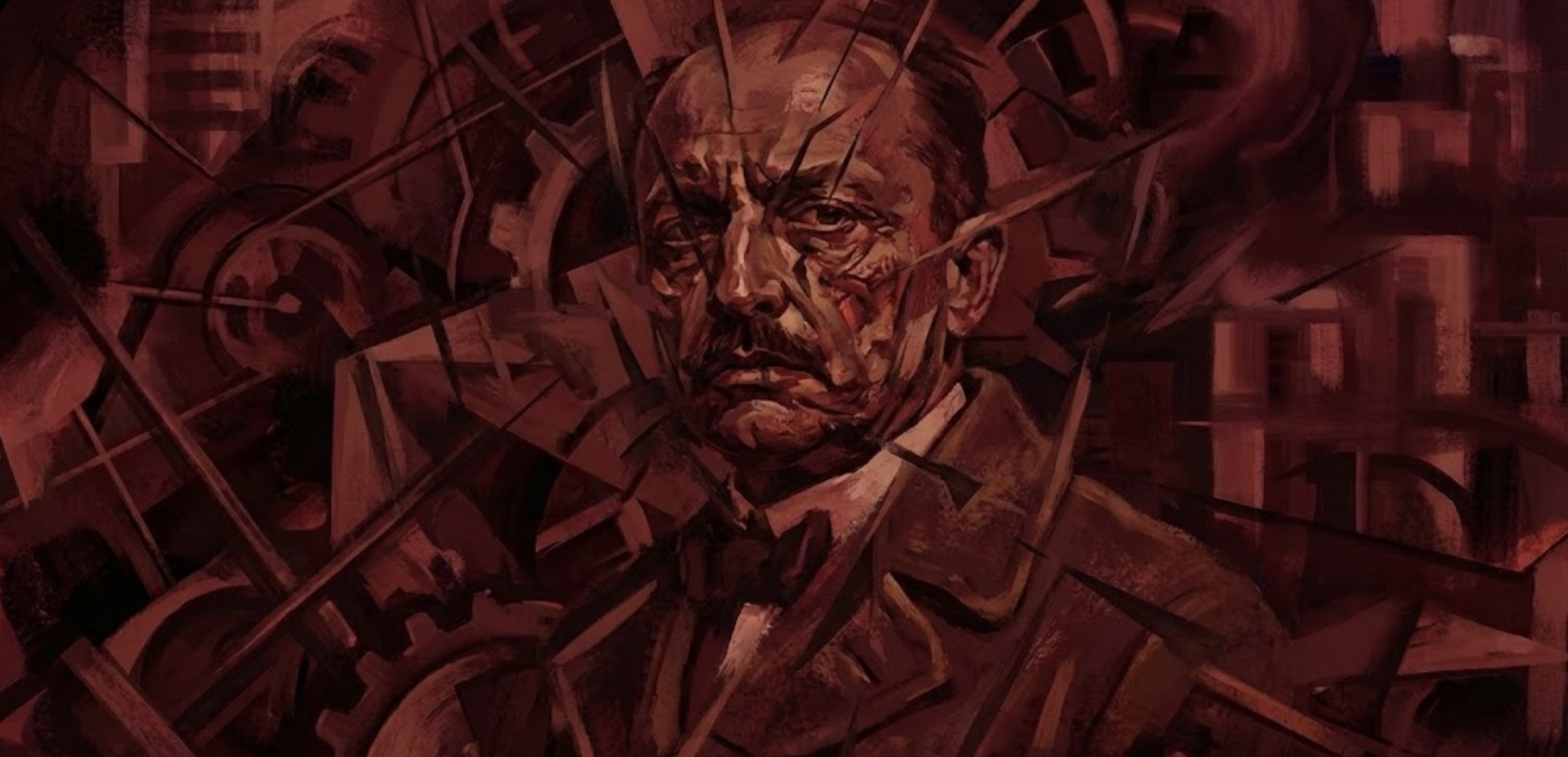
FT Marinetti 1909
This is the pedagogical tightrope I walk every semester, and it’s the same tightrope I’m walking in my work on Jewish futurism.
I’m trying to rescue the core impulse of futurism, the bold, beautiful desire to imagine and design better futures, from what Italian Futurism did to it.
Because here’s the thing: Italian Futurism started with legitimate, even utopian desires, and it still became a cautionary tale. If you’re going to study any kind of futurism seriously, you need to meet Italian Futurism early, not to emulate it, but to understand exactly what can go wrong when speed replaces wisdom and aesthetics trump ethics.
Futurism vs futurism: Why the Capital Letter Matters
I’ve started being very careful about capital F versus lowercase f. Futurism with a capital F names a specific historical movement: Marinetti’s Italian avant-garde, with all its inherited baggage. It’s bound up with nationalism, misogyny, the glorification of war as “the world’s only hygiene,” and an eventual merger with Mussolini’s Fascist Party in 1920. When I write “Futurism,” I’m signaling: we’re talking about that movement, that history, those consequences.
Futurism with a lowercase “f” names something broader and more perennial: the human impulse to imagine, prototype, and design what comes next. It’s the practice of speculating about futures, whether through art, spirituality, technology, or politics. Lowercase futurism is a method and a desire, not an ideology. It’s the thing Jewish futurism, Afrofuturism, Queerfuturism, Sinofuturism, and Gulf futurism all share: the courage to ask what could be, and the willingness to build toward it.
This distinction isn’t just academic. It gives us critical vocabulary. Capital-F Futurism becomes an object of analysis and caution, the ancestor we study to avoid repeating. Lowercase futurism becomes a space for repair, reinvention, and new ethical commitments. Jewish futurism inherits the impulse without inheriting the violence.
How Futurist Movements Emerge: What They All Want at First
Futurist movements consistently arise during periods of dramatic technological transformation and cultural rupture. Italian Futurism emerged from a very specific crisis. Turn-of-the-century Italy was struggling in ways that made the country feel stuck in the past. The government was weak and unstable. There was no real national identity binding the regions together. Industrial development lagged decades behind other European powers. Poverty was widespread, modernization faced fierce resistance, crime and corruption were endemic, and millions of Italians were emigrating in search of better lives.
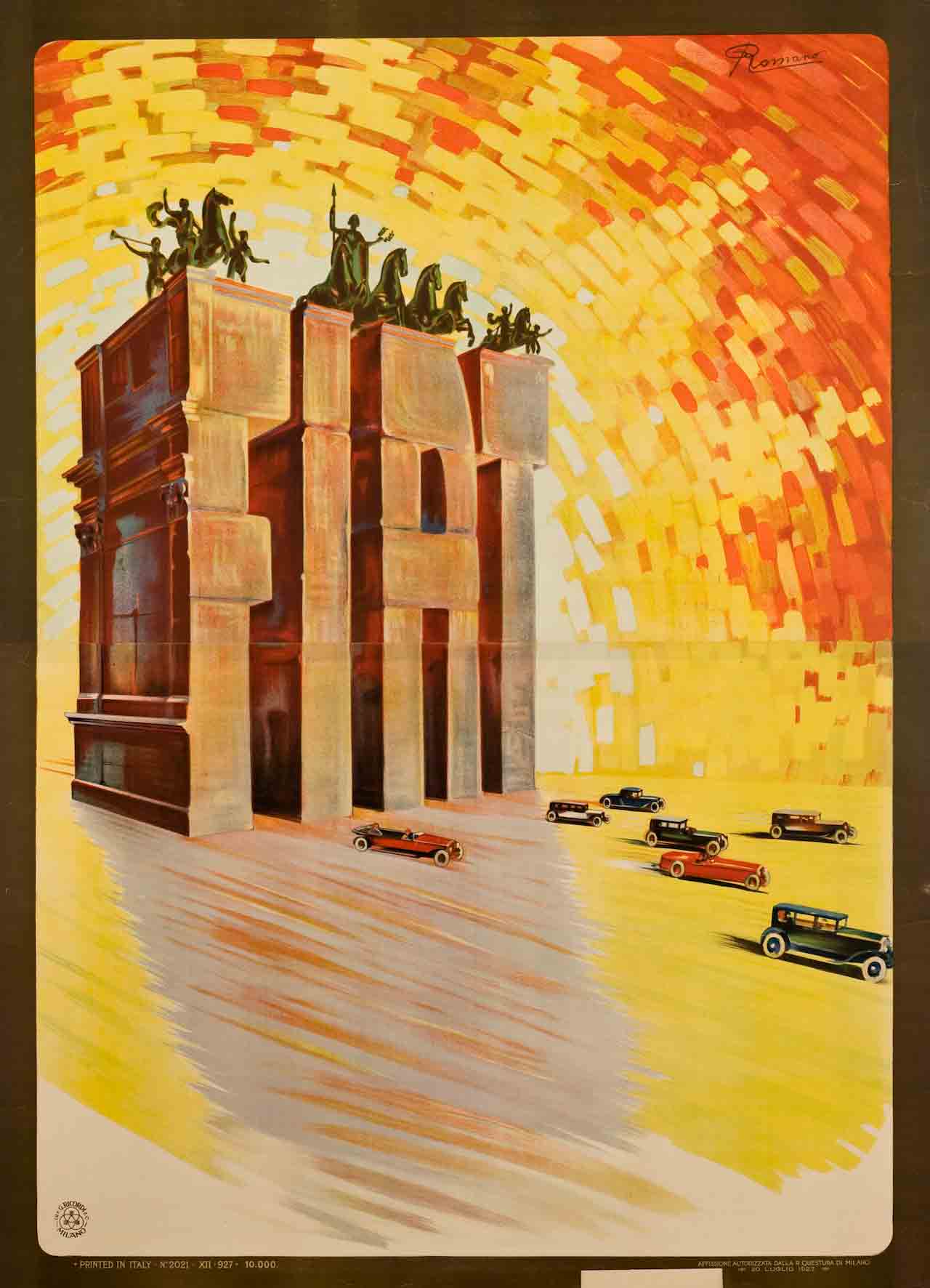
FIAT, 1927 Giuseppe Romano (1905–67) Fondazione Massimo e Sonia Cirulli Collection, Bologna
Meanwhile, foreign tourists flooded Italy to gaze at ancient ruins and Renaissance masterpieces, treating the country like a beautiful museum, a relic of what it once was. For young Italian intellectuals like Marinetti, this was humiliating. People came to see what Italy was, not what it is or could become. The weight of the past felt suffocating.
This pattern repeats across other futurist movements. Afrofuturism developed in response to the ongoing trauma of the transatlantic slave trade and systemic oppression, seeking to reclaim narratives and imagine liberation. Gulf futurism arose from the rapid, oil-driven transformation of the Arab Gulf states. Sinofuturism responds to China’s technological rise and Western anxieties about shifting global power.
Despite their different contexts, these movements share foundational patterns. They reject traditions they perceive as inadequate or stifling. They embrace technology as a catalyst for radical cultural change. Most importantly, they assert the right to imagine and define their own futures rather than accepting externally imposed visions.
Futurist movements emerge from communities experiencing rupture, whether from rapid modernization, colonialism, diaspora, or globalization. They often adopt manifesto culture, broadcasting bold visions to gather followers. They’re youth-driven, appealing to younger generations eager to break free from what they see as the constraints of older orders.
At their inception, futurist movements typically seek cultural sovereignty, the synthesis of heritage and innovation, celebration of dynamism and transformation, radical breaks from oppressive pasts, and social change through technology. These are legitimate, even beautiful desires. The critical question is: what values guide those transformative visions? Italian Futurism demonstrates what happens when the desire to destroy the past overwhelms the responsibility to build just futures.
Filippo Tommaso Marinetti launched Italian Futurism with his 1909 manifesto, and it crackled with revolutionary energy. He declared the racing car more beautiful than the Winged Victory of Samothrace and announced war on museums, libraries, and academies. The movement promised total cultural transformation through speed, machines, violence, and youth.
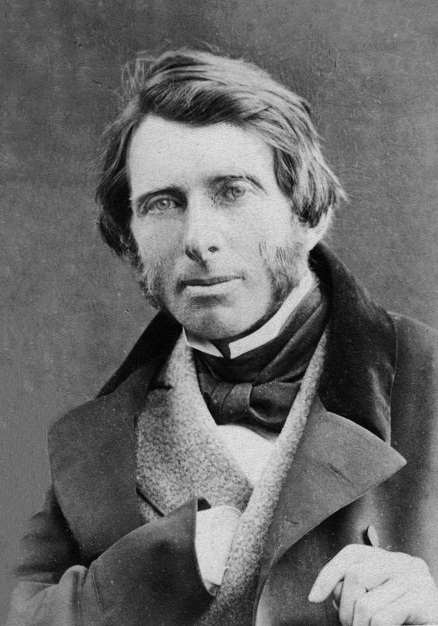
But Marinetti wasn’t speaking metaphorically. He made actual political proposals to sell off Italy’s art heritage in bulk to other countries. Museums were “graveyards,” he argued, places that paralyzed Italy and prevented it from joining the modern world. Venice, beloved by foreign tourists, was dismissed as “Europe’s brothel”. Art critic John Ruskin, who had celebrated Italian cultural heritage, became an enemy figure.
John Ruskin, 29 June 1863, Photo by William Downey (1829-1915)
The Futurist manifesto even contained a self-consuming logic. It declared that when Marinetti himself turned 40, younger futurists should throw him “into the trash can, like useless manuscripts”. The movement advocated not just destroying museums once, but periodic cleansing of cultural memory. Nothing could be allowed to accumulate tradition or meaning.
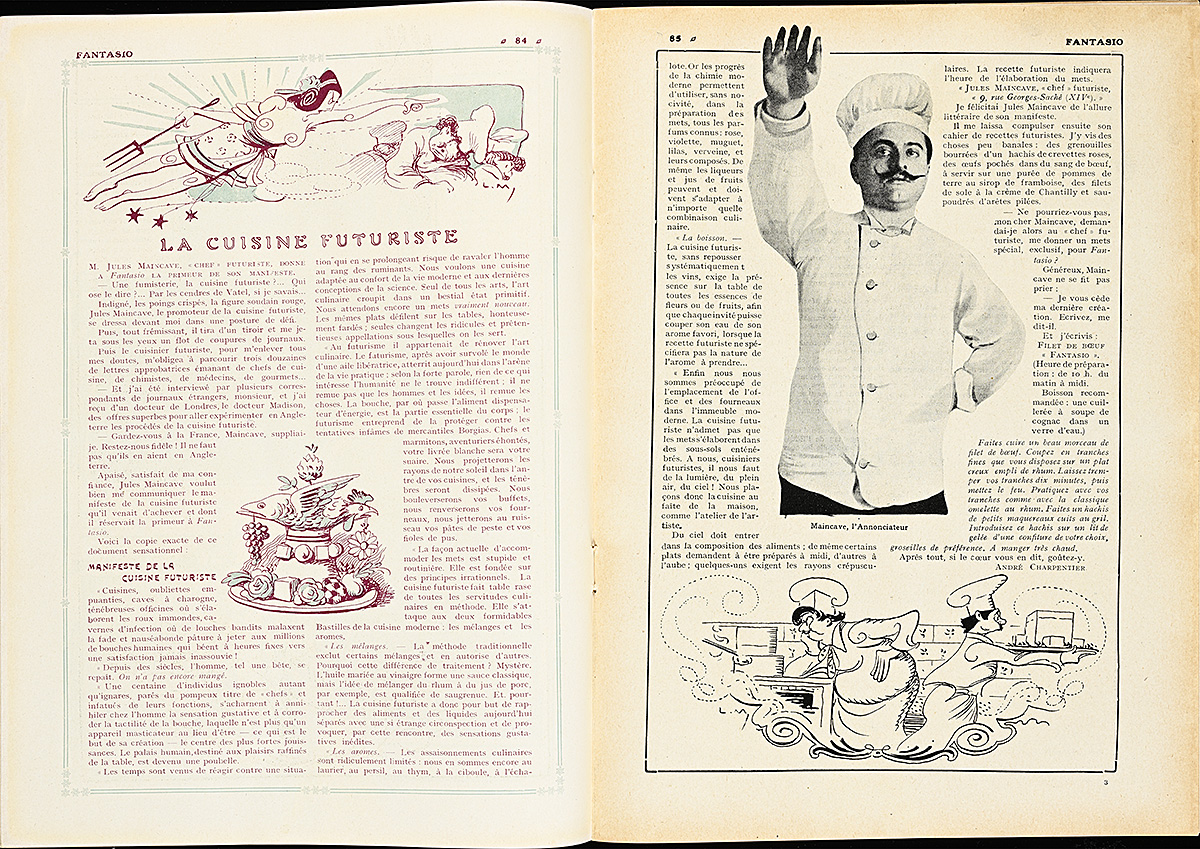
FT Marinetti’s Futurist Cook book- where he calls for the ban of pasta form the Italian diet, 1913 Posterhaus
The seeds of destruction were there from the beginning. Marinetti glorified war as “the world’s only hygiene” and promoted aggressive Italian nationalism. When the Futurist Political Party merged with Mussolini’s Fascist movement in 1920, artistic vision was subordinated to political power. The philosophical contradictions, celebrating individual creative genius while demanding conformity to nationalist ideology, created tensions that made the movement culturally irrelevant even as it gained political influence.
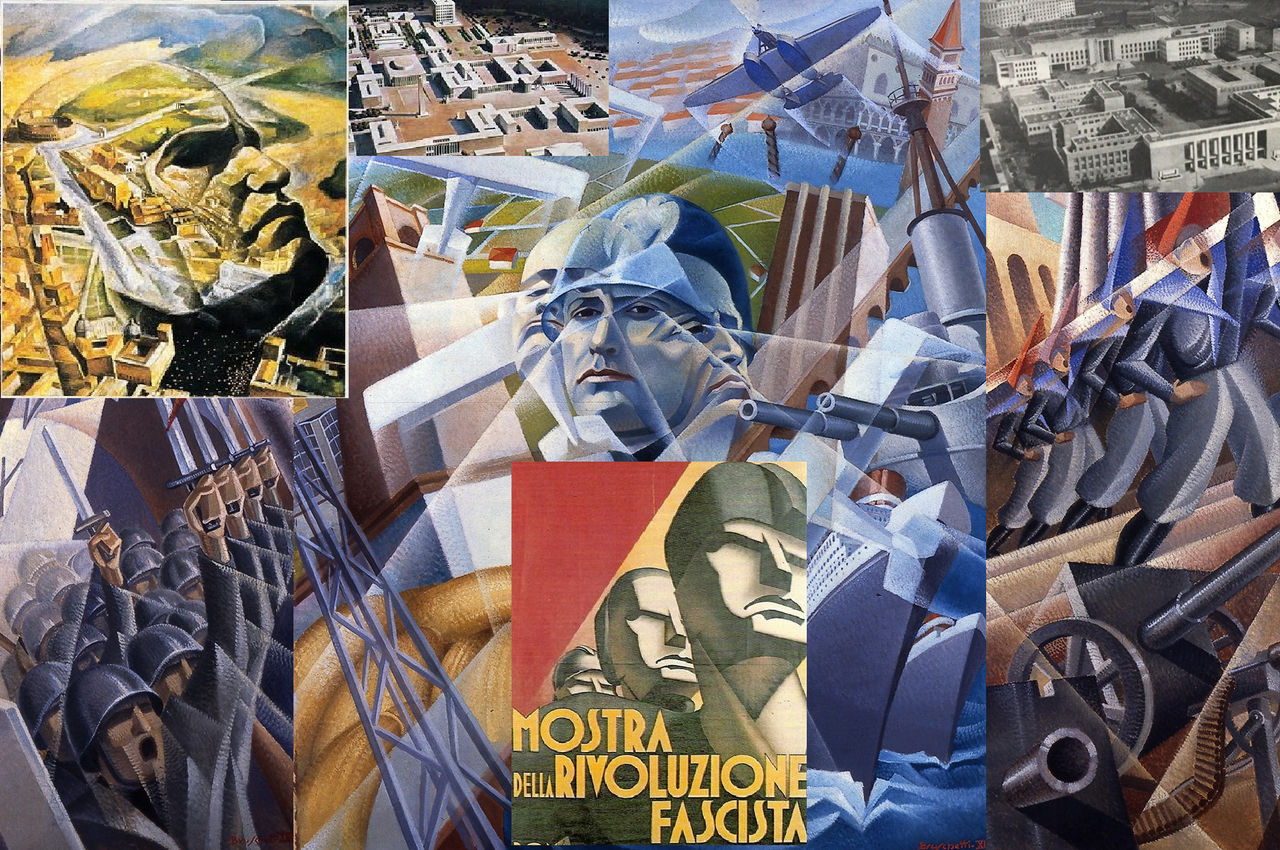
Aeroritratto di Mussolini aviatore, Alfredo Ambrosi, 1930
Five Things That Went Catastrophically Wrong
1. Glorification of Violence and Destruction
Italian Futurism didn’t just accept violence as a historical reality. It actively celebrated war, aggression, and destruction as aesthetic and moral goods. The movement embraced Italian expansionism and cultural supremacy, making technological progress inseparable from domination. Rather than synthesizing past and future, Italian Futurism sought to obliterate history entirely, creating a vacuum that fascist ideology eagerly filled.
This pattern wasn’t unique to Italy. The source material connects Futurism to similar state-sponsored iconoclasm in revolutionary France, Soviet Russia, and Maoist China. When modernization ideology justifies cultural destruction, it creates dangerous precedents. The logic always sounds progressive at first: we must destroy the old to make way for the new. But that destruction rarely stops where its advocates promise.
2. Absence of Ethical Guardrails
The movement valued technology and speed for their own sake, with no moral framework to guide their application. Machines were beautiful because they were fast and powerful, not because they served human flourishing. This absence of empathy-centered design principles meant that when political power beckoned, the movement had no philosophical foundation to resist authoritarianism.
Marinetti viewed Italy’s cultural heritage not as something to be honored or reinterpreted, but as a burden to be liquidated. There was no question of what wisdom traditions might offer, no consideration of what future generations might need from the past. Speed was the only value.
3. Authoritarianism Over Democracy
Italian Futurism began with anti-monarchist and anti-clerical positions, challenging established power. These principles were quickly abandoned when Marinetti saw opportunities for influence within Mussolini’s regime. The movement became a propaganda tool, with artistic vision subordinated to the authoritarian state. Individual creative genius, once celebrated, was channeled into serving nationalist ideology.
4. Exclusionary Cultural Supremacy
Italian nationalism and cultural dominance were core tenets from the start. There was no space for pluralism, interfaith dialogue, or universal design principles. The aggressive rejection of tradition created a vacuum where fascist ideology could flourish, as the movement offered speed and violence but no sustaining vision of human connection. Not to mention that the regime implemented Italian Racial Laws in 1938, introducing discrimination and persecution against Jews of Italy.
The humiliation Marinetti felt when tourists treated Italy as a museum of the past was real. But his response, to erase that past entirely rather than build new futures in dialogue with it, became toxic. Cultural sovereignty doesn’t require cultural amnesia.
5. Aesthetic Without Substance
When Mussolini refused to make Futurism the official state art of fascist Italy, the movement collapsed into cultural irrelevance. Decades of manifesto-writing had produced style over philosophical depth. Without a sustainable ethical foundation, Italian Futurism had nothing to offer once political winds shifted.
The movement’s self-consuming logic guaranteed this outcome. If nothing is allowed to accumulate meaning, if every generation must destroy what came before, then no stable cultural foundation can ever form. You can’t build futures on ground you keep setting on fire.
Jewish futurism: Building From Different Ground
This is where my work begins. Jewish futurism emerges from fundamentally different premises, offering a model for how technological optimism can coexist with ancient wisdom and ethical responsibility. Where Italian Futurism glorified destruction, Jewish futurism centers empathy-led innovation, positioning technology as a tool for meaning-making rather than domination.
Jewish history demonstrates millennia of resilience and reinvention without destroying the past. Continuous reinterpretation, of texts, traditions, cultural practices, allows Jewish communities to honor ancestral heritage while embracing modernity. This mirrors Afrofuturism’s Sankofa principle, which emphasizes learning from the past to inform future trajectories. Rather than revolutionary destruction, Jewish futurism practices synthesis and transformation.
In my own practice, Jewish futurism is rooted in Jewish thought: tikkun olam (repair of the world), justice, responsibility. Technology is never valued for its own sake but always in service of deeper moral commitments. This philosophical grounding provides the ethical guardrails that Italian Futurism catastrophically lacked. The question at the heart of my work is: “What kind of ancestor will you be?” That question changes everything.
Where Marinetti wanted to be thrown in the trash at age 40, Jewish futurism asks what we’re building that will outlast us, what we’re passing down that future generations will need. It’s not about preserving everything unchanged. It’s about being in active, creative dialogue with tradition while we build what comes next.
What We Can Learn: Five Lessons for Building Responsible Futurisms
Ethics Must Precede Aesthetics: Beauty and innovation without moral grounding enable atrocity. Technology requires wisdom traditions to guide its use. Speed without wisdom is just velocity. It doesn’t know where it’s going or why. When Marinetti proposed selling Italy’s art heritage in bulk, he showed what happens when aesthetic ideology overrides ethical consideration.
Honor the Past While Building the Future: Synthesis surpasses destruction as a strategy for cultural renewal. Tradition provides foundation for innovation rather than serving as an obstacle to it. Jewish tradition treats time as cyclical rather than linear, where past, present, and future dynamically interact. The humiliation Italy felt at being treated as a museum was real, but erasure isn’t the only response. We can acknowledge what’s broken in our inherited traditions while keeping what sustains us.
Center Human Dignity Over Cultural Supremacy: Universal design principles create futures for all people, not just dominant groups. futurism must be liberatory rather than oppressive, replacing nationalism with empathy and collaboration. Jewish futurism creates shared spaces for collective growth and interfaith collaboration. The pattern of state-sponsored iconoclasm, from revolutionary France to Soviet Russia to Maoist China, shows us what happens when one vision of the future tries to erase all others.
Resist Political Opportunism: Artistic movements must maintain ethical independence even when political power beckons. When survival requires moral compromise, the movement has already failed. Marinetti’s compromises to ensure the movement’s survival hollowed it out from within. The proposals to liquidate cultural heritage weren’t just aesthetic statements. They were political calculations about access to power.
Root Innovation in Community: Collective meaning-making replaces the cult of individual genius. As I’ve learned in my own practice, the future, like design itself, is fundamentally a team sport. It thrives when we create collectively and collaboratively. Collaboration and care supersede competition and domination. The Futurist manifesto’s call to throw Marinetti himself in the trash at 40 reveals a movement with no concept of intergenerational continuity, no way to pass wisdom forward.
The Responsibility of Imagining Futures
Every speculative vision carries political and ethical consequences. Italian Futurism’s trajectory from revolutionary art movement to fascist propaganda machine demonstrates that enthusiasm for the future, absent ethical grounding, can enable profound harm.
When I stand in front of my design students at Queens, looking at those bold Futurist posters, I don’t want to just critique them. I want to show what it looks like to rescue the core impulse, the courage to imagine radically different futures, from what got corrupted. The frustration Marinetti felt was real. Italy was stuck. The weight of the past was crushing. Foreign tourists treating the country as a beautiful corpse was genuinely humiliating. But his solution, to burn it all down and start from nothing, created more problems than it solved.
Jewish futurism offers that alternative model: technological optimism rooted in ancestral wisdom, innovation guided by empathy, futures built through synthesis rather than destruction. We can honor what we’ve inherited while transforming it. We can be critical of traditions that harm while keeping what sustains. We can build futures that acknowledge the past without being imprisoned by it.
The question isn’t whether we’ll imagine futures. In periods of technological transformation, futurist movements will inevitably emerge. The question is what values will guide those visions. Will we learn from history’s warnings about the price of speed without wisdom, aesthetics without ethics, innovation without responsibility? Or will we repeat Italian Futurism’s mistakes with new technologies and new manifestos?
I’m betting we can do better. Jewish futurism, and the broader family of ethical futurisms it’s part of, shows us how. We can be bold and careful. We can embrace transformation and honor memory. We can design futures that are actually livable, not just fast. That’s the work. That’s what I’m trying to build.
Experimenting with AI tools is one of my favorite parts of my practice, and this particular video generator turned out to be a very cool collaborator. It is not 100 percent accurate, but it gets surprisingly close, and that “almost right” quality ended up becoming part of the interest for me. NotebookLM is a Google product, available at https://notebooklm.google.com, and it works differently from a general chatbot like Gemini or ChatGPT, because it builds everything from the specific sources you feed it rather than from the entire internet.
The video that NotebookLM generated based on my article.
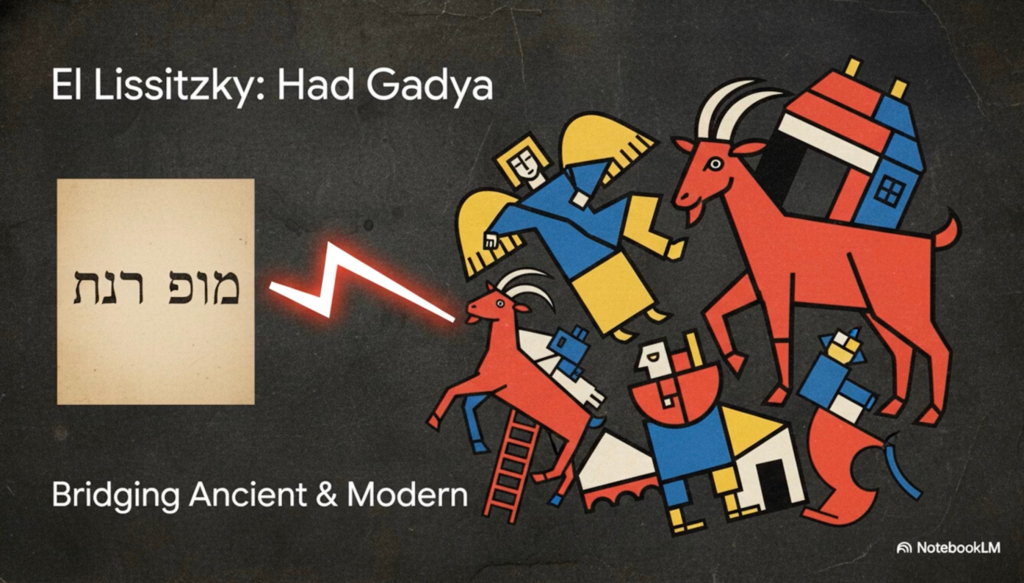
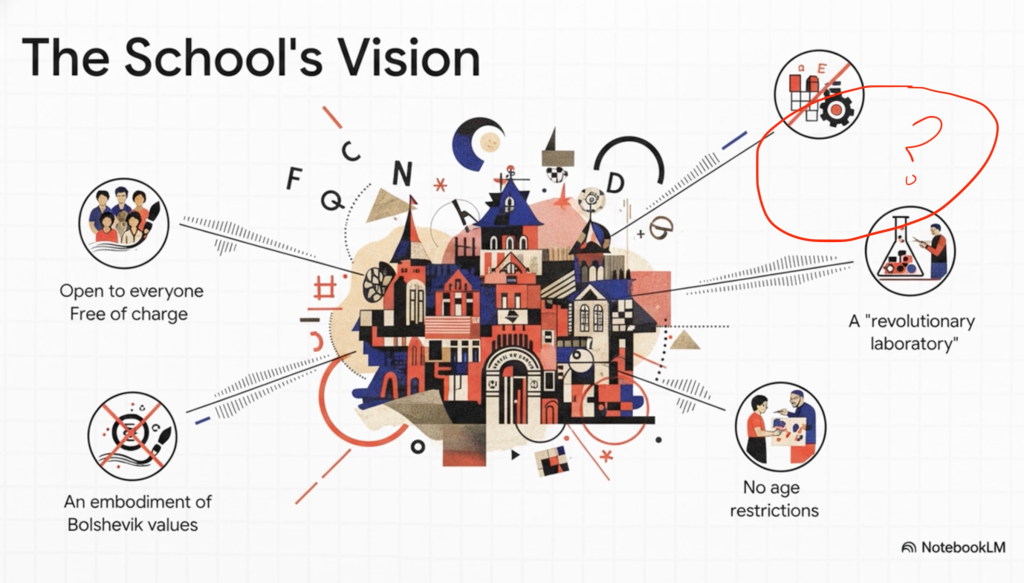
NotebookLM’s video overview tool ended up acting like a surprise co‑director for a project where I wanted to explain proto Jewish futurism in the context of the Vitebsk People’s Art School. Instead of hand crafting every frame, I loaded it up with my recent article and asked it to propose a first pass at a lesson: a narrated video that walks viewers through how Jewish, revolutionary, and avant garde energies briefly converged in Vitebsk. To be more specific, it appears to be a combination of the slideshow generator + a podcast voice generator combined to make a “video”. The result was messy in places, visually strange, and full of small errors, but it still managed to deliver my main argument about Jewish futurist tendencies in this short and intense moment of art education.
Setting up the experiment
I started with a pretty simple goal: turn a dense, theory heavy pile of notes on Vitebsk, Marc Chagall, and the Russian avant garde into something a non specialist could actually watch and follow. NotebookLM’s promise of an auto generated video overview sounded like the right kind of constraint and collaborator for that task. Because it works on data that you explicitly upload or link, I gathered my materials into one place historical sources, exhibition texts, and fragments from my ongoing writing on Jewish futurism and treated the notebook as a compact archive that the system could mine for a narrative, instead of letting it improvise from generic web knowledge.
From notes to video overview
With the sources in place, I asked the system to create an explainer style video focused on three threads: the Vitebsk People’s Art School, the artists at its center, and the ways their work points toward possible Jewish futures. What came back was a sequence of slides paired with narration that moves through the post revolutionary context, the founding of the school, and its radical pedagogical experiments. What surprised me was how clearly the structure echoed my own framing of Vitebsk not as a footnote in art history, but as a kind of prototype for Jewish modernity in motion.
AI generated imagery close, not exact
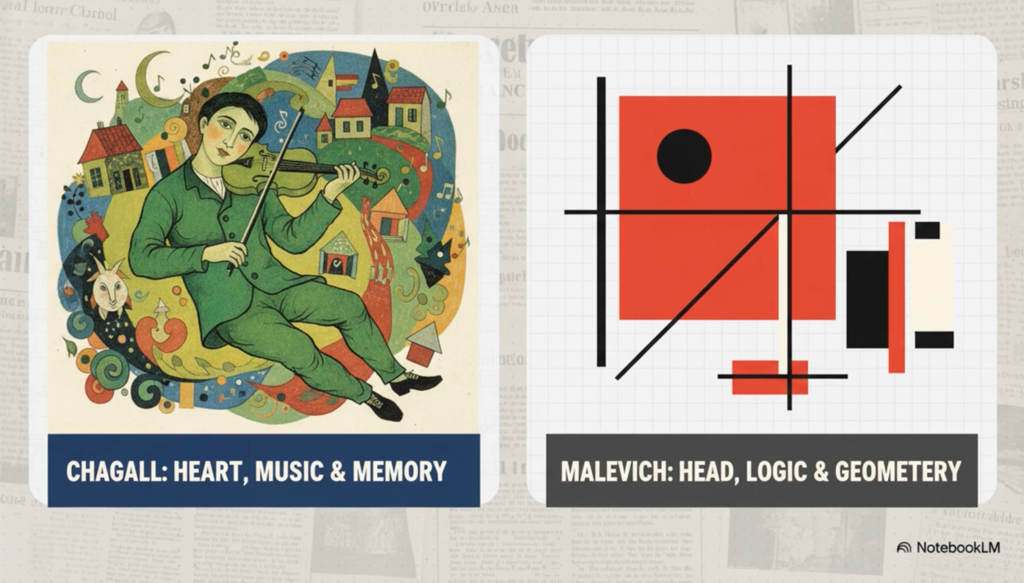
The visuals were where the experiment really got interesting. The system did not reach for actual archival photos or specific paintings. Instead, it produced images that felt like approximations of the artists’ styles. Scenes appeared that looked almost like Chagall’s floating shtetl figures, nearly like Lissitzky’s architectonic compositions, and somewhat like Malevich’s abstractions, but never fully matched the originals. That almost quality created a kind of productive uncanniness. The video builds an atmosphere of Vitebsk’s avant garde world without literally reproducing it, more like a synthetic memory or dream constructed from stylistic cues, which for a project about Jewish futurism feels conceptually on point.
Glitches, spelling errors, and the shape of the argument
The video is clearly not a polished museum product. There are spelling mistakes, clunky phrasing, and the occasional slightly wrong name or term. For me, that did not invalidate the experiment, it just made the mediation visible. This is a generated draft that still needs a human editor, not an authoritative final cut. What mattered more was that underneath those glitches, the bones of the explainer were solid. The video successfully communicated the ideas I wanted to surface: the social and political context of the school, the specifically Jewish dimension of the work, and Vitebsk as a site of radical possibility rather than a nostalgic lost world.
Surfacing a Jewish futurist reading of Vitebsk
The real test for me was whether the piece could carry my reading of Vitebsk as a proto Jewish futurist project. The video condensed that framing into clear, accessible language, repeatedly returning to the school as a laboratory for new Jewish forms and new ways of being together. By forcing my notes into a short, watchable format, the tool pushed me to concretize what I actually mean by proto Jewish futurism in this context: an art school that treats Jewish life as material for design, not just content for preservation, and that treats pedagogy itself as a kind of speculative world building.
In the end, the experiment showed me how an AI generated video can function both as an explainer and as a mirror for my own thinking. It reflected my argument back in another medium, making it obvious which ideas translated smoothly into narrative and which still need more nuance and friction. The off brand imagery, the typos, and the overall coherence all became part of the story, a contemporary, imperfect, and strangely fitting echo of the Vitebsk school’s own attempt to invent a new way of seeing Jewish futures.
If you haven’t tried NotebookLM, I’d make an account and try some experiments on your own.
During my semester long sabbatical, I set out to experiment with new ways to tell Jewish stories, and I kept coming back to the immersive feeling of games. While I stayed focused on my main objective, completing my book Hiddur Olam: Bereshit – Genesis and telling new Jewish stories through art and writing, this Hanukkah, I also felt a pull to expand this idea of immersive storytelling into video games, where players could step inside the work rather than only view or read it. Framing the game projects as interactive midrash let me treat code, mechanics, and level design as another layer of commentary on the same questions that animate the book: how to re engage with foundational Jewish narratives, how to honor tradition while playing with form, and how to imagine Jewish futures that feel both grounded and newly alive in digital space.
Vibe coding and my AI toolbox
For all of these projects, I leaned heavily on what I think of as vibe coding. By vibe coding, I mean describing in natural language how I want something to feel, look, or behave, then using AI coding tools to generate or refactor code until the game’s behavior matches that feeling. I used ChatGPT, Gemini, and GitHub’s coding assistants as a rotating team, asking for everything from small bug fixes and refactors to full systems like player controllers or state machines. I have 20 years of front-end and back-end web development coding experience. Having been a part of a wave of student designer-artist-coders in NY in the late 90s and early 00s making websites by day and net-art by night, vibe coding is great method to make code sketches of ideas or experiments. In this project, I would move the same block of code from one model to another when I got stuck, wanted new insight, or when I wanted to shift from quick procedural hacks into a more object oriented structure. Each of the the different LLM code “voices” helped me see new paths through the same problem. These tools gave me a sense of freedom to soar with code, where in the past I would have been creeping along, slowly teaching myself new methods and getting bogged down in syntax rather than in the Jewish and ludic questions that actually interested me.
Research questions that guided me
A cluster of questions ran through everything I made:
How can I evolve dreidel gameplay beyond a single spin and four letters?
With only four sides, can a dreidel still function as a rich, reusable dice object in a larger game system?
Can the dreidel be used more effectively to tell the story of Hanukkah, not just reference it visually?
What are better ways to tell the story of Hanukkah using the immersiveness of games?
How can I tell new digital Jewish stories that feel both grounded in tradition and native to contemporary game culture?
Is this creative act, moving ritual objects into speculative, interactive worlds, an example of Jewish futurism in practice?
How will Jewish people play dreidel in the future?
Each experiment became a different argument or provisional answer to these questions.
So, over 8 nights, I played with various game and interaction experiments. Here are my best of the best, in no particular order.
Dreidel Run: Neon Grid
Best for dreidel kinetics
With Dreidel Run, I leaned into the question of how to evolve dreidel gameplay at a purely kinetic level. Here, I made the case that the dreidel can succeed as a contemporary and arguably futuristic game mechanic when it is allowed to be fast, flashy, and even a little mindless, while still anchored in
Hanukkah imagery like gelt and glowing colors. Using the Temple Run game mechanics, the experiment argues that not every Jewish game needs an explicit narrative lesson, and that embodied fun, quick reflexes, and the pleasure of catching coins and dodging hazards can themselves be a form of connection, a way of feeling Hanukkah as energy and rhythm rather than only as a story told in words.
Dreidel x Katamari mashup
Best for dreidel physics
In the dreidel and Katamari Damacy inspired mashup, I took seriously the question of whether a small, four sided object could scale up into a world building tool. The design argues that as the spinning dreidel absorbs gelt and grows, it enacts a kind of visual and mechanical midrash on Hanukkah’s themes of accumulation,
excess, and the tension between material things and spiritual light. By exaggerating the physics, I could show how a simple ritual object might literally reshape its environment, and in doing so, I tested how far dreidel based mechanics can stretch before they stop feeling like dreidel play and become something new. Another fun way to play with the dreidel kinetics.
Dreidel Physics Sandbox
Best Holiday Stress Reliever
The smaller dreidel physics sandbox experiments addressed the quieter research question of how players might encounter Jewish content without a fixed goal at all. The spinning battle top game transforms the dreidel into a tornado like object tasked to destroy Seleucid idols of the Temple. It’s instant gameplay makes the argument that
open ended, low stakes experimentation can be a valid form of digital Jewish learning, where the “lesson” is not amoral but a felt sense of spin, friction, wobble, and collapse. In the second experiment I used the Marble Madness type game play, making the dreidel become
a tiny lab for thinking about stability and risk, which echoes Hanukkah’s precariousness, and invites players to linger, tinker, and waste time in a way that is still charged with symbolic possibility. These were worthwhile explorations of the exciting and kinetic nature of the dreidel game.
Dreidel Catan prototype
Most conceptual
In my Catan style prototype, I explored whether a four sided dreidel could act as a meaningful dice object inside a complex resource and territory game that could help tell the story of Hanukkah in terms of the Maccabees, Hellenized Jews, and Seleucids as groups competing for resources and domination in Jerusalem. The design argues that it can, because each side of the dreidel already carries narrative weight, and that weight can be elevated when paired with a card, tableau and board game system like Catan. Resource bonuses, penalties, or events that shape a shared board.
By letting the dreidel drive the different outcomes for each player I was curious to replace the dice with two dreidels. Pushing the game narrative of dreidel from a closed loop into a network of context specific effects.While buggy and complicated, this was one way that Hanukkah themes of scarcity, risk, and negotiation might live inside a modern strategy game.
Hanukkah Quest 1: The Temple of Gloom
Best for Hanukkah story
Hanukkah Quest 1: The Temple of Gloom tackles the question of how to better tell the story of Hanukkah with the immersiveness of a game. Here, I argue that interactive midrash is possible when puzzles, jokes, and spatial navigation all serve as commentary on the holiday’s themes, such as hiddenness,
illumination, desecration, and rededication. Instead of retelling the miracle in a linear script, the game invites players to stumble through a gloomy, playful temple and slowly piece together meaning from their own actions, which models a Jewish way of learning that is iterative, interpretive, and grounded in wandering and return.
Jewish futurist wisdom
These experiments do not just gesture toward Jewish futurism, they enact it and point toward where it might go next. They show that Jewish futurism means keeping ritual objects and stories in play, while re staging them inside interactive systems where players can touch, bend, and argue with them in real time, like a digital beit midrash that anyone can enter. By dropping the dreidel and Hanukkah into arcade runners, resource economies, absurd physics toys, and point and click temples, the work suggests that the future of Jewish storytelling may live in responsive systems rather than fixed scripts, and in shared worlds that generate many valid readings instead of a single correct answer. Your vibe coding practice, using AI to rapidly prototype and reconfigure these systems around a felt sense of Jewish meaning and play, is a clear example of Jewish futurism in practice, and it opens hopeful paths forward: networked Jewish game spaces, collaborative “midrash servers,” classroom rituals that unfold as playable worlds, and future projects where new holidays, communities, and speculative texts are first tested as games before they are written down. In that sense, these games are not an endpoint but a launch pad, a sign that Jewish life will keep unfolding inside new technologies, still circling the same core questions of memory, risk, light, and communal responsibility, while inviting the next generation to help code what comes next.
Judaism has no halakhic precedent, no formal theology, and no inherited best practices for artificial intelligence. There is no daf of Talmud that tells us what to do when our creations begin to imagine, write, and decide alongside us. That absence is not a weakness of tradition; it is a feature of its design.
Across history, Jews have not inherited perfect systems; we have built them and evolved them. The Mishnah transformed memory into a network, medieval commentaries became the first hyperlinked texts, and the printing press democratized Torah (Scholem 207–10). Today, Sefaria, an open‑source library connecting millennia of commentary, extends that same impulse into the digital realm (“Sefaria: A Living Library”). Each technological revolution has become a new revelation of Torah’s possibilities.
These questions are not abstract for me. As a muralist, UX designer, and Jewish futurist, I spend most days sketching ideas for speculative ritual objects, teaching with digital tools, and experimenting with AI‑assisted imagery that asks what Torah might look and feel like in a world of holograms, networks, and neural nets (“Jewish futurism”). The ideas in this essay emerge as much from the studio and classroom as from the beit midrash (Jewish houses of study).
So the question before us is not “What does Judaism say about AI?” but “How might Judaism create with AI?” What might revelation look like when it learns to code?
From Fear to Framework
The Jewish conversation about AI often begins with fear. Questions like, “Can a machine issue psak?”, “Will it erode human authority?”, and “What remains sacred when language itself is synthetic?” appear frequently in contemporary halakhic and communal discussions (Grossman; “AI Meets Halachah”).
Those are vital questions, but they treat Judaism as if its primary task were to regulate technology. In truth, Judaism’s genius has always been to design with it. The halakhic mind guards boundaries, while the artistic mind builds bridges. Both sustain covenant.
In my own work, I see this tension every time I bring AI into a Jewish classroom or community workshop. Some participants arrive worried that a model might replace rabbis, artists, or teachers; others are excited and want to use it as a shortcut for everything. Holding both responses at once has become part of the practice.
AI does not threaten Torah; it extends Torah’s medium. The question is not whether AI can write a responsum, but whether it can help us see Torah more deeply, teach more inclusively, and create more beautifully (Freeman and Mayse).
Judaism as a Metamodern Design System
Theorists of metamodernism describe our age as one that “oscillates between a modern enthusiasm and a postmodern irony” (Vermeulen and van den Akker). Judaism has been oscillating like this for three thousand years. It holds paradox as pedagogy. Every midrash begins with faith that truth exists and ends with humility that no single voice can hold it.
Modernism believed in rational progress, while postmodernism dismantled it. Judaism, like the metamodern imagination, lives between those poles and moves between faith and doubt, reverence and critique, permanence and change (Scholem 5–9). The beit midrash is built on this oscillation, with generations of sages arguing in the margins and preserving even rejected views as part of Torah’s living archive (Kol HaMevaser; Sacks).
Design thinking names this same dynamic: empathy, iteration, and purpose (Brown). Revelation, too, is iterative. Sinai was not just a single event but a recurring dialogue in which each generation prototypes new vessels for holiness such as scroll, page, press, and screen (Kaplan; “A Jewish Theological Perspective on Technology”). To be Jewish in the age of AI is to practice metamodern design and to make meaning through contradiction with sincerity and skepticism in equal measure.
Jewish tradition has long trained us to live with this kind of paradox. In the Talmud, opposing positions can both be affirmed as elu v’elu divrei Elohim chayim, “these and those are the words of the living God,” even when only one becomes binding law (Kol HaMevaser). A machloket l’shem shamayim, an argument for the sake of heaven, is praised precisely because it keeps contradictory truths in productive tension (Sacks). Designing Jewishly with AI means treating its many outputs less as threats to certainty and more as invitations into this older discipline of holding multiple, sincere possibilities at once.
When I teach with AI tools, the classroom becomes a small beit midrash (house of study) that includes the system as a noisy study partner. The goal is not to crown the model as an authority, but to use its strange suggestions to sharpen our questions and clarify what feels authentically Jewish (Freeman and Mayse).
The Missing Dimension in the Jewish AI Debate
Most Jewish writing on AI focuses on halakhah or philosophy, on rules, limits, and fears of replacement (Grossman; “Artificial Intelligence and Us”). What is often missing is the creative and embodied dimension of Jewish life: the building, singing, making, and designing through which Torah becomes lived experience. A growing cohort of Jewish artists and educators is already experimenting with AI in grounded and thoughtful ways, and their practice should shape the wider conversation (Jewish Creative Sensibilities).
What is missing is a language for Jewish Design Thinking, a covenantal process that insists we think, act, and then think again before acting again (Prizmah; Adat Ari El). Jewish Design Thinking uses the raw materials of Torah, halakhah, story, and ritual to prototype futures in which technology serves covenant rather than the other way around. In my own projects, that rhythm looks like sketching speculative altars and merkavot in Procreate, feeding fragments of those images into fine‑tuned Stable Diffusion models trained on my work, and then painting or compositing the outputs back into finished pieces that can live in community spaces (“Jewish futurism”).
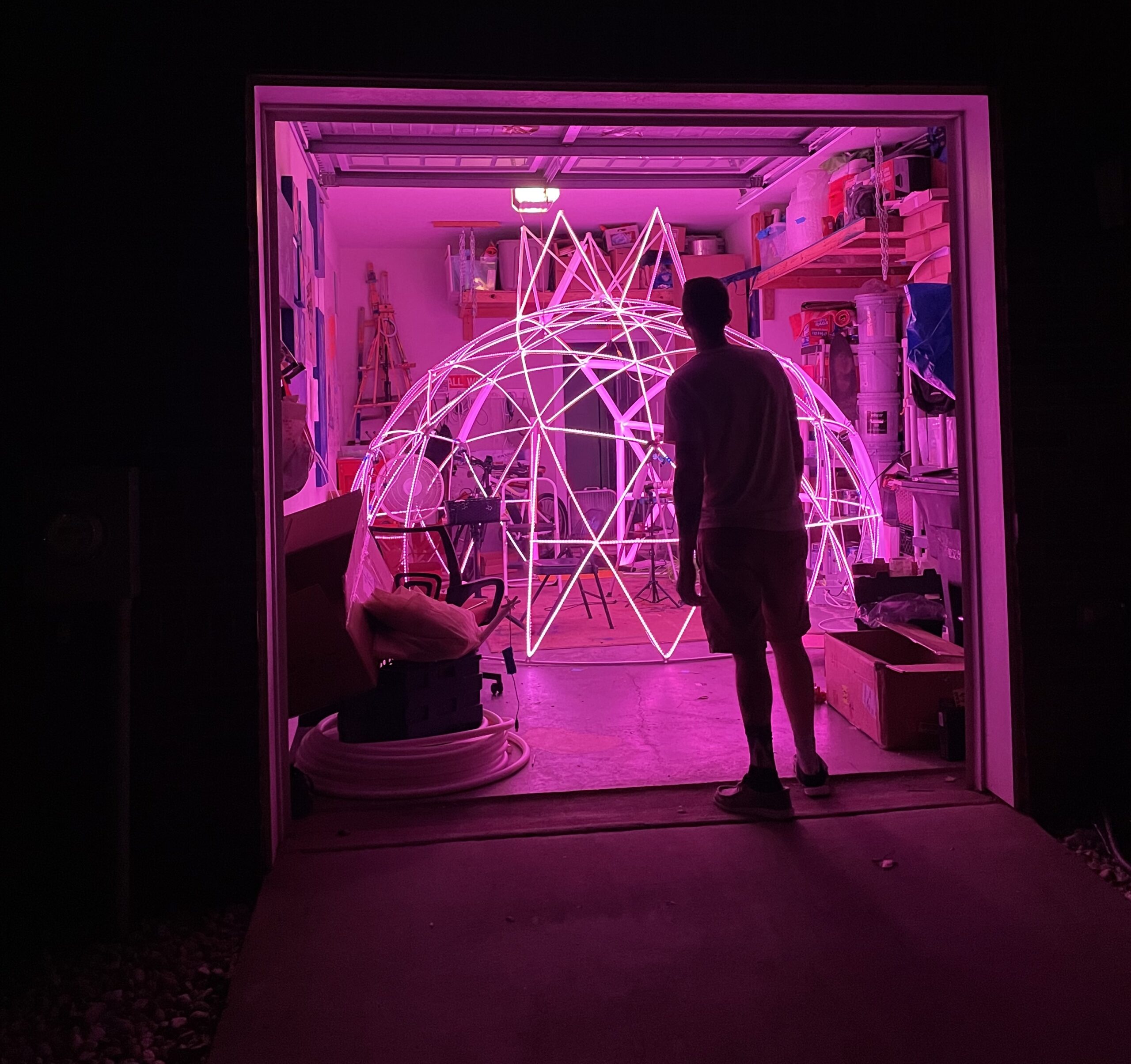
Jewish life has always realized its deepest ideas through concrete forms, from the engineered choreography of Shabbat to the legal and spatial design of the eruv (Prizmah; Adat Ari El). My practice simply extends that logic into neon, pixels, and code.
Judaism is not only a religion of interpretation; it is a culture of creation. The Mishkan was not explained. It was constructed. Bezalel, “filled with the spirit of God,” designed holiness in metal, fabric, and light (Exod. 31.1–5). Art is not ornament to Torah; it is one of Torah’s oldest dialects.
To respond to AI in a Jewish way, we cannot only interpret it. We have to create with it. This is how Judaism answers itself, through making.
The Library, the Aura, and the Algorithm
To locate AI inside this longer story, it helps to notice how modern thinkers have imagined libraries, images, and code. Their work forms a kind of shadow commentary on Torah in the age of algorithms.
In The Library of Babel, Jorge Luis Borges imagined an infinite library of all possible books, an uncanny prophecy of both divine omniscience and algorithmic excess (Borges). His librarians wander an endless text in search of coherence, much like today’s AI systems that spin out countless variations of meaning from their training data.
Walter Benjamin, in The Work of Art in the Age of Mechanical Reproduction, warned that technology could dissolve the “aura” of the artwork, yet he also saw its democratizing power and observed that “the technique of reproduction detaches the object from tradition” (Benjamin 221). Judaism, too, detaches and reattaches tradition each time it is rewritten. Every new edition of the Talmud and every digital platform like Sefaria relocates ancient words into new communities of readers (“Sefaria: A Living Library”).
Lev Manovich later described digital media as infinitely variable and “not fixed once and for all” (Manovich 36), while Ray Kurzweil imagined humanity and technology eventually merging in The Age of Spiritual Machines, a secular echo of Kabbalistic visions of unity (Kurzweil 3–6; Scholem 254–60). Torah, like code, thrives through iteration, versioning, and unexpected recombination.
AI, in this view, is not heresy but a kind of midrashic engine. It recombines the infinite library and tests new relationships between language and light. Classical halakhah is clear that only a human sage, embedded in community and covenant, can issue binding psak; no machine can acquire the da’at and relational responsibility that Jewish law demands (“AI Meets Halachah”; “Not in Heaven”). Yet nonbinding interpretation, or midrash, has always welcomed imaginative recombination, playful juxtaposition, and speculative voices that never become law. In that sense, AI resembles a hyperactive study partner. It cannot decide halakhah, but it can surface unlikely parallels, draft parables, and map conceptual constellations that human learners then sift, critique, and sanctify (Freeman and Mayse).
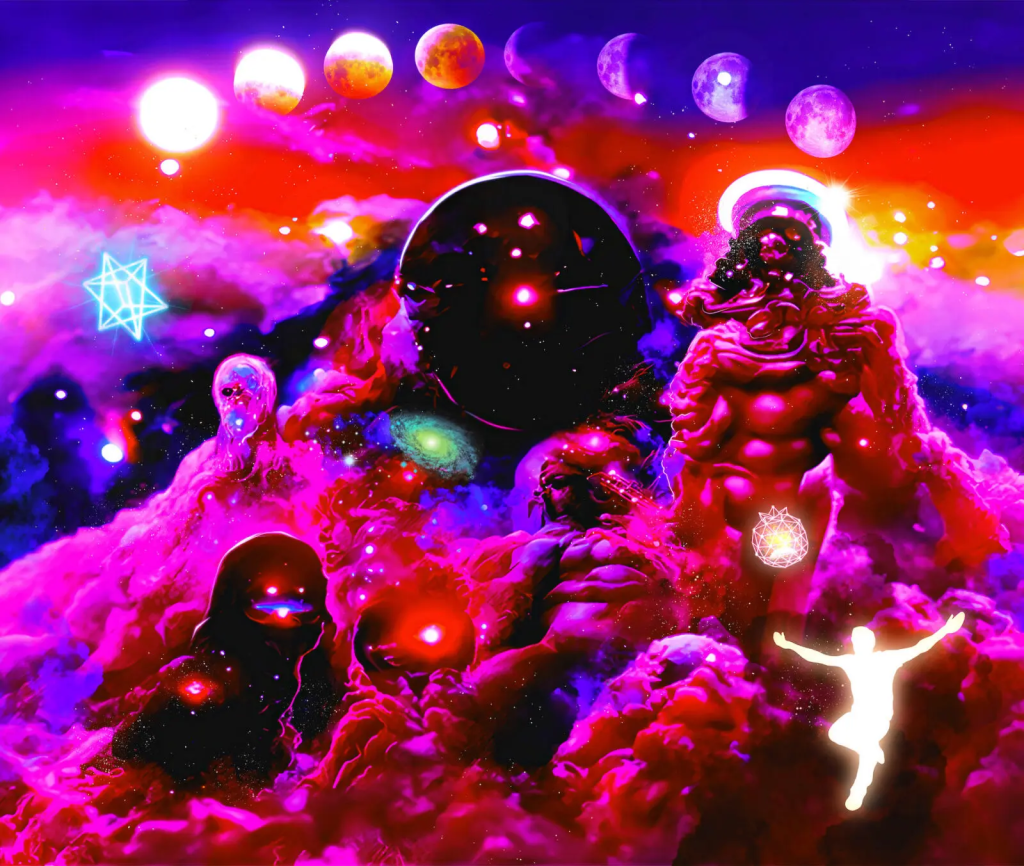
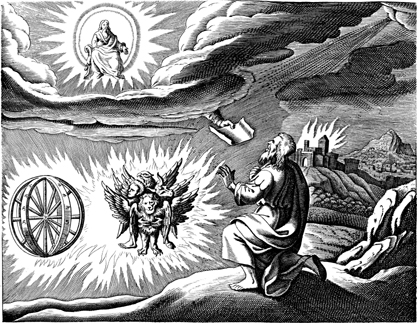
I see this most clearly in a piece that grew out of Ezekiel’s visions of angels. I used my fine‑tuned model to generate non‑angelic, almost alien interpretations of the prophetic descriptions and then collaged them into a single spiritual mass, a kind of living landscape of eyes, light, and motion (“Jewish Futurism”).
Communing with the angels., Collage of human and AI generated elements. Mike Wirth 2022
The glowing figure in the foreground is my own silhouette, walking and dancing through that terrain like a meditative avatar. The AI outputs gave me dozens of unsettling textures, but the real work was deciding which fragments felt true to the terror and beauty of Ezekiel’s language and which were just spectacle.
Another work explores the myth of the Sambatyon river, said to rage six days a week and rest only on Shabbat. For that piece, I fine‑tuned Stable Diffusion on my existing style and then asked it for impossible rivers: streams of light, shattered planets, and planetary eyes that watched the water (“Jewish Futurism”). I layered those textures with hand‑painted elements to create a scene where a lone human figure stands at the edge of a cosmic torrent that briefly calms. The model could hallucinate a thousand strange rivers, but only a human choice could decide which one carried the emotional weight of a world that is always almost at rest and never quite there.
Readiness Before Revelation: The Sar HaTorah Framework
The Zohar’s parable of the Sar HaTorah, the angelic teacher summoned by a rabbi for instant wisdom, warns that revelation demands readiness (Zohar, Introduction). The rabbi gains divine knowledge but nearly dies from overload. The story is not opposed to knowledge. It is about integration.
This tale offers a design ethic for AI. The Sar HaTorah Framework structures engagement in three stages:
Hachanah (Preparation): set intention, purify data, and ask why we are creating.
Hishtatfut (Participation): collaborate consciously with the machine, using its speed and scale while maintaining human authorship, accountability, and empathy.
Teshuvah (Reflection): review consequences, biases, and impacts; take responsibility for harms and repair what was overlooked.
In the classroom, this often looks like taking a breath before anyone opens a laptop, naming aloud what we hope the tool will help us do, and agreeing on red lines for its use (Freeman and Mayse). After a project, it means debriefing not just the final image or app, but the process and its ethical ripples.
Approached this way, AI becomes not a shortcut to wisdom but a partner in its disciplined pursuit. It enacts a metamodern humility in which we build with awe and awareness at the same time.
Hiddur Olam: Beautifying and Repairing
Hiddur Olam, “to beautify the world,” fuses Hiddur Mitzvah (beautifying ritual) with Tikkun Olam (repairing the world). It reframes creativity itself as spiritual service and as a design system where beauty and ethics co‑produce meaning (Wirth, “Hiddur Olam”).
Rooted in Dewey’s experiential learning, Kolb’s learning cycle, and Mussar’s ethical traits (Dewey; Kolb; Wirth, “Hiddur Olam”), Hiddur Olam unfolds in six stages: Study, Envision, Ground, Co‑Create, Reflect, and Carry Forward. When joined with AI, it turns technology into sacred process:
Study: AI can surface patterns across commentary and reveal connections that human readers might miss (“Torah Study and the Digital Revolution”).
Envision: it can visualize text, sound, and symbolism and map Torah as a constellation of interlinked ideas (“Torah Study and the Digital Revolution”).
Ground: it can prompt ethical reflection by modeling dilemmas, bias, or moral consequences (“Judaism and AI Design Ethics Part 1”).
Co‑Create: it can amplify creative collaboration and scaffold group art or music rooted in Torah themes (Adat Ari El).
Reflect: it can archive process transparently and support cheshbon hanefesh, or ethical accounting.
Carry Forward: it can translate insights into accessible formats such as AR, VR, and multiple languages and expand the covenant of learning (Prizmah).
Over the past few years, I have been testing Hiddur Olam through a multi‑volume art book project on the Torah portions, beginning with Bereshit (“Hiddur Olam”). I created one image for each parasha, always starting from a single word, line, or moment in the text that echoed something I recognized from creative life. A character’s hesitation might become a blurred stroke; a moment of cosmic expansion might turn into layered spheres and ripples of color. Sometimes I used AI for ideation or textures, often running newer versions of my own trained model, and then refining by hand until the image felt like an honest parallel to both the Torah story and the inner drama of making anything at all (Wirth, “Spiritual Creativity”). Sharing these works with students and communities has turned the cycle itself into a practice, where the art becomes a mirror for their own struggles with beginning, failing, revising, and starting again.
Each use becomes holy when guided by middot: kavannah (intention), emet (transparency), tzedek (justice), hiddur (beauty), and teshuvah (reflection) (“A Jewish Theological Perspective on Technology”). Hiddur Olam transforms design into devotion and code into covenant (Wirth, “Hiddur Olam”).
Taken together, the Sar HaTorah stages and Hiddur Olam’s six steps form a kind of Jewish Design Thinking cycle. It begins with study and intention, moves through collaborative making, and returns in reflection and repair. This is not generic human‑centered design. It is mitzvah‑centered and community‑centered design, measured by tzedek, emet, and hiddur rather than by engagement metrics alone (Prizmah; Adat Ari El).
Creative Practice as Torah
In the classroom and studio, creative collaboration becomes a form of Torah she’bema’aseh, Torah of action. When communities co‑paint a mural, code a generative landscape, or build an interactive ritual, they perform theology (Jewish Creative Sensibilities).
One workshop on Shabbat and technology at Providence Country Day stays with me. I asked the Jewish students club to design speculative Shabbat devices that would honor the spirit of rest, with one constraint: each idea had to use AI as an ingredient, not a loophole. Their first concepts included a “pre‑Shabbat planner,” an AI that would work only during the week to help organize meals, divrei Torah sources, and guest logistics so that by candle‑lighting every screen could shut down and people could actually exhale into the day of rest. Another group sketched a “story seed” tool that would generate just the first paragraph of a midrashic bedtime tale from a few spoken prompts, leaving the rest of the story to be finished aloud at the table without any devices. As they presented, the students argued, like a pop‑up beit midrash, about which designs genuinely deepened Shabbat and which quietly pulled them back toward constant convenience. The room shifted when one quiet student finally said, “Maybe the most Jewish thing AI can do on Shabbat is remind us to stop using it,” and everyone recognized that their “coolest” ideas were often the ones that erased the need to slow down at all. That shared moment of realization, more than any prototype, was the Torah we made together.
AI enhances this work when it supports, rather than replaces, human imagination:
It can model interpretive possibilities and expand midrashic dialogue (Freeman and Mayse).
It can generate interactive visualizations of text structure and help learners see commentary as relational networks (“Torah Study and the Digital Revolution”).
It can simulate moral scenarios and invite learners to wrestle with empathy in digital form (“A.I., Halakhic Decision Making”).
In these settings, authority dissolves into participation. Knowledge becomes co‑created, ethical, and embodied (Jewish Creative Sensibilities). This is a powerful expression of metamodern faith that is sincere, self‑aware, and alive to paradox.
Judaism Answering Itself
Judaism has always been metamodern. It believes and doubts at once, reveres and revises, and guards and reinvents (Scholem 1–10). Its survival has never depended on static answers but on the courage to redesign its questions.
AI now becomes the next instrument of that redesign. It allows us to test what covenant means in a world of mirrors. It can trace interpretive lineages across millennia, simulate voices of rabbis and philosophers, or visualize the evolution of a single idea through time (“Torah Study and the Digital Revolution”; “A Jewish Theological Perspective on Technology”).
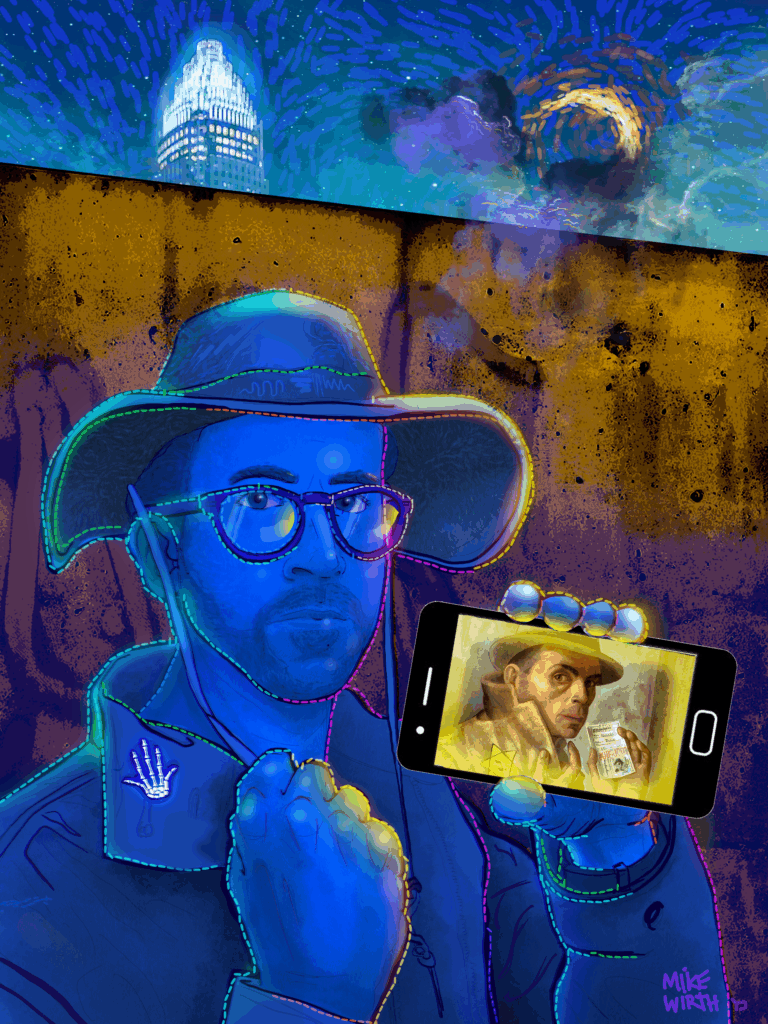
Jewish futurism will not succeed on imagination alone. It needs Jewish Design Thinking, a disciplined way to dream, build, and then review our creations against tikkun olam, emet, and kavannah before we release them into the world (Prizmah; Adat Ari El). My Jewish futurism projects, from neon speculative self‑portraits to AI‑integrated ritual prototypes, are small attempts to practice this in public (“Jewish futurism”; Wirth, “Spiritual Creativity”). They are betas for a future Judaism in which our tools are strange and luminous, but our commitments to repair and responsibility remain non‑negotiable.
AI cannot choose why we study, create, or repair. That remains human work. The Sar HaTorah teaches readiness, and Hiddur Olam teaches responsibility. Together, they suggest a metamodern theology of technology that is reverent, experimental, ethical, and open‑ended (“A Jewish Theological Perspective on Technology”).
Works Cited
Adat Ari El. “The Intersection of Design Thinking and Jewish Education.” Adat Ari El, 29 July 2025.
Benjamin, Walter. “The Work of Art in the Age of Mechanical Reproduction.” Illuminations, translated by Harry Zohn, Schocken, 1969, pp. 217–51.
Borges, Jorge Luis. “The Library of Babel.” Labyrinths, New Directions, 1964.
Brown, Tim. Change by Design: How Design Thinking Transforms Organizations and Inspires Innovation. Harper Business, 2009.
Dewey, John. Experience and Education. Kappa Delta Pi, 1938.
“AI Meets Halachah.” Jewish Action, 7 June 2023.
“Artificial Intelligence and Us.” jewishideas.org.
Freeman, Molly, and Ariel Mayse. “AI and Judaism.” New Lehrhaus, 2024.
Grossman, Guy. “Jewish Perspectives on Artificial Intelligence and Synthetic Biology.” Hakirah, vol. 35, 2023.
Jewish Creative Sensibilities: Framing a New Aspiration for Jewish Education. The Lippman Kanfer Foundation, 2019.
Kaplan, Mordecai. “Religion of Human Techno‑Genesis.” Jewish Philosophy Place, 2014.
Kol HaMevaser. “Elu Va‑Elu Divrei Elohim Hayyim and the Question of Multiple Truths.” 2015.
Kolb, David. Experiential Learning: Experience as the Source of Learning and Development. Prentice Hall, 1984.
Kurzweil, Ray. The Age of Spiritual Machines. Penguin, 1999.
Manovich, Lev. The Language of New Media. MITPress, 2001.
“Not in Heaven: The Major Challenge to Artificial Halakhic Decisions.” Times of Israel Blogs, 2025.
Prizmah. “Design Thinking for Jewish Day Schools.” Prizmah Center for Jewish Day Schools, 2019.
Sacks, Jonathan. “Argument for the Sake of Heaven.” Covenant & Conversation, The Rabbi Sacks Legacy, 19 June 2022.
Scholem, Gershom. Major Trends in Jewish Mysticism. Schocken, 1941.
“Sefaria: A Living Library of Jewish Texts.” Sefaria.org.
“Torah Study and the Digital Revolution: A Glimpse of the Future.” The Lehrhaus, 28 Jan. 2020.
Vermeulen, Timotheus, and Robin van den Akker. “Notes on Metamodernism.” Journal of Aesthetics & Culture, vol. 2, no. 1, 2010.
Wirth, Mike. “Hiddur Olam: Creativity, Community, and the Future of Religious Education.” 2024.
Images included are used solely for commentary and academic analysis under fair use provisions of U.S. copyright law.
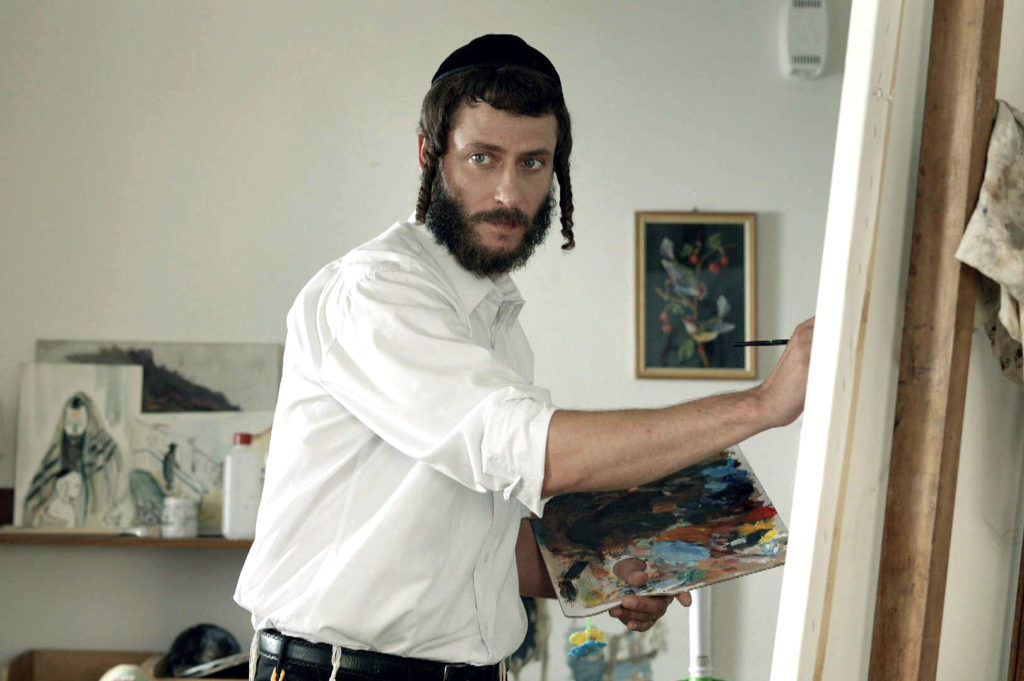
During the first year of the pandemic in 2020, a friend recommended I read My Name Is Asher Lev. We had just finished watching Shtisel, the Israeli drama about a Haredi family in Jerusalem. Akiva, the show’s painter protagonist, is gentle, passionate, and deeply conflicted between his community’s expectations and his need to create (Lyons; Mazria Katz; “The Art and Politics of Desire”). His journey is like Asher Lev’s and raises a still-vital question, what makes art Jewish?
Promotional still from Shtisel. Copyright Yes TV. Used for academic commentary.
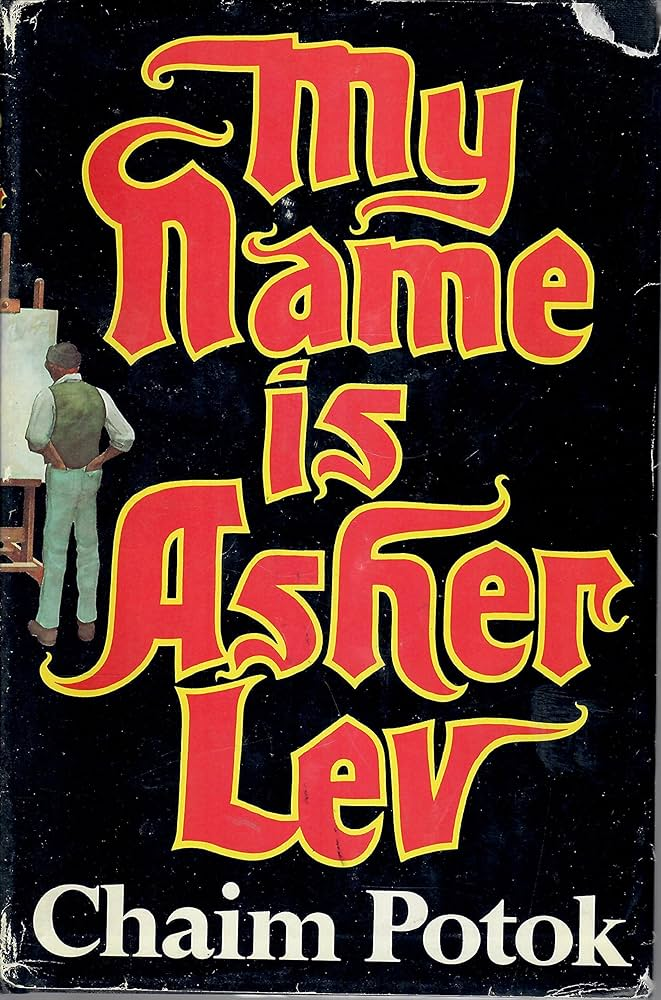
Our connection of Asher Lev to Shtisel illuminated an ongoing continuum of reinvention in Jewish storytelling and ritual. Originally a novel, Asher Lev’s journey was adapted for the stage by playwright Aaron Posner, premiering at the Arden Theatre Company in 2012 and later finding success Off-Broadway, where it won several awards including the Outer Critics Circle Award for Outstanding New Off-Broadway Play (“My Name Is Asher Lev – Dramatists”; Broadway.com; Fountain Theatre). The adaptation brings Potok’s exploration of art, faith, and family into the lived immediacy of theater, allowing new audiences to encounter and interpret these questions on their own terms. In this way, Asher Lev’s/Akiva’s conflict with tradition, creativity, and communal belonging, continues to inspire and reshape Jewish art in every new medium.
Cover of My Name Is Asher Lev. Copyright Anchor Books, 2003. Used here under fair use for purposes of scholarly analysis.
Reading Asher Lev reframed the question for me. Both Akiva and Asher are artists negotiating communal obligation and personal inspiration, risking nearly everything to remain true to their gifts. Their stories trace a path toward sacred creativity, providing a foundation for what can be called Jewish futurism.
When Chaim Potok published My Name Is Asher Lev, he gave Jewish artists an enduring guide. Potok’s Hasidic protagonist struggles to reconcile tradition and creative drive. As Potok writes, “…an artist is a person first. He is an individual. If there is no person, there is no artist” (My Name Is Asher Lev). This tension between individuality and belonging is a persistent theme in Jewish artistic life. Jewish futurism affirms that Jewish art isn’t fixed in the past; rather, it unfolds with every creative act, no matter the medium.
Potok’s novel contends that creative instinct itself is sacred. Asher paints not out of pride, but from necessity, a need that is intertwined with spiritual purpose. Potok argues, “A life is measured by how it is lived for the sake of heaven” (Potok, Goodreads). For Asher, creative intuition becomes a form of ruach elohim, the divine breath of creation.
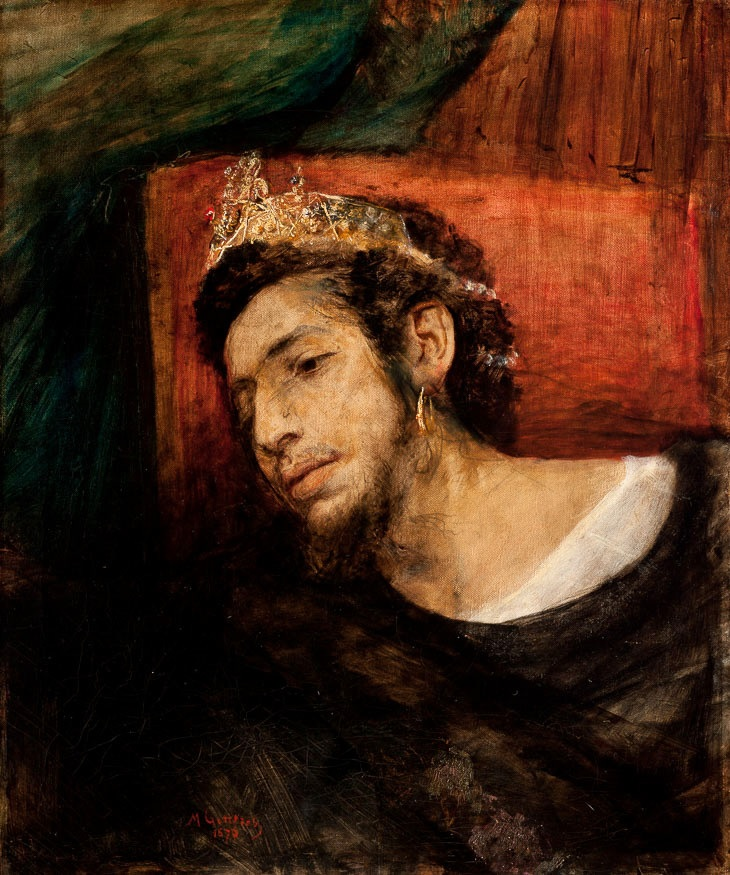
The narrative of Asher Lev is rooted in the idea of Tzelem Elohim, the belief that each person is made in the image of God. When Asher paints The Brooklyn Crucifixion, he is not betraying his Judaism. Instead, he translates personal anguish into communal compassion (SparkNotes; LitCharts). This ability to turn emotion into understanding reflects a hallmark of Jewish artistic practice. Maurycy Gottlieb, the nineteenth-century Jewish painter, struggled in similar ways. His art often explored the tensions between personal identity, Jewish tradition, and the surrounding culture (YIVO Encyclopedia; Culture.pl; Jewish Virtual Library; Brandeis).
Maurycy Gottlieb – Ahasuerus wandering (Self portrait) – 1876, Oil on Canvas. Image is in the Public Domain. Used here under fair use for purposes of scholarly analysis.
Like Asher Lev, Gottlieb faced societal expectations and pressures from family, peers, and the broader Jewish community. He frequently channeled his own pain and longing into works that resonate with empathy and universal dignity (YIVO Encyclopedia; Jewish Virtual Library; Brandeis; Segula Magazine). Their creative journeys illustrate how Jewish artists inspired by the concept of Tzelem Elohim bring individual and collective experience into dialogue, turning private struggles into forms of connection and healing.
Akiva’s journey in Shtisel parallels Asher’s in many ways. He transforms his family and grief into paintings, using creativity as a form of tikkun, or repair (Lyons; Mazria Katz; “The Art and Politics of Desire”). Despite resistance from his world, Akiva, like Asher, brings faith and creativity together, refusing to separate the two.
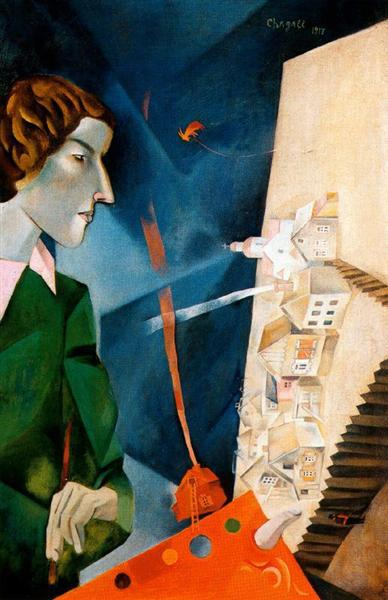
Jewish modernism’s dialogue with tradition is exemplified by Marc Chagall, whose paintings fill modern art with Jewish memory and mysticism. As Chagall observed, “If I create from the heart, nearly everything works; if from the head, almost nothing” (Chagall qtd. in “Analysis of Marc Chagall”; Grad). Chagall’s career models how Jewish creativity can look forward while remaining emotionally and spiritually grounded.
Self portrait with palette 1917, Marc Chagall, Liozna, near Vitebsk, Belarus, Image from source. Used here under fair use for purposes of scholarly analysis.
This same process of transformation is reflected in Potok’s exploration of art’s creative and destabilizing power. “Art is a danger to some people… Picasso used to say, art is subversive,” Potok reminds us (Bookey). In both modern and traditional contexts, Jewish artists risk pushing boundaries in order to offer new interpretations of spiritual experience.
Jewish spiritual practice teaches that every action gains significance through intention, or kavanah. Potok mirrors this sentiment: “Creativity, self-expression, and truth…emerge from honesty about oneself” (LitCharts). Jewish futurists apply this mindset to every new creative medium, continually asking if their work reveals more goodness and light.
Today, artists like Deborah Kass and Archie Rand carry these values forward as Jewish artists fully integrated into the mainstream art world. Kass’s OY/YO at the Brooklyn Museum and Rand’s The 613both embody the creative tension between reverence and innovation (Brooklyn Museum; Rand).
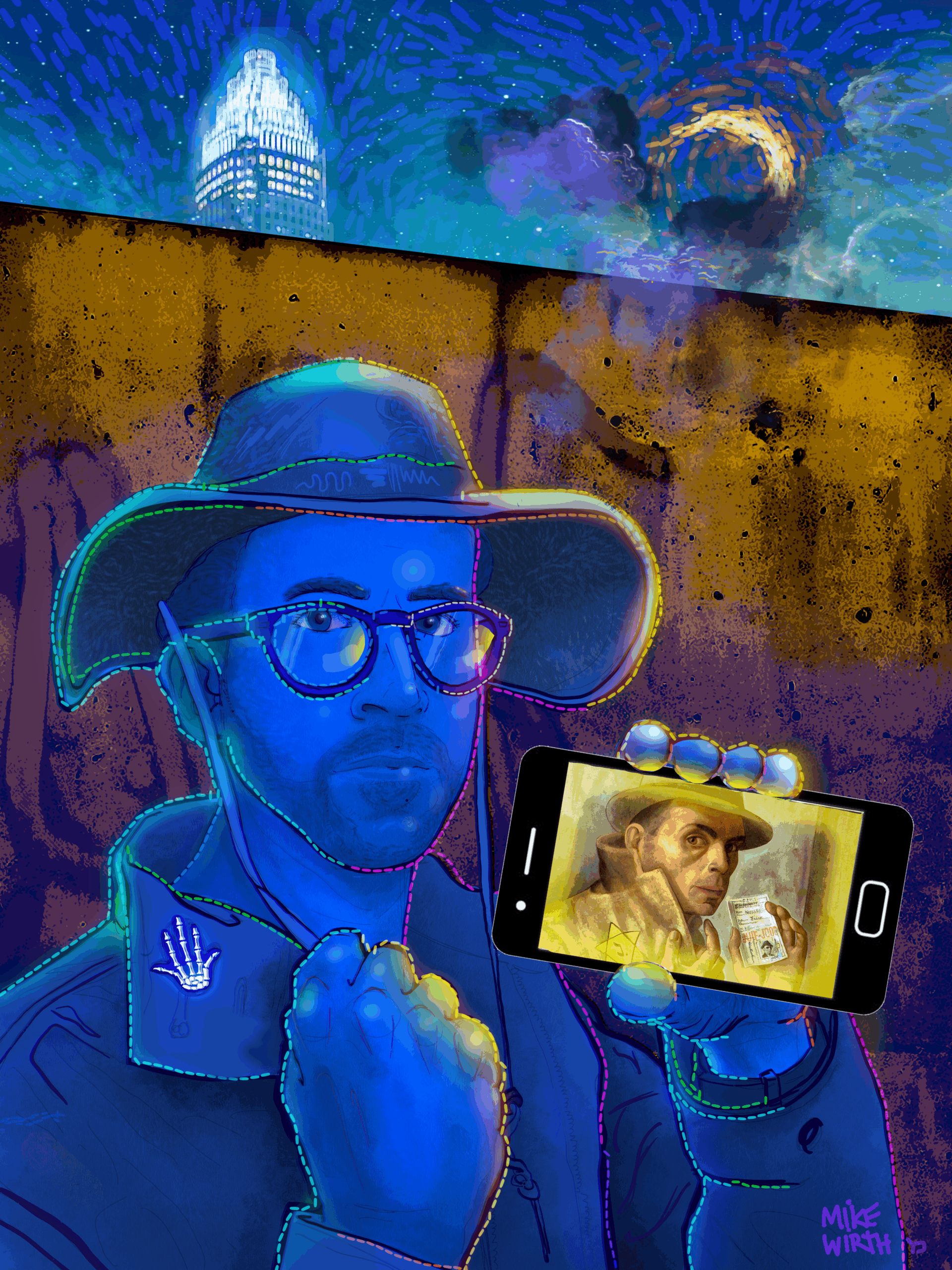
Silent Remembrance (self-portrait), 2024, Mike Wirth, Digital Illustration. Image property of artist.
My own contemporary Jewish work was inspired by these characters. In my digital illustration piece, Silent Remembrance, I restaged a self portrait by Felix Nussbaum, a Jewish-German painter who perished in the Shoah (Holocaust).
All of our artwork is apart of a has a legacy and reaffirms the idea that beauty and sacredness can and should coexist.
The journeys of Asher Lev (page and stage), Akiva from Shtisel, Maurycy Gottlieb, Marc Chagall, and many Jewish contemporary creatives illuminate a vibrant continuum of Jewish artists who, across generations and media, confront the tension between personal inspiration and communal tradition (Morinis; Segula Magazine; YIVO Encyclopedia; SparkNotes; LitCharts; Wullschlager). Each pursues the middah of emet (truth), striving for honesty and authenticity in their creative practice, even when this honesty leads to conflict or alienation within their communities. Asher paints his deepest truths, Akiva wrestles to honor his art within the constraints of Jerusalem’s Haredi world, Gottlieb channels his longing for acceptance and identity into portraits and biblical scenes, and Chagall infuses his canvases with heartfelt reverence, mystical memory, and universal feeling (Grad; Art Prodigy Blog).
Along the way, each artist embodies anavah (humility), recognizing their role as a vessel for creativity, and rachamim (compassion), using their gifts to turn personal struggle and sorrow into works of empathy and communal connection. Their creative processes mirror the stages of Mussar: deep self-examination, engagement with inner and outer conflict, risking rejection or misunderstanding, and ultimately returning to offer artistic repair, tikkun, to their communities and to Jewish tradition itself (Morinis; Mussar Institute; Ritualwell; My Jewish Learning).
Through these acts of creative repair and ethical growth, their art becomes a conduit for goodness and revelation. Their stories remind us that Jewish artistic futurism is not static but unfolds wherever artists grapple honestly, humbly, and compassionately with the tensions of their lives. Revelation and healing do not end in moments of exile or struggle; rather, they continue through every artist who brings fresh insight and loving repair to their people.
If you’ve not read My Name is Asher Lev, watched Shtisel, or viewed Gottlieb’s work, I highly recommend all three. I’m excited to see the stage production, myself. I hope you find kindred souls in these stories, like I have.
When I teach Design history courses, my students love how similar events, people and milestones are neatly packaged into movements and eras with interesting names, usually with an “ism” thrown in for good measure. One of our favorite thinking exercises is to try and apply a movement or era name to the art happening today. We mostly think of Frankenstein-like names, following the contemporary trend of making combinations of specific cultural groups, places, with older movement names. Like Jewish and futurism, we learned that every movement has its ancestors, both good and bad, even if they didn’t call themselves by the same name. I can say that as teacher and artist in this story, the feeling of placing oneself into the continuum of creative history is inspirational and revealing of purpose.
Before “Jewish futurism” was a modern phrase, there were lowercase “f” futurists in Biblical prophets, medieval mystics, modern artists, inventors, and one rejected capital “F”, Futurist (Italian), who for better for for worse, all had dreams with variegated mixtures of optimism and pessimism of the world ahead. Jews who were in awe of speed, energy, and light- imagined boldly and used creativity to repair what was they saw as broken in their time. They were asking the same or similar futurist questions we ask now, but with varying intentions:How do we sanctify technology? How do we balance innovation with ethics? How can art and design deepen our connection to our values rather than distract from it?
But unlike other futurist movements, Jews were rarely gathered under one banner. In the eighteenth through twentieth centuries, they were often distributed participants within the world’s avant-garde movements.
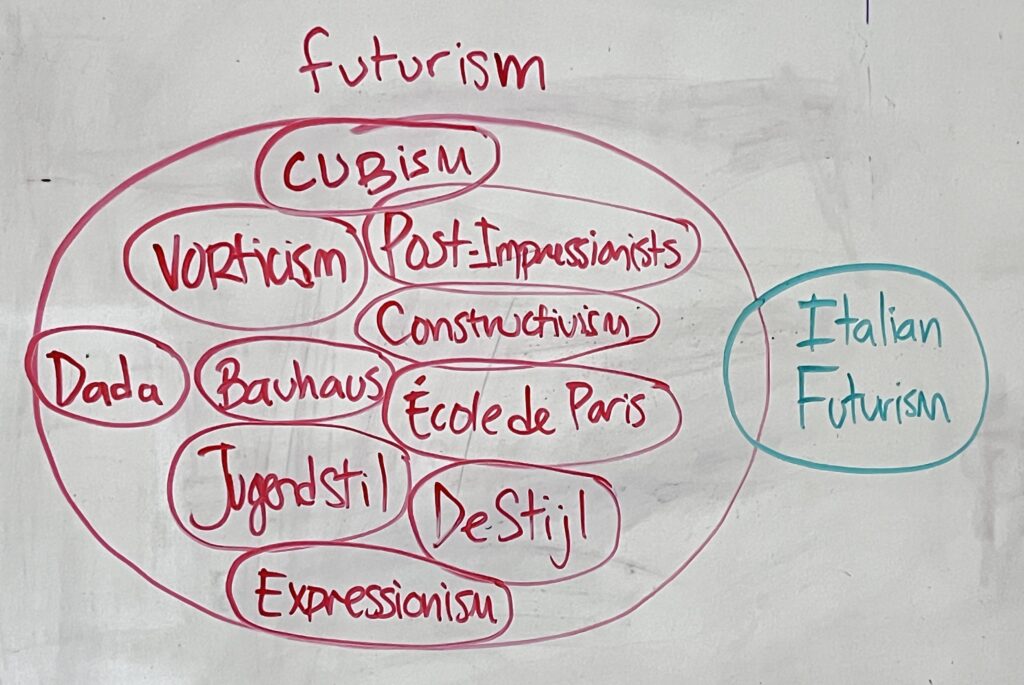
Photo of futurism vs Futurism notes on whiteboard 2018, Queens University of Charlotte, Photo by Mike Wirth
They were scattered across modernism, abstraction, and science fiction. Jewish artists and thinkers helped define of futurist leaning movements like Cubism, Vorticism, Constructivism, Art Nouveau (Jugendstil), the Bauhaus, comics, science, cinema, and technology, yet they entered these movements as outsiders, navigating exile, assimilation, and the tension between belonging and vision.
In contrast, Jewish futurism, then, is a reunion of that diaspora. It’s a collective recognition that Jewish creativity has always been dispersed, but futurist. Our task now is to connect those remote sparks into a shared constellation.
Jewish futurism, as I understand it, isn’t about breaking from tradition, it’s about revealing the through line of Torah, design, and imagination. The real work is to dialogue with this evolution together. Our ancestors did it through parchment, pigment, and print. We do it through pixels, algorithms, and immersive light.
This essay is an attempt to trace that lineage by identifying the people and moments, ancient and modern, that carried the qualities of Jewish futurism before we had words for it.
2. Prophets and Visionaries: The First Jewish Futurists
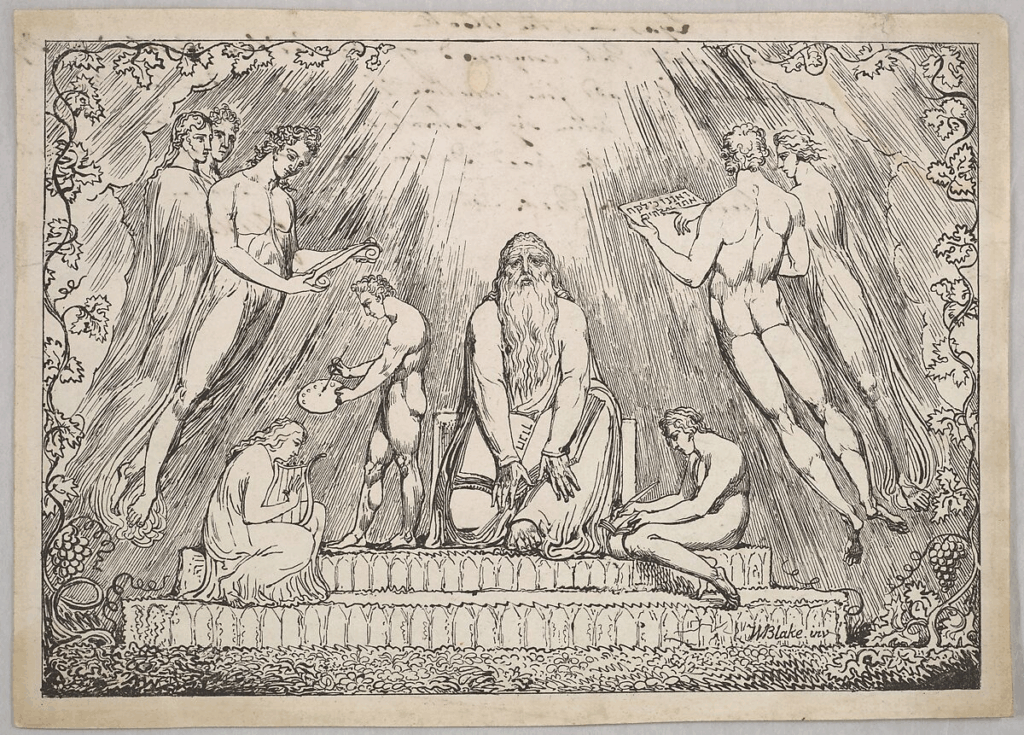
The Jewish imagination has always been forward-looking and possessed the virtues of futurist thought. Many stories in the Torah show characters facing grave challenges who reluctantly, yet diligently, press onward toward many future promises. Isaiah dreamed of a world where swords would become plowshares (Isaiah 2:4), reimagining technology as an instrument of peace rather than domination. The non-canonical, Book of Enoch envisioned the celestial ascent of a very minor Torah character, an early meditation on transformation and transcendence.
Enoch 1806-7, William Blake, Via Wikimedia Commons
These were not myths of escape but frameworks for moral invention and prototypes of a better world.
The Torah itself ends in anticipation when Moses glimpses the Promised Land but never enters. The Jewish story begins by looking at the horizon toward a promise deferred, yet always pursued. That restless hope is also in the DNA of Jewish Futurism.
3. “Next Year in Jerusalem”: Our First Futurist Statement
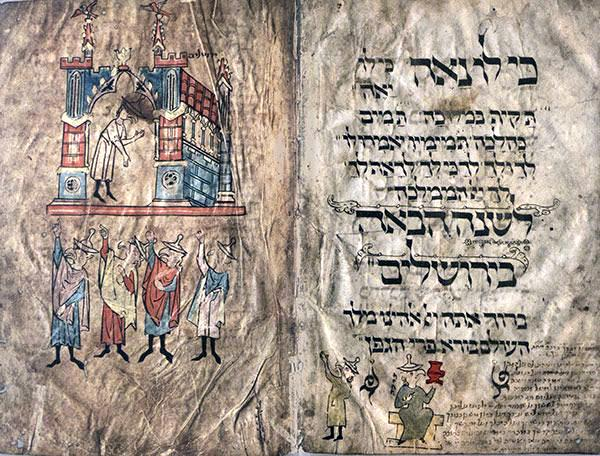
The phrase L’shanah haba’ah b’Yerushalayim, Next year in Jerusalem, has always been the ultimate Jewish futurist phrase. It is both prayer and design challenge. It asks: what will it take, ethically and creatively, to build the world where that hope becomes real?
“Next Year in Jerusalem” translated from Hebrew, Birds’ Head Haggadah, 1296 Image via Sefaria
Jerusalem is not only a city but a symbol of the convergence of heaven and earth, ethics and aesthetics, faith and form. Every Jewish generation has tried to construct its own version of it. Jewish Futurism is our turn to do the same, using the tools and technologies of our age to reimagine what Jerusalem might mean tomorrow.
4. Mystics, Makers, and the Ethics of Revelation
Centuries later, the mystics of the Zohar built the first great Jewish model of complexity. Attributed to Rabbi Shimon bar Yochai, the Zohar describes creation as a system of divine emanations, the Sefirot, a network of energy, feedback, and interdependence that sounds remarkably like a precursor to modern systems or network theory.
An even earlier mystical text, the Hekhalot Rabbati, contains the story of the Sar HaTorah, the “Prince of Torah.” In it, a rabbi summons an angelic teacher to grant him instant divine wisdom. The revelation overwhelms him beyond capacity, leaving him nearly destroyed. The angel warns that knowledge received without readiness shatters the vessel. This is not a warning against study, but a parable about integration, teaching that divine insight requires ethical preparation, humility, and spiritual maturity.
This early mystical story prefigures a central idea of Jewish Futurism: revelation without discipline leads to collapse. Innovation, like wisdom, must be tempered by moral structure.
A few centuries later, in Safed, Isaac Luria (the Arizal) and his circle extended that vision, transforming cosmic trauma into design theology. Their concept of Tikkun Olam, repairing the world, framed healing not as an abstract ideal but as an iterative process of creation and refinement. The Kabbalists turned Divine catastrophe, the shevirat ha-kelim or shattering of vessels, into a blueprint for human creativity, a call to rebuild with intention.
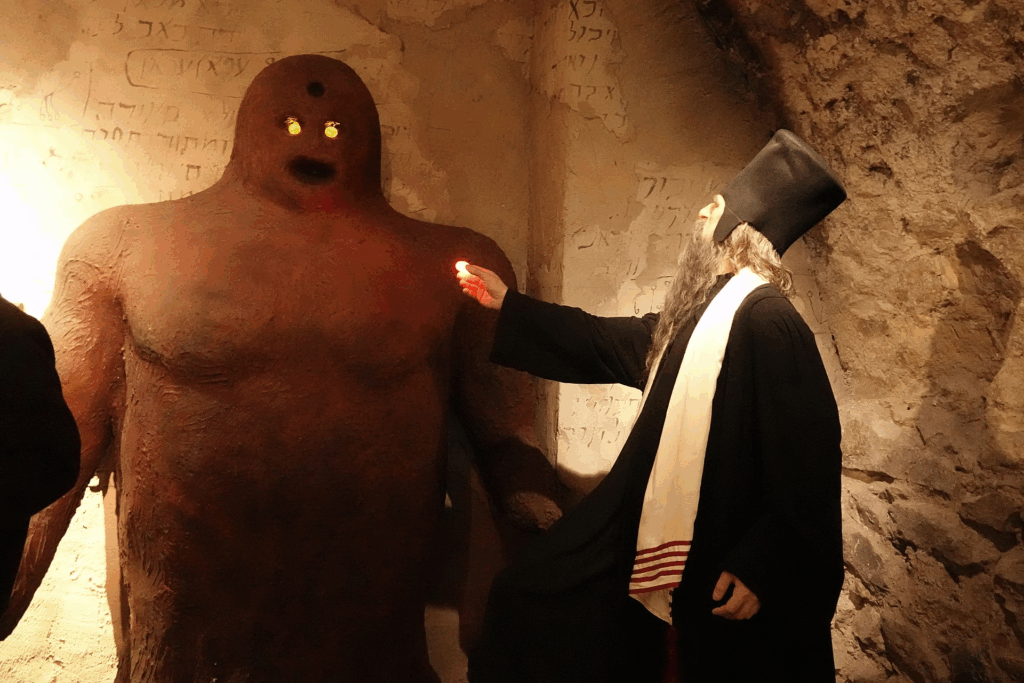
In the same spirit, Rabbi Judah Loew of Prague gave shape to one of Judaism’s most enduring myths of technological creation, the Golem, a being formed from clay and animated through sacred language. The Golem’s body was innovation, its control was halakhah. It remains Judaism’s first meditation on artificial life, automation, and moral limits, what we now call the ethics of technology.
Together, these three sources, the Zohar’s vision of divine networks, the Sar HaTorah’s warning about unintegrated revelation, and the Golem’s lesson in ethical creation, form the foundation of Jewish Futurism. They map the two coordinates that still define our creative practice today: creation as systems design, and ethics as the boundary of holiness.
5. Enlightenment, Utopia, and Early Jewish Design
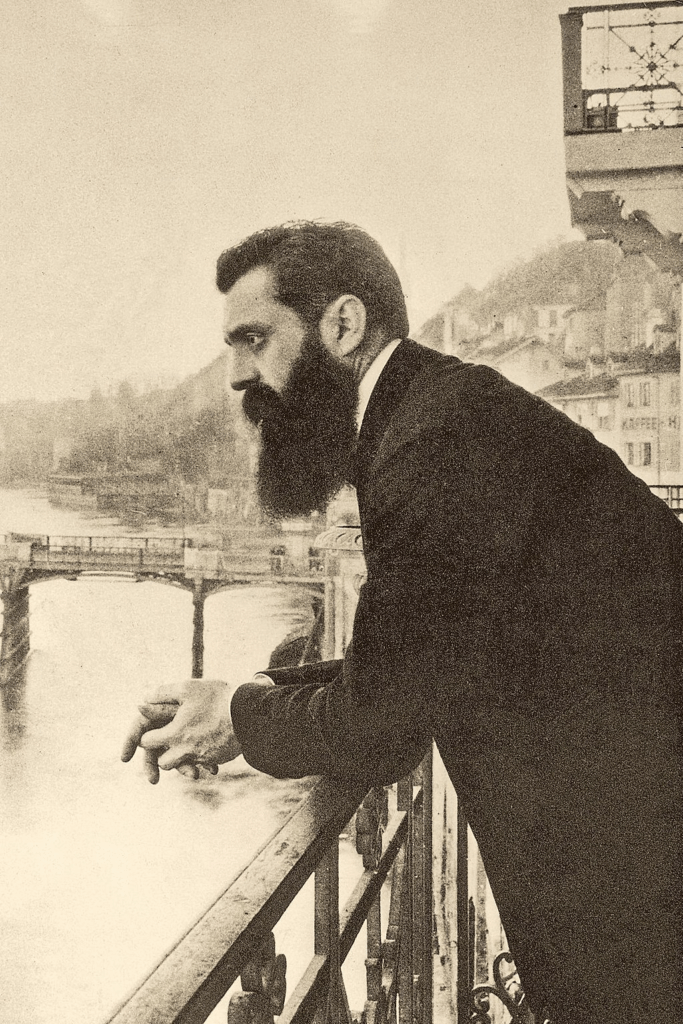
The 19th and early 20th centuries brought the industrial age, and with it, new Jewish imaginings of the future. Theodor Herzl’sAltneuland (1902) offered not just political
Theodor Herzl in Basel, 1901, Photo by EM Lilien via Wikimedia Commons
Zionism but a speculative blueprint of his vision of a technologically advanced society guided by justice. Ephraim Moses Lilien, often called the “first Zionist artist,” translated Herzl’s ideas into visual form, merging Art Nouveau (Jugendstil) beauty with prophetic idealism.
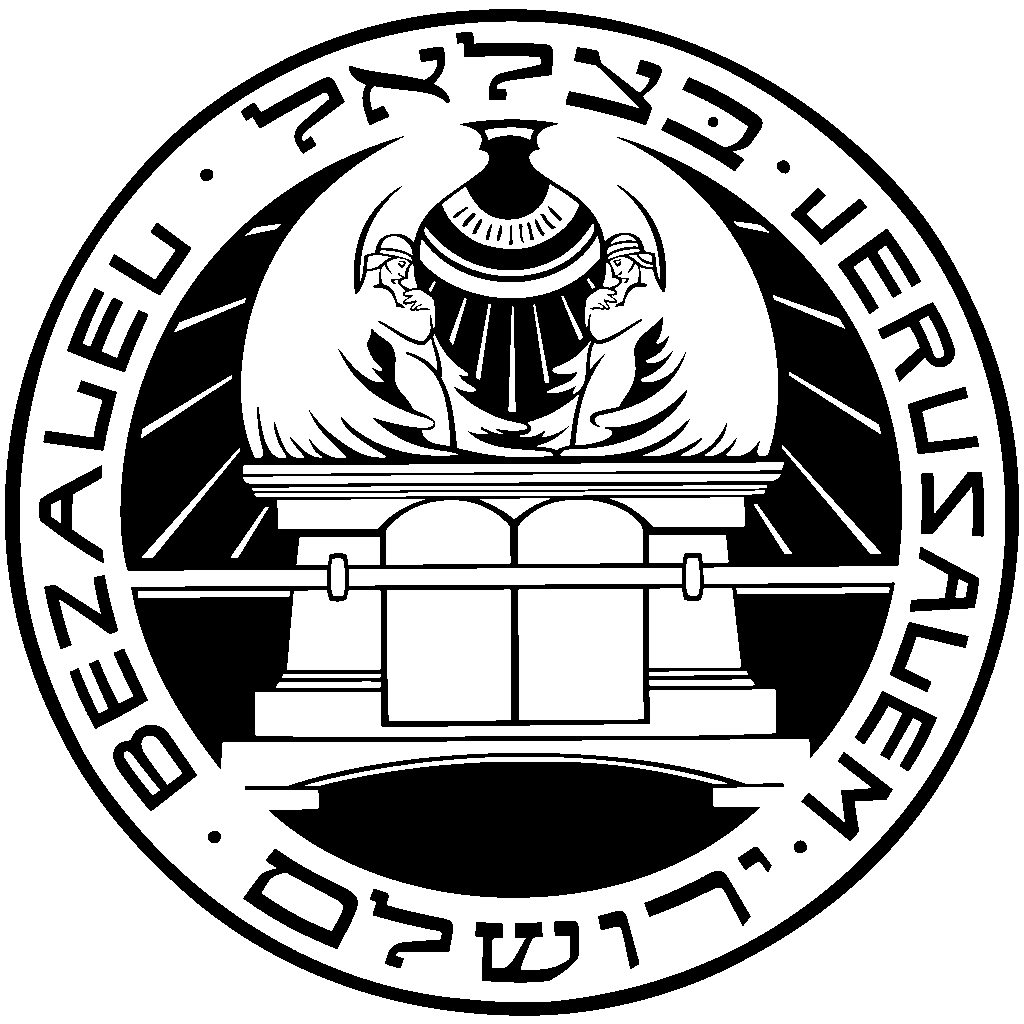
Around the same time during late Ottoman period (1906) and into British Mandate rule, Boris Schatz founded the Bezalel School of Art and Design in Jerusalem.
He believed that Jewish creativity could rebuild both spirit and society and was a major shaper of the Zionist art movement. The school fused European aesthetics, often brought by fleeing Jewish practitioners, with biblical themes, teaching the essence of Hiddur Mitzvah, beautifying the mitzvah.
Logo of The Bezalel School 1906, by EM Lilien. Via Wikimedia Commons
The Bezalel School was the first organized institutional embodiment of Jewish Futurism making art and design as acts of national and spiritual renewal.
1. Futurism vs. futurism: Origins and Overlaps
Futurism (capital F) was first coined as an art movement name by Filippo Tommaso Marinetti in 1909. His Futurist Manifesto, published in Le Figaro, announced a radical social ideology backed by an aesthetic devoted to speed, light, energy, and the mechanical beauty of modern life. Artists such as Umberto Boccioni, Giacomo Balla, and Gino Severini sought to capture motion and power in a new visual language for the twentieth century. Yet as the movement matured, its rhetoric of destruction and renewal fused with Italian nationalism and ultimately fascism, turning artistic innovation into ideology.
One adjacent Jewish figure, Margherita Sarfatti, an art critic and Mussolini’s cultural adviser, championed early Futurist ideals while stressing that art must bridge past and future, not obliterate tradition. When fascism hardened, she was expelled from Italy under the racial laws, exposing Futurism’s fatal contradiction — a vision of progress that devoured its own makers.
By contrast, futurism (lowercase f) describes the broader impulse toward innovation that surfaced across Europe under other names: Vorticism in Britain, Constructivism in Russia, and the Bauhaus in Germany. The same fascination with machines, energy, and new media became, outside Italy, a moral and creative language for modern life.
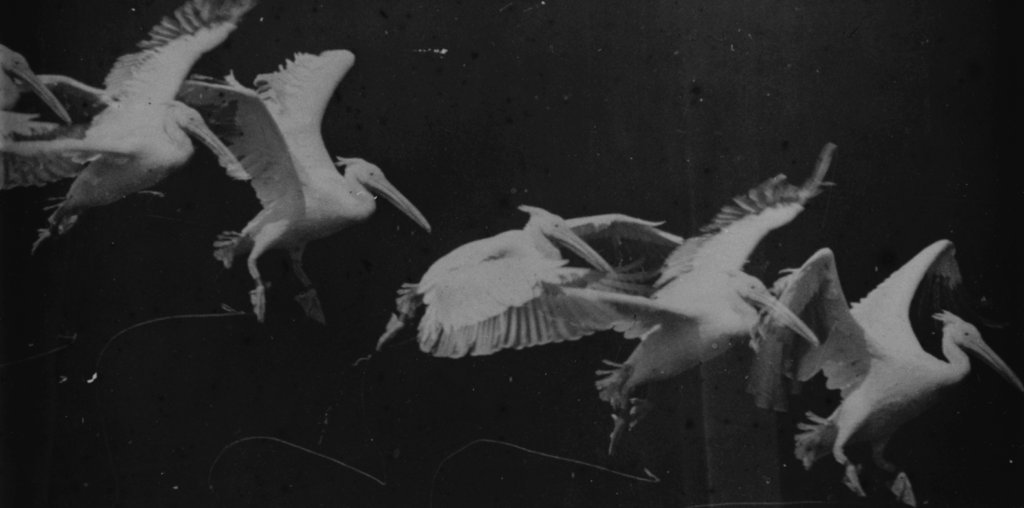
The groundwork for all of these movements was laid by proto-futurists — visionaries who imagined the future before it had a name. Jules Verne and H. G. Wells wrote of flight, electricity, and space travel. Scientists and photographers Étienne-Jules Marey and Eadweard Muybridge dissected motion through sequential imagery.
Photo montage of flying pelican taken by Étienne-Jules Marey 1882, Image is in the Public Domain from source
Philosophers Henri Bergson and Friedrich Nietzsche, along with Symbolist poets, infused culture with ideas of vitality, time flux, and transformation that would animate futurist art decades later.
Although none of these early futurists were Jewish, Jewish innovators shaped the technological world that made Futurism possible.Albert Einstein’s relativity redefined time and space.
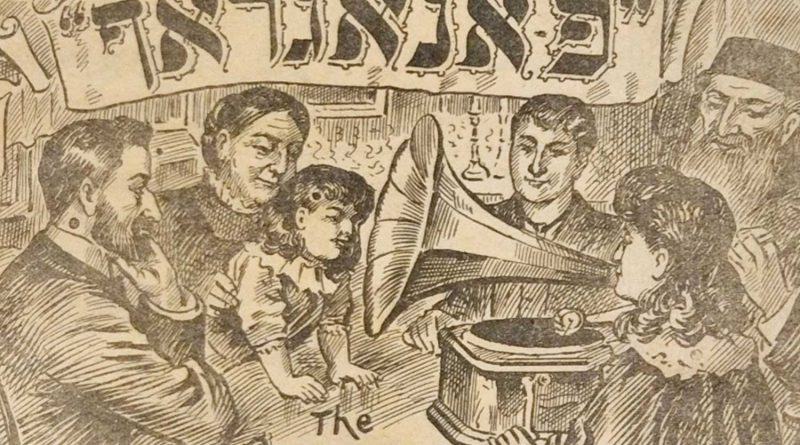
Yiddish language advertisement for Edison’s Phonograph, the competitor of the Gramophone, 1909, Weekly Jewish Bits Newspaper. Image via source
Emil Berliner invented the gramophone making it possible for Jewish sound and oral tradition to be archived and disseminated globally for the first time; Charles Adler Jr. created the traffic-signal system that organized modern cities.
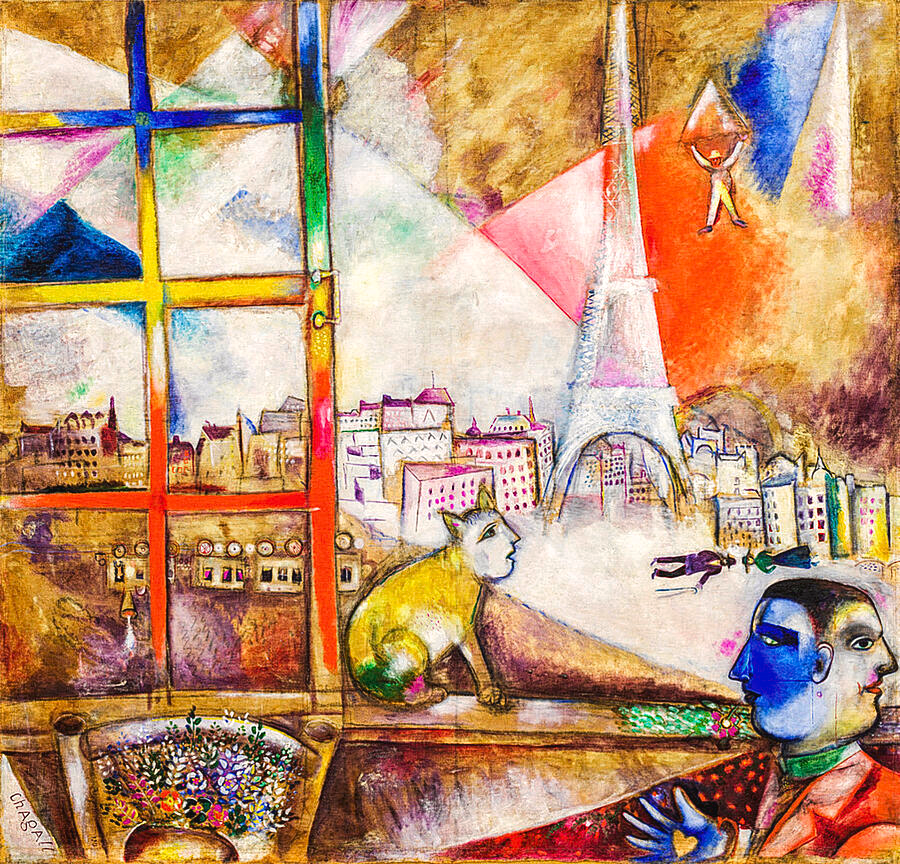
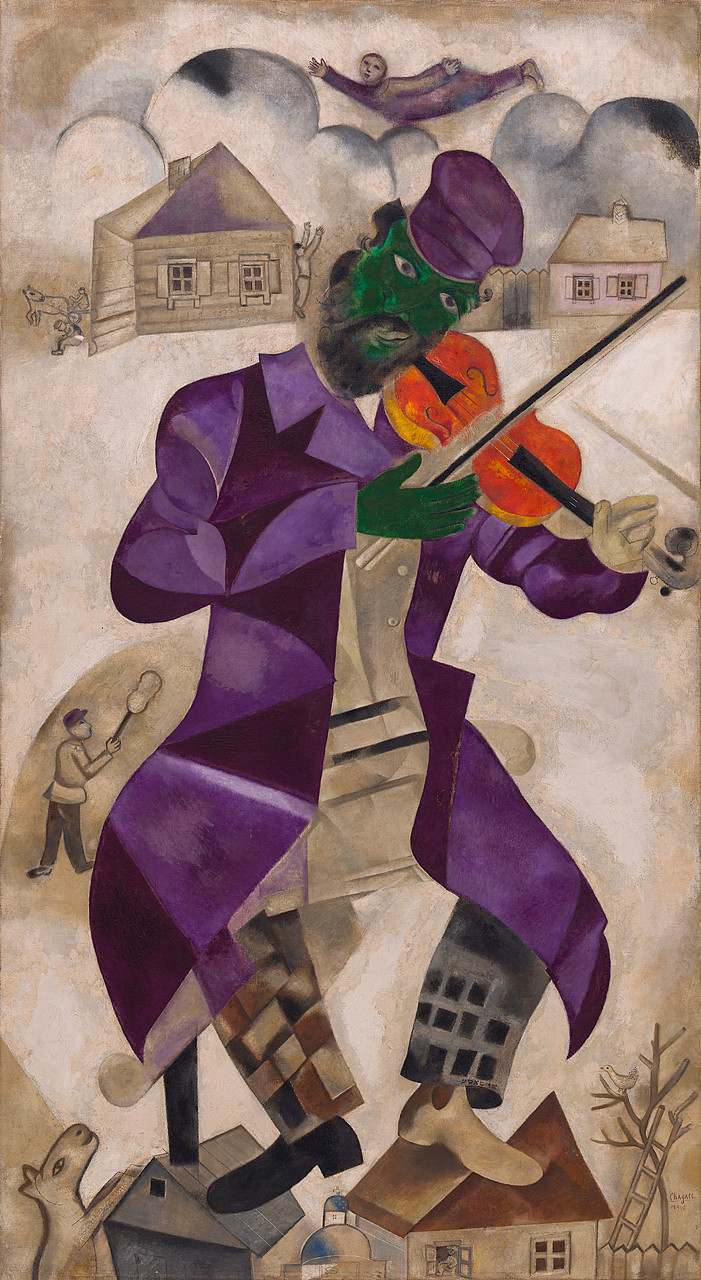
In the arts, Jewish modernists such as Marc Chagall and Jacques Lipchitz extended Cubist abstraction into spiritual allegory, transforming the language of modernism into a vessel for transcendence. Chagall, especially in his Paris period, reimagined futurism not as mechanical speed but as illumination and ascent. I call this mystical futurism. Paintings like Paris Through the Window (1913)
and The Eiffel Tower (1911) shimmer with the chromatic pulse of electric light, fracturing the modern city into simultaneous layers of time, memory, and dream.
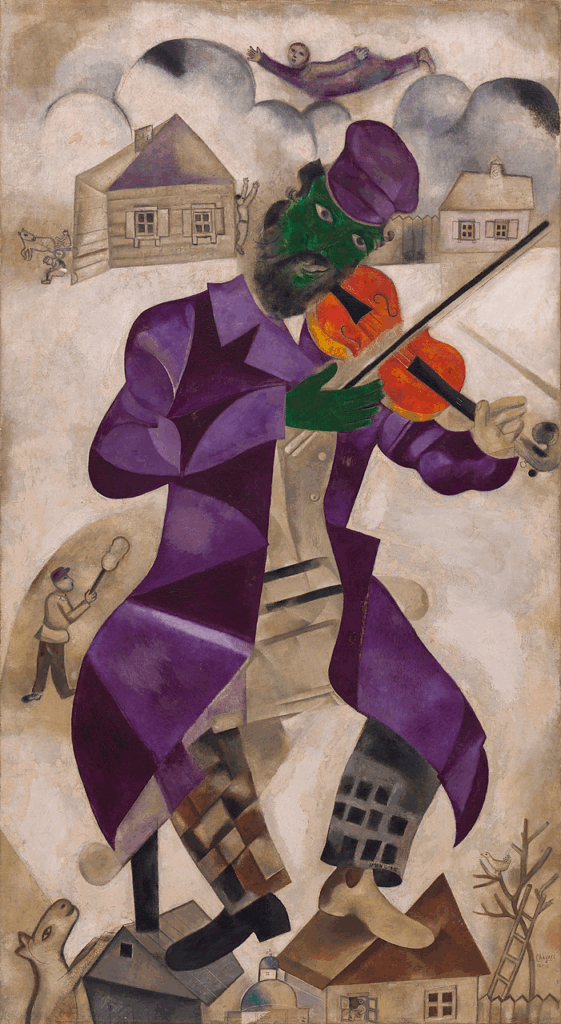
The Green Violinist 1923-24, Marc Chagall, Oil on Canvas, Image in Public domain via source
His Violinist series vibrates with musical energy rendered as color and form, suggesting that sound itself could become a visual current. In Chagall’s hands, the machine age becomes a theater of revelation—modernity recast as a mystical experience of motion, radiance, and spiritual flight.
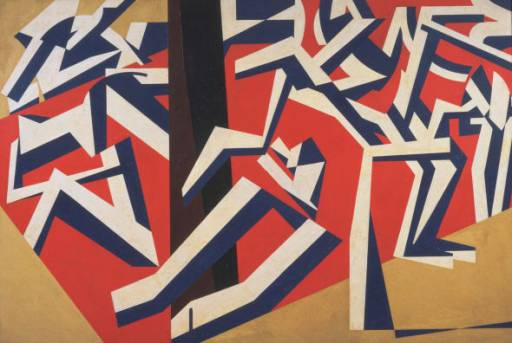
Jacques Lipchitz, working in sculpture, carried this vision into three dimensions. His early Cubist bronzes such as Man with a Guitar (1915) and Flight (1918) dissolve the human form into rhythmic, interlocking planes that seem to oscillate in space. Rather than glorifying machinery, Lipchitz sought to capture the vital energy and inner light of movement itself. Both artists turned Cubism’s structural analysis into a Jewish futurism of rhythm and spirit, where motion was not domination but devotion, and modern form became a bridge between earth and heaven. And in Britain, David Bomberg fused modern geometry with prophetic vision. Bringing a softer humanism to the abstract modernist aesthetics of Vorticism, the UK cousin of Futurism.
The Mud Bath 1914, David Bomberg (1890-1957) oil on canvas. Image in the Public Domain via source
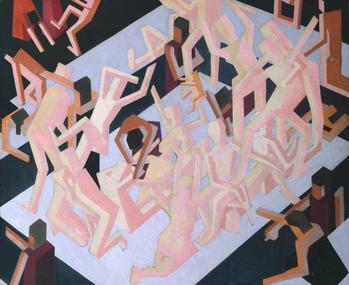
His painting The Mud Bath (1914) exemplifies the mechanical rhythm of Vorticism, while The Vision of Ezekiel (1912) merges machine aesthetics with biblical wonder. For Bomberg, the mechanical and the mystical share a single pulse — creation itself.
Vision of Ezekiel, 1912,David Bomberg, oil on canvas. Tate Gallery.
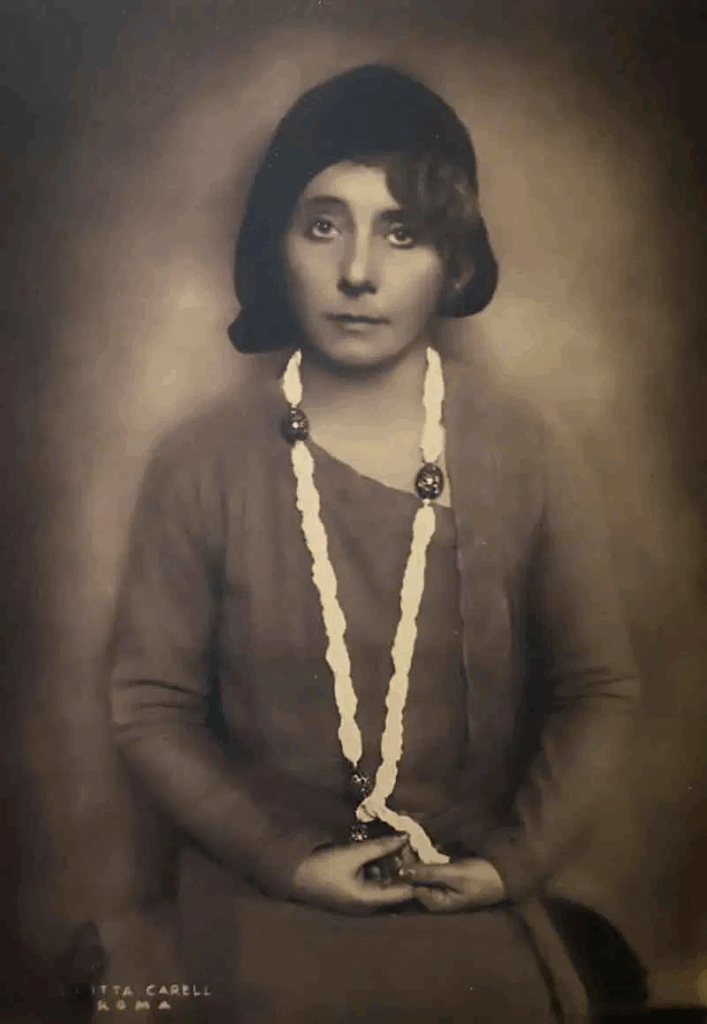
A telling example is Margherita Sarfatti (1880-1961), the only female member associated with the Italian Futurism art and design movement (1909-1944), was Jewish, an art critic and intellectual. She once championed the movement’s early aesthetics of speed and even personally advised Mussolini as well as being his mistress.
While Sarfatti’s writings do not emphasize her Jewish background, they articulate a sustained belief in modernity that is anchored in continuity that art must recall and transform tradition, not demolish it. In her words: “This idea of art as a bridge from past to future aligns with the broader notion of futurism not as mere disruption but thoughtful renewal.”Her reviews and essays would propel the Futurist movement to a national level.
Margherita Sarfatti, (1920s) Photo by Litta Carell Image via source
When fascism hardened in 1938, she was expelled from Italy for being Jewish. Her story encapsulates the fate of many Jewish modernists: contributors to cultural innovation, later rejected by the very movements they helped inspire.
5. Modernism and the Avant-Garde: Lissitzky to the Bauhaus
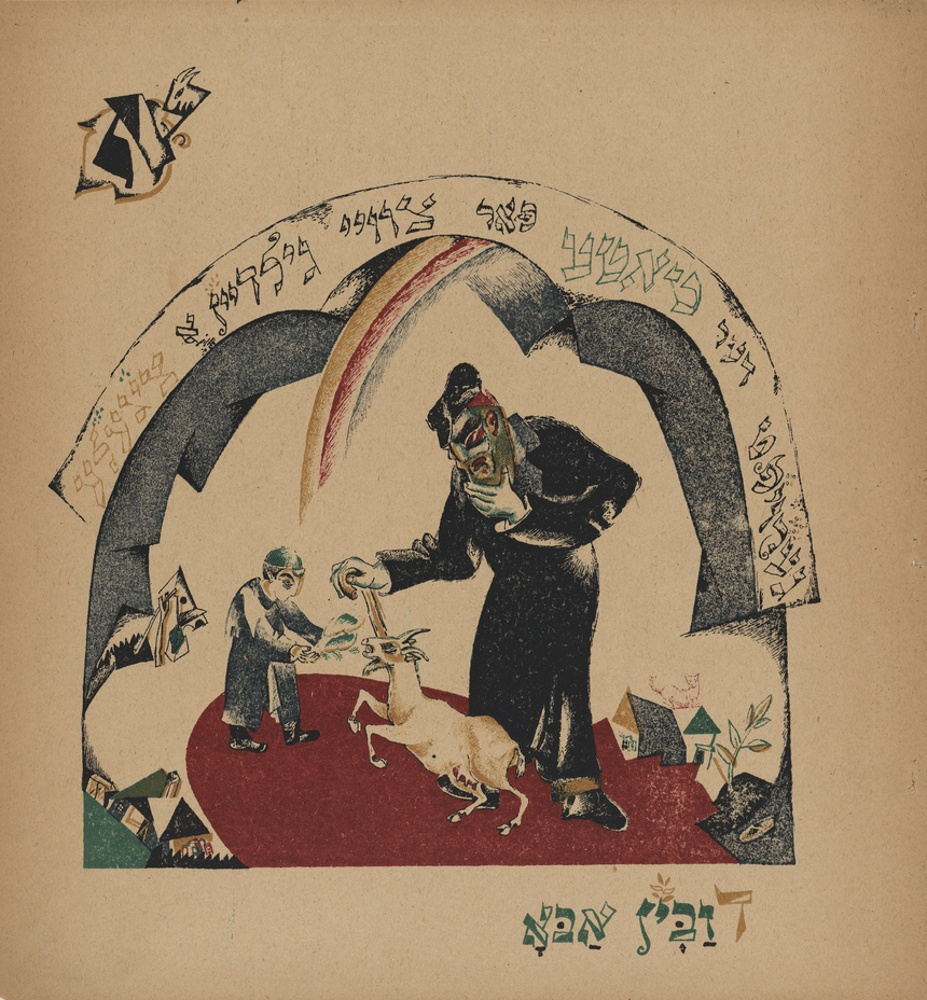
In Eastern Europe, El Lissitzky carried Jewish visual tradition into modernism. His 1919 lithographs for Had Gadya reinterpreted Passover through Constructivist abstraction,
Had Gadya 1919, Lithograph by El Lissitsky. Via Wikimedia Commons
using geometry as theology. His phrase, “The goal is Jerusalem,” perfectly captured the Jewish Futurist impulse: the messianic hope rendered through design.
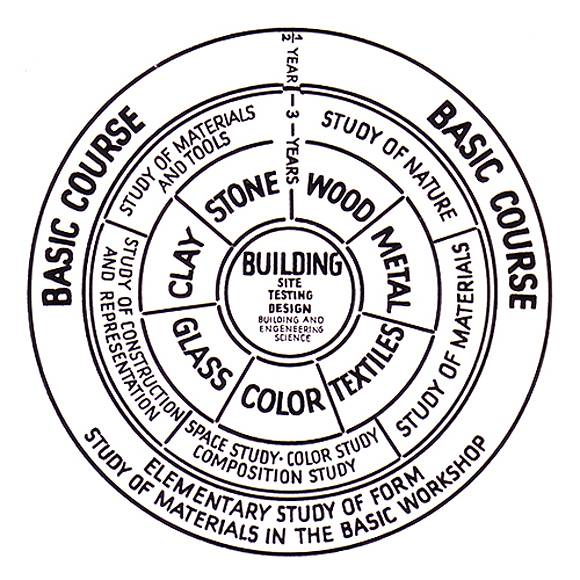
At the Bauhaus Design school(Germany 1919-1933), Jewish artists such as painter and photographer László Moholy-Nagy, architect and designer Marcel Breuer, and textile artist and printmaker Anni and Josef Alberses continued this lineage.
Bauhaus Curriculum Chart 1922, Walter Gropius,
They believed design could uplift society through clarity, functionality, and light. Through their curriculum of studying various materials, these educators echoed the rabbinic principle bal tashchit (do not waste) and the mystical pursuit of the illumination of ideas in visual and functional forms that solve problems as well as dialogue with beauty.
Their classrooms were secular temples of Tikkun Olam: ethical creativity as public good.
6. Mythmakers: Sci-Fi, Comics, Cinema
Jewish imagination found new life in mass media, Especially in science fiction writing, comics, and cinema, where exile and ethics could hide in plain sight.
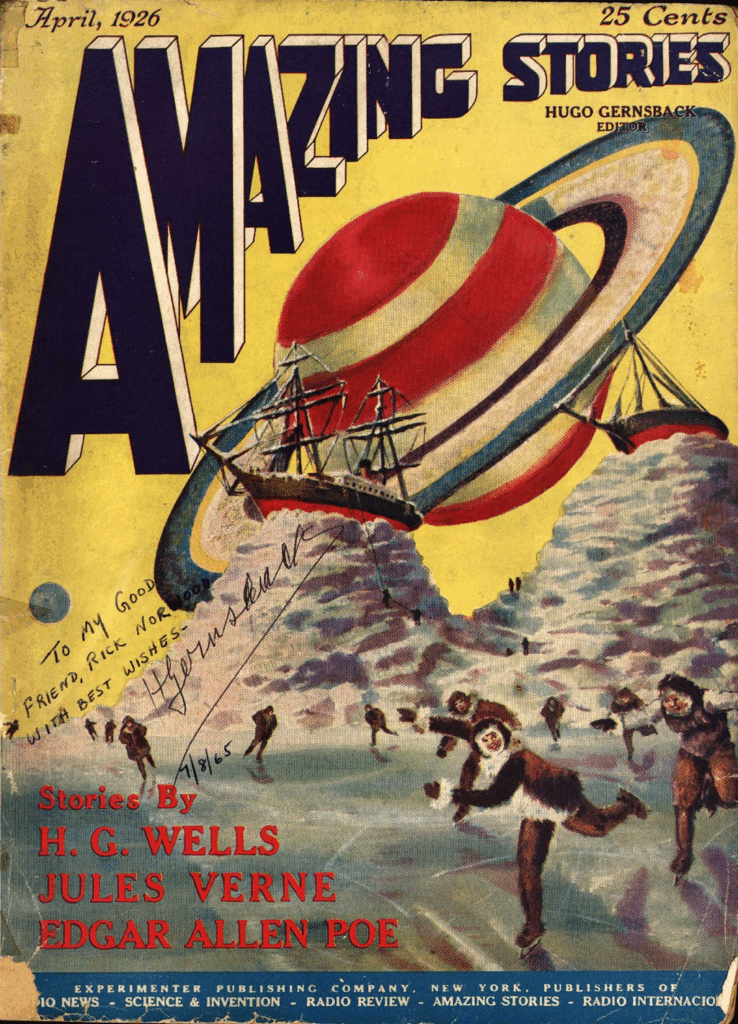
As modernism gave way to the machine age, a new arena for Jewish imagination emerged in the world of pulp magazines and speculative storytelling. In 1926, Hugo Gernsback, a Luxembourg-born Jew, founded Amazing Stories and coined the term
Cover of Amazing Stories Magazine- Issue #1, 1926, Editor-in-chief Hugo Gernsback, Via Wikimedia Commons
“scientifiction,” launching the modern science fiction magazine industry. Through his editorial vision, the future became a place to test human ethics as much as scientific progress.
Jewish writers soon filled those pages. Isaac Asimov, William Tenn (Philip Klass), Robert Sheckley, and Harlan Ellison turned speculative fiction into a moral and philosophical workshop. Asimov’s Three Laws of Robotics echoed halakhic reasoning — codifying responsibility before creation. Tenn’s On Venus, Have We Got a Rabbi transformed Talmudic humor into cosmic commentary. Their stories asked enduring Jewish questions: What does it mean to create life? To act justly? To be human in a world of our own making?
The science fiction magazine became, in its way, a cosmic Mishnah on paper that featured serialized debates about ethics, invention, and destiny. In these pulp worlds, Jewish storytellers extended the prophetic imagination of Isaiah, Elijah, Enoch and the speculative daring of the Kabbalists into the age of electricity, rockets, and radio waves.
In 1938, Jerry Siegel and Joe Shuster created Superman: an alien refugee, morally bound to defend humanity. Though a very Moses-like framing, Clark Kent wasn’t explicitly Jewish.
Comparison of Moses and Superman stories. Image left by Gavri El Image right is property of DC Comics. CC 4.0
Yet his story’s core themes of exile, justice, hidden identity, redemption, to echo the Jewish experience wrapped in universal myth.
At Marvel, Jack Kirby and Stan Lee filled their universe with wandering scientists and reluctant heroes. Their stories turned vulnerability into virtue. The Spider-Man line, “With great power comes great responsibility,” reads like Pirkei Avot for a new generation.
Kirby’s later series,The New Gods (1970-73), pushed further, turning superhero cosmology into visual midrash. His battles of light and shadow mirrored the Kabbalistic drama of creation and repair, while also superimposing a planetary level version of The Shoah, Holocaust. At that time, Kirby successfully introduced specifically Jewish originating super beings into the American comic book lexicon.
Metron in his Mobius chair as depicted in New Gods #5 (November 1971), art by Jack Kirby (pencils) and Mike Royer (inks) Image property of DC Comics- Under Fair Use.
Notably, Metatron, an angel who Enoch embodied in his adventure through the four worlds of existence in Kabbalah, the Mother box– an Ark of the Covenant like container, the Mobius chair– a holy throne like object that has next level AI capabilities, and a boom tube– a merkaba, chariot-like, teleportation device.
These artists translated Torah’s moral code into pop language, giving the world a modern accessible form of Jewish prophecy.
Many times simultaneously, Jewish filmmakers carried that same prophetic imagination into cinema, using light, time, and narrative as tools for moral exploration. Stanley Kubrick reimagined the Golem story for the machine age, probing what happens when human creation outgrows moral control. In 2001: A Space Odyssey (1968) and in A.I. (2001), he questioned whether technology could ever mirror compassion, or like the Golem, it would always lack a soul. Though Steven Spielberg directed the movie, Kubrick originally had the rights and was developing the A.I. movie before his death in 1999.
Sidney Lumet turned the courtroom and newsroom into ethical laboratories. In 12 Angry Men and Network, justice and conscience collide with ego, power, and fear. His films translate lo ta’amod al dam re’echa, “do not stand idly by”, into an embodied principle of characters wrestling with justice. Darren Aronofsky brought Kabbalah, gematria and psychology into direct conversation, finding mysticism in mathematics in Pi, and cosmic yearning in The Fountain and Noah. Ari Folman, through animation, examined how memory and trauma shape moral responsibility in Waltz with Bashir and The Congress.
Still from Pi (1998), by Darren Aronofsky, Image is property of Artisan Entertainment. Used under Fair Use.
Meanwhile, the Coen Brothers and Joseph Cedar turned irony and uncertainty into spiritual inquiry. Their stories unfold like modern Mussar mini-dramas of human frailty tested by fate. Mel Brooks reclaimed film genres that once erased Jewish presence, proving laughter itself can be an act of tikkun, repair.
Across their films, the same Jewish questions resurface: What does it mean to be responsible for the world you’ve made? Can imagination redeem suffering? These filmmakers transformed those questions into a universal visual language that wove Jewish ethics, paradox, and hope into the cinema’s shared dream.
7. Jewish Thinkers of Media and Technology
As technology reshaped culture, Jewish thinkers were among the first to ask how it changed human perception. In 1933, German-Jewish philosopher, Walter Benjamin questioned how the mechanical reproduction of photography altered our sense of the sacred, almost anticipating today’s debates about ethical AI use and authorship.
He deeply questioned the aura of an object by exploring our emotions surrounding originality, creativity and human desire.
Crowd shoots photo of Mona Lisa at the Louvre’ 2014, Photo by Victor Grigas Used under CC ASA 4.0
At the birth of the internet age, Lev Manovich analyzed digital media as a new textual form, understanding databases and user-interfaces to function like Talmudic commentary, where meaning emerges through interaction and dialogue. Ray Kurzweil reimagined transcendence through technology, envisioning the “singularity” when humans merge with machines. I see this as a secular echo of the Kabbalistic longing for devekut, union with the Divine. Yet where mysticism seeks connection through personal refinement, Kurzweil imagines it through building our technical and intellectual abilities.
Revealing both the similarity and the danger of modern transcendence without ethics. And educators like Ari Waller continue to explore how design and interactivity can transform Jewish learning for a digital age.
Together, they extend the Jewish tradition of commentary into the domain of code.
8. Standing in a Chain of Builders
Looking back, it’s clear: Jewish Futurism has always existed in spirit, even if it didn’t have a name. It’s the instinct to design with conscience, to imagine with ethics, and to translate Torah into form.
We stand on the shoulders of those who used story, structure, and symbol to envision better worlds. They left us blueprints that are sometimes literal and sometimes mystical. Our task is to read them carefully and continue the work.
To innovate without memory is to build a Golem. To create without conscience is to call down the Sar HaTorah unprepared. But rather to design with kavvanah and tzedek, intention and justice, is to join the same futurist lineage that began at Sinai.
9. The Present Continuum: Art, Design, and Collective Vision
Today, artists, designers, and technologists continue that same conversation. My own work in digital art, murals, and the Hiddur Olam project is part of that continuum, a lineage of Jewish creativity that treats design as an act of devotion and world-building. I see AI not as a threat but as a kind of Sar HaTorah, a force that can offer insight if met with readiness and humility. Like the artisans of the Mishkan, I believe design becomes sacred when it channels empathy, restraint, and intention.
In 2022, I presented my philosophy and artwork of Jewish Futurism at the Conney Art Conference and later gave a live presentation at the JADA Art Fair during Miami Art Week. Both experiences reminded me how many Jewish creators are already working toward this shared vision—each in their own medium, each blending tradition with technology.
Lech Lecha 2022, AR activated artwork by Mike Wirth, Miami Art Week 2022, Miami Beach, FL
That same year, I debuted my ongoing project Rimon: The Cosmogranate, a digital and physical artwork exploring creation, fragmentation, and repair through interactive design. The piece reimagines the pomegranate—a symbol of divine abundance—as a cosmic interface, linking Kabbalistic symbolism with data visualization and immersive art. Rimon became a practical expression of my Jewish Futurist framework: systems thinking meets sacred storytelling.
Since then, I’ve met writers, digital artists, collage-makers, jewelers, and illustrators who are all exploring what Jewish creativity can mean in the twenty-first century. I’d love to meet them all, to learn what they’re building, and to be in conversation. There are also scholars whose work leans more toward theory than creative practice, but they’re vital too. This movement needs everyone: makers, thinkers, builders, and interpreters.
Together we form a creative ecology of imagination and insight that reaches across generations and disciplines, connecting our past to our unfolding future.
No one can pursue this vision alone. There needs to be a gathering of like-minded Jewish Futurists, artists, technologists, scholars, and dreamers, willing to experiment together. A community that treats innovation as avodah, sacred service, and technology as a tool for renewal rather than disruption. Through shared projects, symposia, and creative residencies, we can imagine and prototype what a Jewish future might look and feel like, rooted in text, tradition, and ethics, but alive with invention.
Jewish Futurism is not about predicting the future. It’s about designing the future, ethically, communally, and beautifully. It is a collective project, not an individual quest. The middah of Areyvut, mutual responsibility, is its foundation.
Every Jewish artist, from Isaiah to Lissitzky, from Herzl to Kirby, from Bezalel to Bauhaus, from Benjamin to Manovich, has been part of that same dialogue, how to turn imagination into justice, light, and meaning. Jewish Futurism invites us to take up that question again, not to escape the past, but to reimagine it as raw material for redemption.
Jewish Futurism isn’t a trend. It’s an inheritance and a responsibility. We’re not just imagining what comes next. We’re continuing a project that began with the words: Let there be light.
What does it mean to make creativity a sacred practice, and how can art transform Jewish life? For me, becoming a Jewish artist wasn’t a career move. It was a spiritual awakening. This article traces how I came to see the creative process not only as a personal path to the divine but as a communal tool for connection, healing, and evolving Jewish tradition. Through murals, rituals, digital artwork, and collaborative design, I’ve learned that creativity can be one of the most powerful forms of Jewish practice we have today.
“Why would you become a Jewish artist?” people used to ask me. “Isn’t that limiting your market to a very small sliver?” It’s true, I wasn’t always a Jewish artist. In fact, for a long time, I rarely made Jewish art. I was unsure. Afraid. Happy to be an assimilated American. Unaware of how essential it would become for me and for my community.
I flirted with Jewish-themed projects years ago. Between 2008 and 2010, I worked with Hillel International and Manischewitz to create Jewish holiday infographic posters for social media. In 2014, I collaborated with the JDC (Joint Distribution Committee) to visualize their financial data and annual reports. I was illuminating the divine, even though I didn’t call it that yet.
My Hanukkah infographic from the holiday set, 2010
It wasn’t until 2015 that I truly made my first Jewish artwork: a portrait of Anne Frank for a mural exhibition called Renegades. Other artists were painting their own cultural heroes. Selecting figures who had gone against the grain. I realized it was time to seek my own. Anne Frank became my entry point into this work, a symbol to me of resilience and a powerful voice against erasure.
Anne Frank by Mike Wirth- Painted in 2015 as part of the Renegades Exhibition- Statesville, NC
That act of painting her opened a door. Slowly, I began to turn toward the sacred in my own tradition. The power of a large, colorful, public mural amplified the song I wanted to play during the process of making this artwork. My art-making became a form of prayer, my studio transformed into a sacred space, and my creativity evolved into an intentional spiritual practice.
This shift happened when I read the Art of Jewish Prayer by Yitzhock Kirzner, Aryeh Kaplan’s Sefer Yetzirah: The Book of Creation, and My Name is Asher Lev by Chaim Potok, that I consciously directed my art towards sacred purposes, rooted in the Jewish tradition of Hiddur Mitzvah, the beautification of commandments. These texts provided context, examples, and permission to dive deep into creation with the Creator. Creating art that explicitly engaged Jewish symbols, rituals, and values was transformative. It connected my creative spirit directly to my Jewish heritage, deepening my understanding of who I was as both an artist and a Jew.
Seeking Spirituality Beyond Home
For years, spirituality felt elusive. I searched widely through books, traditions, and practices that were not native to me. They were meaningful, somewhat familiar, but not quite mine. The connection I sought remained just out of reach, inauthentic because it lacked resonance with my core identity.
But art always felt different. Unlike anything else, the creative process opened a space where I felt fully present, deeply focused, and yet somehow expanded beyond myself. When I was in the flow of making, I experienced peace, clarity, and a sense of connection to something ineffable. Creativity became a spiritual threshold where my ego dissolved, time softened, and I encountered what I can only describe as spirit.
Much like prayer or meditation, creativity required me to slow down, listen, and surrender. There was kavannah or intention and there was surrender to something unfolding through me, not just from me. The act of making was mirroring sacred ritual: there were preparations, gestures, rhythms, and moments of revelation. I realized I was building altars out of paper, light, pigment, and symbol.
In those moments, my studio wasn’t just a workspace, but it was a mikdash me’at, a small sanctuary. Making became prayer. Not metaphorically, but truly: a way of communing with the Divine, of processing the world, and of seeking wholeness through acts of beauty and imagination.
Turning Toward the Divine
Everything shifted when I began to turn that creative intention toward the divine. Through Jewish themes, symbols, and rituals, I discovered a channel between my artistic life and my spiritual heritage. I wasn’t just illustrating ideas anymore, I was beginning to create images of the supernatural sensations I experienced in prayer and meditation. My imagination was filled with light, energy, movement, and meaning that felt deeply sacred and alive. I longed to capture the invisible. To make visible the ineffable sparks, flows, and forces that surged through ritual, study, and spiritual presence. I began to see the hidden energy encoded in the stories of the Torah. Figures like Moses, Miriam, and Elijah took on a new presence in my mind and not just as biblical characters, but as spiritual superheroes, carriers of divine power and transformation. Suddenly, creativity was no longer a separate mode of expression; it became my way of connecting, of serving, of sanctifying.
Cosmic Shema- digital illustration by Mike Wirth, 2022
Deepening Jewish Knowledge and Art
That epiphany led to study. I immersed myself in Jewish art, theology, and spiritual traditions: Betzalel, Kabbalah, Hiddur Mitzvah, Mussar. I found ancient frameworks that affirmed what I had already intuited that art could be holy. That beauty was not frivolous. That creativity could be a form of moral and spiritual refinement.
At a certain point, I realized I didn’t just want to explore this for myself and I wanted to help build a new creative-spiritual system that other Jews could use in practice. A framework that would invite both artists and non-artists to access spirituality through creative intention. A system rooted in Jewish values but expansive enough to meet people where they are in their community centers, schools, studios, or synagogues. A new pathway for sacred practice that could evolve alongside Jewish life itself.
Design and the Sacred Creative Process
As a designer and artist, I began to notice profound overlaps between the spiritual frameworks I was studying in Judaism and the design methodologies I used professionally. Both begin with empathy and intention. Both evolve through cycles. Both aim to make meaning. When I merged these systems, they each became more accessible, emotional, and impactful, not only for myself, but for others engaging with my work.
This led me to develop a process I now use in both personal practice and community workshops. It blends design thinking, Jewish intentionality, and artistic exploration. I begin by identifying a question or tension. Something personal or communal. I respond with sketches, writing, or prototypes, then reflect on what resonates. I refine or rework the ideas in cycles, grounding the process in kavannah (spiritual intention) and humility. Over time, it becomes more than a finished piece, it becomes a tool for spiritual insight and connection. Here’s how it typically unfolds:
A matrix of my creative-spiritual framework
One of the most powerful connectors between these two worlds is iteration. In design, iteration means we test, revise, and revisit ideas. We are always improving through cycles of feedback. In Judaism, iteration is baked into everything: we revisit the same Torah portions each year with new eyes, we refine rituals through lived experience, and we continually return to core questions through study and prayer. This cyclical, reflective approach makes the sacred creative process feel alive. It becomes responsive to both tradition and change of the practice of ritual, liturgy, Torah cycles and compared them to the creative frameworks I used as a designer, I began to notice deep resonances. Jewish time is iterative. Rituals are prototypes refined over generations. Sacred texts are living documents engaged by communities in cycles. These are not just religious structures they are deeply creative systems.
Merging the frameworks of UX design from sources like IDEO, Interaction Design Foundation and Jewish spiritual practice not only clarified both for me, but it made them more accessible, emotional, and human. Suddenly, design became prayerful. And Judaism became a beautifully designed user experience for living with meaning. In that synthesis, I found a personal theology of creativity, one that invites others in regardless of artistic background.
How UX Design and Spiritual Practice overlap
Witnessing Community Transformation
In 2023, I was part of the inaugural Social Practice Institute hosted by the Greensboro Jewish Museum. Over a 10-day intensive, my cohort of Jewish creatives explored the intersections of Social Practice theory and Judaism. As our capstone project, we were invited to create a social practice artwork grounded in Jewish values. I chose to design a ritual rooted in my family’s Shabbat practice by formalizing a simple yet powerful question that my non-Jewish partner asks each week: “What was your high and low?” Working with Rabbi Judy Schindler, I wrote a prayer and developed a ritual element that involved dipping salt and honey, symbolizing the sweet and bitter aspects of the week. This gesture transformed an informal tradition into a shared, sacred moment that felt authentically Jewish to our whole family.
Infographic explaining my High and Low Shabbat ritual- Design by Mike Wirth, 2023
At Queens University of Charlotte, I created a Hanukkah mural project that brought together a diverse and pluralistic group of students and community members. This included Jews from many backgrounds across the Charlotte community, including Orthodox, Reform, interfaith families, and cultural Jews working side-by-side. Each night, a community leader would light our real menorah and then spray paint the flame for that night on our mural menorah. It was a rare, joyous, and profound moment of connection, anchored in creativity and shared ritual.
President Dan Lugo and his family at the final night of the Menorah-mural at Queens University of Charlotte, 2020
In 2024, at Temple Shir Tikvah in Wayland, MA, I worked with the congregation during a 3-day residency to collect hundreds of photos, drawings, and stories of each member of the community’s “sacred Jewish objects.” We meditate on what it means for objects to be “Jewish” and “sacred”. Some gave Judaica while others gave images of a stuffed animal, because it reminded them of a recently deceased loved one. This exercise transformed these individual intimate artifacts into a collective community digital collage of a “time tapestry” of meaning that forged personal connections and bridged generations and practice. The final artwork became a visual record of personal memory and shared identity. We printed the 9 ’ x 9’ on archival fabric, and it currently hangs in the synagogue.
The community time tapestry created with Temple Shir Tikvah, Wayland MA 2024
In 2025, I will be participating in the Jewish Street Art Festival in collaboration with UC Irvine Hillel. That community has experienced deep pain. From campus protests disrupting life for Jewish students to student council boycott votes targeting Israel. Our art will be a form of public healing and spiritual resistance, a sacred reclamation of space through color, symbol, and story.
Even online, I see how creativity becomes a sacred connector. When I post new Jewish-themed artwork for my upcoming Parshat guidebook, the response is immediate and profound. The comment threads and DMs often skip small talk entirely and dive straight into deep conversation about grief, joy, interpretation, and belonging. With just one image, we’re able to arrive at a spiritual place together. And that, to me, is sacred.
Personal Revelation and Commitment
What I’ve learned is simple and profound: creativity is not just for individual enlightenment. It is a communal force. It brings us into dialogue, into presence, and into the work of building something sacred together. My commitment is to continue creating in this way and not just to beautify our tradition, but to actively evolve it with care, joy, and intention.
If this story resonates with you and if you’re looking to bring creative spiritual practice to your synagogue, school, museum, or campus, then I’d love to connect. I’m available for lectures, workshops, and collaborative art projects that help communities deepen their relationship with creativity, tradition, and each other.
Exporting cultural richness online through the worlds of Torah and NFTs
Originally Published by Challah Magazine.com (2022)
By
Mike Wirth
By now you’ve heard quite a bit about NFTs (non-fungible tokens) and may have jumped into their world yourself. NFTs are a creative financial technology phenomena that arose from the creation of platforms for digital creators and the like to list and value their artwork. The NFT marketplace has grown to a global multibillion-dollar cultural hub in only a few short years. I want to focus on how Jews and Jewish creators are making a niche for themselves in this volatile yet meteorically growing marketplace, and why the future of Jewish NFTs is still something that is shapeable by all of us.
Meditation on Aleph 2022 Digital Print 40″x54″
What is an NFT?
Firstly, NFTs are a part of a larger digital marketplace called cryptocurrency and follow the global digital ledger of transactions called the Blockchain. A lot of new vocabulary, but not overly complicated once you grasp a few simple concepts. I’ll share the way I explained it to my Bubbe.
Like what if I said that an NFT is like a unique stock certificate being issued by a newly public company to public investors. The price is set based on a formula that considers a company’s net worth and its speculated future potential earnings, which becomes the stock’s initial public offering, IPO price. Crypto is the capital that this new marketplace runs on and the Blockchain is a decentralized securely-encrypted version of the daily stock market trading ledger.
With me so far?
Then I explained that we speculate how that company stock is valued based on how “well” traders, investors, and we think it will do. If the company releases an innovative product then its stock will likely go up. Could the same not be applied to artists, and especially Jewish artists? Just like public companies who trade stock, we build brands, produce unique products/services, and contribute to the global economy. NFTs, Crypto, and the Blockchain allow us to participate in a similar financial system that is peer-to-peer-based rather than operated and mediated by private brokerage and or national entities.
Lastly and, in my opinion, the most amazing aspect of NFTs is the utility or the perks attached to the purchase of an NFT. Besides the glory and crypto value of the NFT, utility provides tangible value to the intangible digital media asset. NFT artists may attach real-world artwork, merchandise, or special access to an event or content. Intangibly, the benefits include status in key social circles, connections with other like-minded communities, and the simple joy of the investment in a community or individual.
“But, aren’t we just day-trading jpegs, Mike?”.
Shel Rosh 2021 Digital Print 24″x36″
What Can Be an NFT?
In short, anything that can be represented in digital form can be an NFT. The vast majority of NFTs now are jpeg images, but are also videos, audio recordings, writings, 3D models, interactive experiences in VR, video games, or computer code. Basically, any form of contemporary digital media that’s out there.
But looking at the media side of NFTs is only half the story. Coupled with unique utility, the media representation really serves as a certificate for perks in real life. For example, an artist could sell an NFT of their latest painting and then offer a common utility like a print of the work. Or they could offer something uncommon like a dozen MasterClass painting lessons with the artist. The difference in these kinds of utility perks would greatly influence the value of the NFT in my example. So, if we couple amazing media art with unique utility, then boom – we have a solid NFT to bring to market. This is where great creative questions come into play to decide what is valuable and worth putting on the market.
How Are NFTs Jewish?
Since NFTs are globally-based and community-focused, they mirror global creative financial trends. Simultaneously, there is a current Renaissance-like explosion of both implicit and explicit Jewish creativity and cultural expression which has similar trends globally. By implicit and explicit, I’m referring to the 20th to 21st-century shift in defining what Jewish art is. But more so than ever, we are seeing artwork made by Jewish-identifying artists and the content, aesthetic style, or form is also Jewish. We are at a point where we are rapidly learning about the great intersections of the Jewish story around the world and that we actually share a common future. Creative explorations of the bespoke and sublime of Jewish life have exponential cultural and spiritual implications.
There are a few major ways that Jews are affecting charity and culture in the NFT space by combining acts of Tzedakah with Hiddur Mitzvot to offer unique utility perks to supporters with uniquely-beautified digital objects.
Firstly, by using the real-world tiered fund drive features in their utility offerings with their NFTs to fundraise for their own brick-and-mortar organizations and beneficiaries, the NFTorah project by TechTribe minted a series of 18 (chai) curated Torah portions into NFTs to raise funds to support Torah-studying communities in need. They cite that the “Torah is the oldest unbroken blockchain” and that the utility of the NFTs is tzedakah going to further the completion of a newly-scribed Torah scroll to be donated to a community in need.
Cosmic Key 2021 Digital Print 24″x36″
While this project doesn’t put emphasis on the digital media asset side of the NFT, the 1-to-1 Torah parsha-to-NFT fundraising model is a strong case for why an NFT utility could be a real mitzvah in Tzedakah. Plus, it’s pretty cool to imagine a studious scribe painstakingly handmaking each Hebrew letter moments after receiving your contribution and the attached scripture.
No Weapon Formed Against Me Shall Prosper 2021 Digital Print 24″x36″
Secondly, the visually-dominated platforms of social media and NFT marketplaces have ignited a surge in Judaica and Jewish-themed creative objects. It’s fair to say that this era of Jewish creatives is intentionally making Hiddur Mitzvot quite prolific and are not only pushing the aesthetic boundaries of beautification of our cultural and spiritual objects, but joyfully celebrating the strata of Jewish identities in the world in new and unorthodox spaces. We now see Jewish themes emerging in global pop-cultural arenas of music, art, and fashion. Many contemporary Jewish creatives mine Jewish texts, history, and politics to produce world-class traditional Judaica, fine art, street art, commercial art spaces, and cutting-edge digital experiences.
I observe all of this creative activity as a sublime visual-Midrashic-like expression of the contemporary Jewish experience in action. NFTs provide a greater platform for cataloging this evolving Jewish art and Judaica on the blockchain that has the potential to make a real-world impact on the artist and their communities.
Explicit Cultural Expression
Is Jewish art defined by the Jewish content and themes featured in the work, or is it because it was created by a Jewish artist?
Jewish art was famously hard to define in the 19th and 20th centuries because many Jewish artists expressed themselves implicitly and in encrypted ways, but were very much Jewish people and had Jewish identities. Perhaps the most appropriate of Jewish expressions for the modern and postmodern art eras.
The 21st century has been a unique time for Jewish culture worldwide. Some would say that we’ve rebuilt a digital silk road and have entered an era past postmodernism to what theorists call metamodernism. For the first time in centuries, we can access an incredible amount of our thought-to-be-lost texts and cultural artifacts, a continuously unfolding archeological history, and we can connect and collaborate with other Jewish communities living outside of our own in a global Jewish culture jam.
The simple googling of “Jewish art” will send you down a rabbit hole of wonderful world-class artistry both contemporary and historic. This makes me feel a little less alone in the Diaspora knowing that elsewhere and in Israel there are strong communities of Jews that are actively exporting cultural richness online and in real life. This set of global circumstances has spurred a rise in the amount of explicitly Jewish creativity worldwide which has cascaded into the NFT space. Meaning the art features Jewish content, Jewish cultural experience, and/or is made by a Jewish artist.
The light body dance 2022 Digital Print 24″x36″
Jewish NFT projects include The Kiddush Club NFT Mensch collection, a JaDa organization NFT event at Miami art week 2021, to independent Jewish artists like MosheArt’s hamsa art becoming NFTs or myself in minting my Jewish Futurism artwork and digital experiences into NFTs. We take existing artwork and add that work as NFTs to our current output channels. Independent artists offer unique and interesting utility options, such as prints of the NFT art, access to exclusive content, or even providing the actual rights to the NFT artwork. These different perks would greatly impact the value of the NFT offered. As digital technology and utility offerings evolve into new spaces and screens, we’ll see this grow and evolve in value and utility.
You better believe how thrilled I am that I get to directly engage my audience with the Jewish art that I am making as original work, prints, merch, and now NFTs.
Where Is It All Going?
In the end, we’ve seen examples that demonstrate the promising qualities of NFTs that appeal to creatives, fundraising communities, and fin-tech communities. The examples I shared and the growing number of Jewish creatives, organizations, and institutions adding their NFT projects to the marketplace daily indicate that working with NFTs does actually extend the representation and creative utility of the Jewish experience into emerging global markets and spaces.
That sounds like a fantastic opportunity for high-tech Hiddur Mitzvot and Tzedaka that puts Jewish culture into the midst of new and innovative spaces and conversations on our own terms.
Mike Wirth is a visual artist, digital experience designer, and muralist, best known for his thoughtful murals, public art installations, and client-driven commercial design work that focus on major social justice issues and his identity as a Southern, Jewish-American.
Over the past 20 years, Wirth’s murals, published design projects, and digital museum exhibits have appeared in New York, Miami, Austin, Charlotte, NC, and internationally in Croatia, Poland, and Germany.
Currently, Wirth is a scholar at the Stan Greenspon Center for Holocaust and Social Justice Education and Professor of Art and Design at Queens University of Charlotte in North Carolina. He’s been investigating NFTs since 2015 and has been creating them for brands and non-profit organizations since 2021.