Episode 17- Recoding the Lehrhaus: Jewish Learning in the Future Tense
/
RSS Feed
Share
Link
Embed
This episode explores Franz Rosenzweig’s radical vision for Jewish education through the Frankfurt Lehrhaus (1920) and traces its influence into contemporary experiments in creative, future-oriented learning. Rosenzweig rejected passive transmission of knowledge and instead cultivated dialogical, participatory study rooted in lived experience. His Lehrhaus was not simply a school. It was a reorientation of how Jewish life could be learned, practiced, and renewed in modernity.
That same impulse appears in emerging frameworks like Jewish futurism and the Hiddur Olam creative learning system, which treat tradition as a living medium rather than a fixed archive. The episode draws a line between Rosenzweig’s early 20th century intervention and present-day efforts to design learning environments that are adaptive, imaginative, and relational.
The episode also highlights the Lehrhaus in Boston as a contemporary expression of this lineage. On June 24, 2026, an in-person course on Jewish futurism will take place there, offering a practical extension of these ideas. The session invites participants to move beyond preservation toward creative responsibility, asking not only what has been inherited, but what must be built.
Along the way, the episode examines what might be missed when Rosenzweig is reduced to philosophy alone. His educational project was infrastructural. It reshaped who teaches, how learning happens, and what counts as participation. That shift remains unfinished.
In this episode of The Jewish futurism Lab: Torah, Tech, Tomorrow, host Mike Wirth sits down with his friend, Israeli digital artist and projection‑mapping creator Erez Cohen. Mike first encountered Erez’s work through a projection‑mapping piece called Metamorphosis, where veins and fungi slowly overtake a Jerusalem building and turn the city itself into a living, speculative Jewish landscape. You can explore more of Erez’s video mapping, sound, and interactive pieces in the My Works section of his portfolio at erezcohen.art.
The conversation traces Erez’s journey from hacking video games and running private servers to building immersive environments with tools like Visual Studio, TouchDesigner, and 3D animation. Together they dig into how that background in world‑building feeds directly into his practice of Jewish futurism, why his art is Jewish simply because he is Jewish, and what it means to design custom, generative experiences for a generation raised on platforms like Roblox and Minecraft.
Mike and Erez also reflect on collaborating on a digital projection project for Israel after October 7, the impact of war and canceled exhibitions on an artist’s plans, and the tension between staying present to crisis and still imagining the futures our kids might inhabit. It is a grounded, personal look at how one artist is using projection, sound, and code to explore Jewish identity, memory, and possibility in real time.
Episode 15- Hiddur Olam: The Creative Torah System for Jewish futurist Living
/
RSS Feed
Share
Link
Embed
In this episode, Mike unpacks Hiddur Olam, his creative Torah system and multi‑volume art book series that reimagines Genesis through Jewish futurism, design thinking, Mussar, and Kabbalah. Listeners will hear how weekly parsha study, visual storytelling, and spiritual practice come together as a framework for beautifying the world through creative Torah.
Discover Hiddur Olam, a creative Torah system and illustrated book series that reimagines the first portions of Genesis as luminous encounters between humanity and the Divine. Mike Wirth shares how Torah study, design thinking, Mussar, and Kabbalah weave into a practical framework for Jewish futurist creativity and spiritual growth. Learn how weekly parsha art, reflective commentary, and a structured creative process became the backbone of a multi‑volume Hiddur Olam series and its upcoming companion workbook. This episode is for artists, educators, rabbis, and seekers who want to turn their own creative practice into a form of Torah learning and world‑beautifying action.
EP 14- Papayas on the Moon- My Chat with Alejandro Glatt
/
RSS Feed
Share
Link
Embed
In this episode of The Jewish futurism Lab, I sit down with Mexican artist and papaya visionary Alejandro Glatt, the first Mexican artist to send a papaya to the Moon as part of the Lunaprise art museum project connected to NASA’s Artemis missions. Recorded on the day of the Artemis II launch, our conversation weaves together Jewish futurism, space exploration, and the surprising holiness of fruit in my own evolving sense of contemporary Jewish life.
Alejandro and I first met at the Jerusalem Biennale, and in this interview I explore how his “Papayas to the Moon” work merges art, ritual, and space technology, turning a simple papaya into a cosmic symbol of life, diaspora, and connection. I ask him about his “Feel the Fruit” experiences, his role as a community builder and trip leader to Israel, and how he imagines Jewish civilization carrying its stories, symbols, and sacred objects into orbit and beyond.
As you listen, you’ll hear me probing how Alejandro’s art on the Artemis missions reshapes my own questions about Jewish presence in space, how beauty and tiferet might travel with us off‑planet, and why sending a papaya to the Moon could be a kind of blueprint for future Jewish creativity among the stars. You can explore more of Alejandro’s work at alejandroglatt.com and see how his papayas are expanding the conversation about Judaism, ecology, and interstellar imagination.
Episode 13: How a Jewish Immigrant Named Hugo Created Sci-Fi
/
RSS Feed
Share
Link
Embed
Before science fiction was a genre, Hugo Gernsback was already building the infrastructure for it: radio magazines, hobbyist communities, wild speculative stories, and the first publication devoted entirely to imagining tomorrow. A Jewish immigrant from Luxembourg, he launched Amazing Stories in 1926 and quietly trained a generation of readers and writers to think in futures, long timelines, and unintended consequences. His magazines hosted women in leadership roles, predicted computer dating, video calling, and the social costs of new technology, while also carrying the casual racism and sexism of their era. We place him alongside Einstein, the artists of Vitebsk, and Fritz Lang’s Metropolis to ask what it meant for Jewish creators to be building the future from the cultural margins. And we end with the question he would have loved most: who is building that kind of futures literacy today?
Episode 12: Professors, Dads, and the Jewish future with Shai Davidai
/
RSS Feed
Share
Link
Embed
In this episode of The Jewish Futurism Lab, Mike Wirth sits down with Shai Davidai, the Israeli‑born social psychologist and former Columbia Business School professor who became a prominent voice for Jewish students after October 7. Together they trace Shai’s journey from secular Israeli kid to public Jewish advocate, unpack what really happened for him on campus, and explore how his training as a social psychologist shapes the way he reads our power, our responsibility today, and the continuity of our legacies tomorrow. They talk about fatherhood, professorship, and podcasting, and ask what kinds of institutions, communities, and narratives the Jewish future will need.
Episode 11: Jews, AI, and the Real Meaning of “Creative”
/
RSS Feed
Share
Link
Embed
In this episode of The Jewish futurism Lab, Mike Wirth uses the 4C model of creativity to map out what we really mean by “creative” in an age of AI art and endless images. He traces his own journey from parametric code experiments to Jewish futurist murals, then layers in Jewish history, exile, and the long tension around graven images as a lived curriculum in world‑building.
Along the way, Mike explores flow, aura, and authorship, asking who holds intention and responsibility when AI enters the studio. The conversation lands in Jewish futurism as an ethical frame, inviting listeners to treat narrative and technology as tools for building livable futures.
Episode 10 – From Utopia to Conspiracy: The Secret Battle Over Jewish Futures
/
RSS Feed
Share
Link
Embed
In this episode of The Jewish futurism Lab, Jewish futurist and we’ll explore early Jewish futurism, Zionist art, and media history through Theodor Herzl’s Altneuland, Ephraim Moses Lilien’s Zionist Art Nouveau, and Boris Schatz’s Bezalel School in Jerusalem. He contrasts these utopian blueprints and design prototypes with the antisemitic hoax The Protocols of the Elders of Zion, showing how Jewish artists, writers, and educators used print, ritual objects, and visual culture to claim Jewish agency and design a different future.
Episode 9: From Cult to Code: Tracing the History of the Aura in Art
/
RSS Feed
Share
Link
Embed
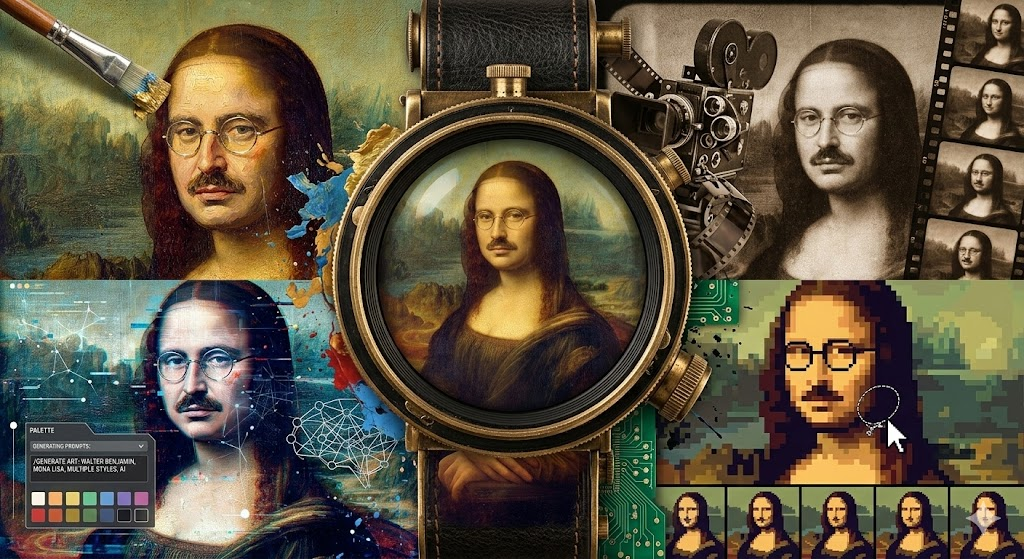
Walter Benjamin, AI, & the Aura of Art: In this episode of The Jewish futurism Lab, host Mike Wirth unpacks Walter Benjamin’s “aura” of art and asks what presence means when every image can be copied, remixed, and generated on demand. Moving from Byzantine icons and ritual objects to photography, social media, NFTs, and AI image models trained on his own work, Mike maps six value eras of art, from cult value and exhibition value to digital manipulation, circulation, synthetic scarcity, and generative value.
Along the way, he explores why a family Hanukkiah, a live performance, or a handmade painting still feel different from a viral post or a blockchain-certified NFT, and how Jewish ritual and textual tradition offer a counter-story to purely market-driven ideas of originality and authenticity.
The episode lands on a haunting, guiding question for our AI age: when you stand in front of an image, an object, or an artwork today, was anyone present when this was made?
Walter Benjamin is not a household name. But he should be.
In 1936, this German philosopher and cultural critic wrote an essay that predicted, with startling precision, almost everything that has happened to art since. He described what it would feel like when images became infinitely copyable. He anticipated the strange hollowness of standing in front of a famous painting you have already seen a thousand times on a screen. He named the feeling you get in front of a great original that no photograph ever quite captures. And he called it, simply, the aura.
“Even the most perfect reproduction of a work of art is lacking in one element: its presence in time and space, its unique existence at the place where it happens to be.” — Walter Benjamin, Illuminations (214)
You already know what aura is. You have felt it. It is the difference between seeing a photo of the Grand Canyon and standing at its edge. It is why people still cry in front of paintings in museums. It is why a vinyl record from a musician you love feels different from the same album on a streaming service. It is why your grandmother’s ring means something her ring’s photograph does not. Benjamin just gave it a name and asked what happens to it when technology makes everything reproducible.
I have been asking that same question for most of my adult life. The answer, it turns out, is complicated. And beautiful. And a little devastating.
What Benjamin Actually Said
Benjamin’s core argument is simple enough to fit on a Post-it note: every original artwork has a presence tied to the specific place and moment it occupies in history. He called this its “here and now” (Benjamin 214). A painting carries the weight of every hand that ever touched it, every room it ever hung in, every century it survived. That accumulated presence is its aura. And the moment you photograph it, print it, digitize it, or copy it in any way, something essential leaks out. The copy is everywhere. The original is still only here.
I remember reading this in college and thinking it sounded romantic, maybe even a little precious. It took years of making things, and years of watching how people relate to things I made, before I understood he was not being romantic at all. He was being precise.
He was writing at a moment when photography and film were brand new cultural forces, and he watched them doing something no previous technology had managed: not just reproducing art, but changing what people expected from it. The museum poster, the art history textbook, the film still. Suddenly the image of the artwork was more familiar than the artwork itself.
“That which withers in the age of mechanical reproduction is the aura of the work of art.” — Walter Benjamin, Illuminations (221)
What makes Benjamin so prescient is that he was not simply mourning this loss. He saw something potentially liberating in it too. If art was no longer locked inside churches and palaces and the reverence of the elite, maybe it could become something more democratic. Maybe it could be politically alive in ways sacred objects never were. I find that tension in his thinking genuinely useful. He does not give you a clean answer because there is not one. He holds the grief and the possibility at the same time, which is, I think, the only honest way to engage with what technology does to culture.
The Six Lives of Aura
What Benjamin could not have predicted was how many more transformations were coming. Aura did not simply wane and disappear. It kept reinventing itself, finding new containers, mutating into new forms of value with each new technology. When I map these transformations out, what strikes me most is not how much has changed but how consistent the underlying human longing remains. Every era destroys one version of presence and immediately starts trying to rebuild it.
“The desire for authenticity, for the unrepeatable, for the original: this is what drives the market’s endless attempts to reconstruct aura under new conditions.” — Jos de Mul, Cyberspace Odyssey
Here is how that history maps across six eras.
Before the camera, art had cult value. It existed in one place, for one community, embedded in ritual (Benjamin 217). You had to travel to it. The gap between you and the object was not an obstacle. It was the point. Think of a Byzantine icon, a cathedral fresco, a Torah scroll passed down through generations. These things were not primarily decorative. They were alive with the weight of where they had been and who had held them.
I think about this constantly in my work with Jewish material culture. A Hanukkiah that has been in a family for four generations is not the same object as an identical one bought last year. It carries a history in its scratches and its dents and its smell. That is cult value. And I want to be clear about something that often gets lost in discussions of Benjamin: cult value has not disappeared from contemporary practice. Studio artists working in slow, material-intensive disciplines, oil painting, ceramics, hand-pulled printmaking, still generate genuine aura through the ritual of making. The visible trace of time, the irreproducible encounter with an original surface: these conditions still produce something real. I have stood in front of works that stopped me cold in ways I could not explain, and I believe that experience is not nostalgia. It is recognition.
Photography gave us exhibition value. Art could now travel to you, flattened and portable (Benjamin 225). More people than ever could access it, which was genuinely democratic and genuinely good. But the form of that access had changed fundamentally. The Mona Lisa on a postcard belongs to no place and no moment. It has been liberated from its context and, in that liberation, hollowed out a little. I do not say this with contempt for the postcard. I own plenty of them. I say it because the hollowing is real, and pretending otherwise does not serve anyone.
“The technique of reproduction detaches the reproduced object from the domain of tradition.” — Walter Benjamin, Illuminations (221)
The market fought back almost immediately: signed editions, numbered prints, certificates of authenticity. I find this reflex fascinating and a little poignant. The demand for aura did not disappear when the technology changed. It went underground and started looking for new containers. That pattern repeats in every era that follows, and once you see it you cannot unsee it.
The digital age brought manipulation value. Theorist Lev Manovich argued in 1998 that the database had replaced narrative as the dominant logic of new media culture (Manovich, “Database”). In a database, nothing has a fixed place or hierarchy. Everything is a node, waiting to be queried, remixed, and recombined. Art became raw material. Its worth shifted from what it was to how generative it could be.
“The database represents the world as a list of items, and it refuses to order this list.” — Lev Manovich, “Database as a Symbolic Form”
Hip-hop producers understood this intuitively before any theorist named it. Joseph Schloss establishes in Making Beats that producers sample not because it is convenient but because it is aesthetically beautiful, governed by a strict ethics of creativity and reverence for the source (Schloss 60–61). I find this argument genuinely moving. A Madlib record is built from hundreds of samples, each one carrying the aura of its source: a 1972 soul session, a Brazilian jazz recording, a forgotten film score, all folded into something new. The manipulation is also an act of love. He knew what he was taking. He was accountable to it.
“Sampling itself is an embodiment of this active process of engaging with history.” — Jeff Chang, Can’t Stop Won’t Stop (qtd. in DiCola and McLeod 74)
That accountability is everything. It is what separates sampling from mere recombination, and it becomes the critical distinction when we get to AI.
Social media created circulation value. In the age of Instagram, TikTok, and viral sharing, what an artwork is worth is inseparable from how far and fast it moves (Eryani). I remember when this shift started to feel real to me, not as a theoretical idea but as something I was actually living. Works I made that circulated widely took on a kind of social weight I had not anticipated. Works I made that did not circulate felt invisible regardless of how much they meant to me. That asymmetry disturbed me. It still does.
“In the digital age, the aura of an artwork is no longer tied to its physical uniqueness but to its cultural resonance and the collective experience it generates.” — Rulla Eryani, “Aura Reimagined”
A work now risks losing significance not by being too widely reproduced but by not being reproduced widely enough. Obscurity, not ubiquity, is the threat. Benjamin would have found this deeply strange. I find it both funny and genuinely disorienting.
NFTs tried to engineer scarcity value. When digital technology made reproduction totally free and infinite, the market did not accept the loss of aura gracefully. It built a financial instrument to simulate it. A blockchain certificate acted as a surrogate original, a unique claim of ownership over an infinitely copyable file (Jin). I watched this happen in real time and felt something like recognition mixed with exhaustion. Of course the market did this. It always does.
“NFTs don’t reinvent the aura — they show us what it always was: a structure of power, hierarchy, and exclusivity dressed in spiritual language.” — Laurie Rojas, Caesura Magazine
What NFTs revealed, more nakedly than anything in recent art history, is that the desire for aura was never purely spiritual. It was always also about property, exclusivity, and the economics of being the one person who owns the real thing. The container was synthetic. The longing was genuine. I think that distinction matters enormously.
AI generation has brought us to generative value. This is the strangest and most unsettled territory of all, and I say that as someone who is inside it. AI does not reproduce existing works. It generates entirely new ones, trained on millions of images, producing outputs that look like art, circulate like art, and affect people the way art does, but which were made by no one in particular, in no specific moment, with no hand, no resistance, no decision under pressure.
“AI systems trained on cultural databases continue the database logic of new media, generating new narratives and images from accumulated cultural archives.” — Lev Manovich and Emanuele Arielli, Artificial Aesthetics
I have fine-tuned my own image models on my own work. I fed them my visual language, my aesthetic history, my accumulated decisions as an artist, and watched them generate images that look, in some meaningful way, like me. I want to be honest about how strange that experience is. The outputs are genuinely useful. I use them for ideation, for unlocking directions I might not have found otherwise, for seeing my own sensibility reflected back at unexpected angles. But I have never used AI output in a final work. Something stops me every time. I have spent a lot of time trying to name what that something is, and I think Benjamin finally gives me the language: the generated image carries the shape of my aura but not its weight. The model learned from objects I made in specific moments. It was not there when I made them.
This is also where collage becomes a useful and genuinely complicated contrast. Hannah Höch, Kurt Schwitters, Romare Bearden built entire practices on the deliberate rupture of aura in source materials. And yet their works carry unmistakable aura of their own. The cut is a decision. The placement is a decision. The tension between fragments is authored, lived, physically enacted in a specific moment by a specific person. AI image generation looks like collage from the outside but the difference is exactly what Benjamin would have identified: there is no hand, no moment, no resistance.
“A work of art produced by a human hand communicates something of the artist’s presence, their struggle with materials, their decision-making under pressure — none of which a machine can replicate.” — Eva Cetinic and James She, Leonardo (Cetinic)
A collage artist ruptures aura intentionally and then reconstructs something from the rupture. An AI model has no relationship to rupture because it was never present to the wholeness of what it borrowed from. Collage and hip-hop sampling both taught me that context can be destroyed and meaning can still be made. AI is asking me whether that is still true when the displacement is total and no one was accountable to the source. I genuinely do not know the answer yet.
Why This Matters Now
Here is the thing about Benjamin’s argument that keeps bringing me back to it after all these years: the desire for aura never disappears. Every technological shift triggers an almost immediate cultural attempt to reconstruct what was just lost. Signed prints, authentication certificates, blockchain tokens, the slow craft revival, the vinyl resurgence, the return to film photography among young artists. These are not nostalgic accidents. They are symptoms of a persistent human need for the irreplaceable encounter, for the object or experience that cannot be anywhere else because it is only here.
I see this in my students. I see it in collectors. I see it in myself every time I walk into a room with an object that stops me. The need is real. What changes is only the form it takes and how honestly we reckon with whether the form is delivering what we actually hunger for.
“The authenticity of a thing is the essence of all that is transmissible from its beginning, ranging from its substantive duration to its testimony to the history which it has experienced.” — Walter Benjamin, Illuminations (221)
The question Benjamin leaves us with, and the one I find most urgent right now, is not whether aura survives. It clearly does, in some form, in every era. The question is what conditions make genuine aura possible and what conditions produce only its simulation. The handmade object, the live performance, the face-to-face encounter: these still generate something real. The blockchain certificate, the AI output, the viral image: these generate something that rhymes with aura but plays by different rules. Knowing the difference, and caring about the difference, might be the most important thing an artist, a designer, or a thoughtful consumer of culture can do right now.
Walter Benjamin died in 1940, at the Spanish border, fleeing the Nazis, carrying a manuscript no one has ever found. He did not live to see television, the internet, the smartphone, or the AI image generator. But he understood the essential dynamic that drives all of them: every new technology promises to bring art closer to everyone, and every new technology changes what art is in the process of doing so. The question he asked in 1936 is the same one I keep asking.
Was anyone present when this was made?
This essay is part of an ongoing exploration of Jewish Futurism, design thinking, and the cultural stakes of emerging technology.
Works Cited
Benjamin, Walter. “The Work of Art in the Age of Mechanical Reproduction.” Illuminations: Essays and Reflections, edited by Hannah Arendt, translated by Harry Zohn, Schocken Books, 1969, pp. 214–240.
Cetinic, Eva, and James She. “The ‘Aura’ of Artworks in the Era of Artificial Intelligence.” Leonardo, vol. 58, no. 4, MIT Press, 2025, pp. 352–360.
Chang, Jeff. Can’t Stop Won’t Stop: A History of the Hip-Hop Generation. St. Martin’s Press, 2005.
de Mul, Jos. Cyberspace Odyssey: Towards a Virtual Ontology and Anthropology. Cambridge Scholars Publishing, 2010.
DiCola, Peter, and Kembrew McLeod. Creative License: The Law and Culture of Digital Sampling. Duke University Press, 2011.