
by Mike Wirth
Judaism has no halakhic precedent, no formal theology, and no inherited best practices for artificial intelligence. There is no daf of Talmud that tells us what to do when our creations begin to imagine, write, and decide alongside us. That absence is not a weakness of tradition; it is a feature of its design.
Across history, Jews have not inherited perfect systems; we have built them and evolved them. The Mishnah transformed memory into a network, medieval commentaries became the first hyperlinked texts, and the printing press democratized Torah (Scholem 207–10). Today, Sefaria, an open‑source library connecting millennia of commentary, extends that same impulse into the digital realm (“Sefaria: A Living Library”). Each technological revolution has become a new revelation of Torah’s possibilities.
These questions are not abstract for me. As a muralist, UX designer, and Jewish futurist, I spend most days sketching ideas for speculative ritual objects, teaching with digital tools, and experimenting with AI‑assisted imagery that asks what Torah might look and feel like in a world of holograms, networks, and neural nets (“Jewish futurism”). The ideas in this essay emerge as much from the studio and classroom as from the beit midrash (Jewish houses of study).
So the question before us is not “What does Judaism say about AI?” but “How might Judaism create with AI?” What might revelation look like when it learns to code?
From Fear to Framework
The Jewish conversation about AI often begins with fear. Questions like, “Can a machine issue psak?”, “Will it erode human authority?”, and “What remains sacred when language itself is synthetic?” appear frequently in contemporary halakhic and communal discussions (Grossman; “AI Meets Halachah”).
Those are vital questions, but they treat Judaism as if its primary task were to regulate technology. In truth, Judaism’s genius has always been to design with it. The halakhic mind guards boundaries, while the artistic mind builds bridges. Both sustain covenant.
In my own work, I see this tension every time I bring AI into a Jewish classroom or community workshop. Some participants arrive worried that a model might replace rabbis, artists, or teachers; others are excited and want to use it as a shortcut for everything. Holding both responses at once has become part of the practice.
AI does not threaten Torah; it extends Torah’s medium. The question is not whether AI can write a responsum, but whether it can help us see Torah more deeply, teach more inclusively, and create more beautifully (Freeman and Mayse).
Judaism as a Metamodern Design System
Theorists of metamodernism describe our age as one that “oscillates between a modern enthusiasm and a postmodern irony” (Vermeulen and van den Akker). Judaism has been oscillating like this for three thousand years. It holds paradox as pedagogy. Every midrash begins with faith that truth exists and ends with humility that no single voice can hold it.
Modernism believed in rational progress, while postmodernism dismantled it. Judaism, like the metamodern imagination, lives between those poles and moves between faith and doubt, reverence and critique, permanence and change (Scholem 5–9). The beit midrash is built on this oscillation, with generations of sages arguing in the margins and preserving even rejected views as part of Torah’s living archive (Kol HaMevaser; Sacks).
Design thinking names this same dynamic: empathy, iteration, and purpose (Brown). Revelation, too, is iterative. Sinai was not just a single event but a recurring dialogue in which each generation prototypes new vessels for holiness such as scroll, page, press, and screen (Kaplan; “A Jewish Theological Perspective on Technology”). To be Jewish in the age of AI is to practice metamodern design and to make meaning through contradiction with sincerity and skepticism in equal measure.
Jewish tradition has long trained us to live with this kind of paradox. In the Talmud, opposing positions can both be affirmed as elu v’elu divrei Elohim chayim, “these and those are the words of the living God,” even when only one becomes binding law (Kol HaMevaser). A machloket l’shem shamayim, an argument for the sake of heaven, is praised precisely because it keeps contradictory truths in productive tension (Sacks). Designing Jewishly with AI means treating its many outputs less as threats to certainty and more as invitations into this older discipline of holding multiple, sincere possibilities at once.
When I teach with AI tools, the classroom becomes a small beit midrash (house of study) that includes the system as a noisy study partner. The goal is not to crown the model as an authority, but to use its strange suggestions to sharpen our questions and clarify what feels authentically Jewish (Freeman and Mayse).
The Missing Dimension in the Jewish AI Debate
Most Jewish writing on AI focuses on halakhah or philosophy, on rules, limits, and fears of replacement (Grossman; “Artificial Intelligence and Us”). What is often missing is the creative and embodied dimension of Jewish life: the building, singing, making, and designing through which Torah becomes lived experience. A growing cohort of Jewish artists and educators is already experimenting with AI in grounded and thoughtful ways, and their practice should shape the wider conversation (Jewish Creative Sensibilities).
What is missing is a language for Jewish Design Thinking, a covenantal process that insists we think, act, and then think again before acting again (Prizmah; Adat Ari El). Jewish Design Thinking uses the raw materials of Torah, halakhah, story, and ritual to prototype futures in which technology serves covenant rather than the other way around. In my own projects, that rhythm looks like sketching speculative altars and merkavot in Procreate, feeding fragments of those images into fine‑tuned Stable Diffusion models trained on my work, and then painting or compositing the outputs back into finished pieces that can live in community spaces (“Jewish futurism”).
Jewish life has always realized its deepest ideas through concrete forms, from the engineered choreography of Shabbat to the legal and spatial design of the eruv (Prizmah; Adat Ari El). My practice simply extends that logic into neon, pixels, and code.
Judaism is not only a religion of interpretation; it is a culture of creation. The Mishkan was not explained. It was constructed. Bezalel, “filled with the spirit of God,” designed holiness in metal, fabric, and light (Exod. 31.1–5). Art is not ornament to Torah; it is one of Torah’s oldest dialects.
To respond to AI in a Jewish way, we cannot only interpret it. We have to create with it. This is how Judaism answers itself, through making.
The Library, the Aura, and the Algorithm
To locate AI inside this longer story, it helps to notice how modern thinkers have imagined libraries, images, and code. Their work forms a kind of shadow commentary on Torah in the age of algorithms.
In The Library of Babel, Jorge Luis Borges imagined an infinite library of all possible books, an uncanny prophecy of both divine omniscience and algorithmic excess (Borges). His librarians wander an endless text in search of coherence, much like today’s AI systems that spin out countless variations of meaning from their training data.
Walter Benjamin, in The Work of Art in the Age of Mechanical Reproduction, warned that technology could dissolve the “aura” of the artwork, yet he also saw its democratizing power and observed that “the technique of reproduction detaches the object from tradition” (Benjamin 221). Judaism, too, detaches and reattaches tradition each time it is rewritten. Every new edition of the Talmud and every digital platform like Sefaria relocates ancient words into new communities of readers (“Sefaria: A Living Library”).
Lev Manovich later described digital media as infinitely variable and “not fixed once and for all” (Manovich 36), while Ray Kurzweil imagined humanity and technology eventually merging in The Age of Spiritual Machines, a secular echo of Kabbalistic visions of unity (Kurzweil 3–6; Scholem 254–60). Torah, like code, thrives through iteration, versioning, and unexpected recombination.
AI, in this view, is not heresy but a kind of midrashic engine. It recombines the infinite library and tests new relationships between language and light. Classical halakhah is clear that only a human sage, embedded in community and covenant, can issue binding psak; no machine can acquire the da’at and relational responsibility that Jewish law demands (“AI Meets Halachah”; “Not in Heaven”). Yet nonbinding interpretation, or midrash, has always welcomed imaginative recombination, playful juxtaposition, and speculative voices that never become law. In that sense, AI resembles a hyperactive study partner. It cannot decide halakhah, but it can surface unlikely parallels, draft parables, and map conceptual constellations that human learners then sift, critique, and sanctify (Freeman and Mayse).
I see this most clearly in a piece that grew out of Ezekiel’s visions of angels. I used my fine‑tuned model to generate non‑angelic, almost alien interpretations of the prophetic descriptions and then collaged them into a single spiritual mass, a kind of living landscape of eyes, light, and motion (“Jewish Futurism”).
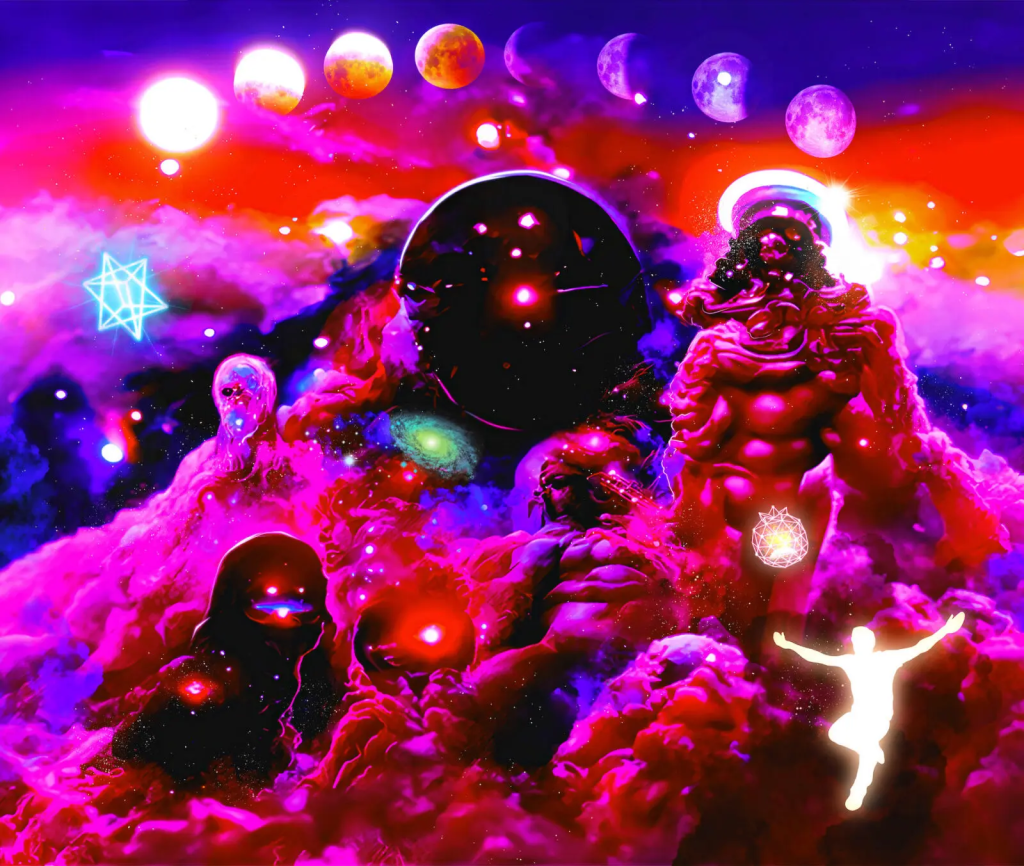
The glowing figure in the foreground is my own silhouette, walking and dancing through that terrain like a meditative avatar. The AI outputs gave me dozens of unsettling textures, but the real work was deciding which fragments felt true to the terror and beauty of Ezekiel’s language and which were just spectacle.
Another work explores the myth of the Sambatyon river, said to rage six days a week and rest only on Shabbat. For that piece, I fine‑tuned Stable Diffusion on my existing style and then asked it for impossible rivers: streams of light, shattered planets, and planetary eyes that watched the water (“Jewish Futurism”). I layered those textures with hand‑painted elements to create a scene where a lone human figure stands at the edge of a cosmic torrent that briefly calms. The model could hallucinate a thousand strange rivers, but only a human choice could decide which one carried the emotional weight of a world that is always almost at rest and never quite there.
Readiness Before Revelation: The Sar HaTorah Framework
The Zohar’s parable of the Sar HaTorah, the angelic teacher summoned by a rabbi for instant wisdom, warns that revelation demands readiness (Zohar, Introduction). The rabbi gains divine knowledge but nearly dies from overload. The story is not opposed to knowledge. It is about integration.
This tale offers a design ethic for AI. The Sar HaTorah Framework structures engagement in three stages:
- Hachanah (Preparation): set intention, purify data, and ask why we are creating.
- Hishtatfut (Participation): collaborate consciously with the machine, using its speed and scale while maintaining human authorship, accountability, and empathy.
- Teshuvah (Reflection): review consequences, biases, and impacts; take responsibility for harms and repair what was overlooked.
In the classroom, this often looks like taking a breath before anyone opens a laptop, naming aloud what we hope the tool will help us do, and agreeing on red lines for its use (Freeman and Mayse). After a project, it means debriefing not just the final image or app, but the process and its ethical ripples.
Approached this way, AI becomes not a shortcut to wisdom but a partner in its disciplined pursuit. It enacts a metamodern humility in which we build with awe and awareness at the same time.
Hiddur Olam: Beautifying and Repairing
Hiddur Olam, “to beautify the world,” fuses Hiddur Mitzvah (beautifying ritual) with Tikkun Olam (repairing the world). It reframes creativity itself as spiritual service and as a design system where beauty and ethics co‑produce meaning (Wirth, “Hiddur Olam”).
Rooted in Dewey’s experiential learning, Kolb’s learning cycle, and Mussar’s ethical traits (Dewey; Kolb; Wirth, “Hiddur Olam”), Hiddur Olam unfolds in six stages: Study, Envision, Ground, Co‑Create, Reflect, and Carry Forward. When joined with AI, it turns technology into sacred process:
- Study: AI can surface patterns across commentary and reveal connections that human readers might miss (“Torah Study and the Digital Revolution”).
- Envision: it can visualize text, sound, and symbolism and map Torah as a constellation of interlinked ideas (“Torah Study and the Digital Revolution”).
- Ground: it can prompt ethical reflection by modeling dilemmas, bias, or moral consequences (“Judaism and AI Design Ethics Part 1”).
- Co‑Create: it can amplify creative collaboration and scaffold group art or music rooted in Torah themes (Adat Ari El).
- Reflect: it can archive process transparently and support cheshbon hanefesh, or ethical accounting.
- Carry Forward: it can translate insights into accessible formats such as AR, VR, and multiple languages and expand the covenant of learning (Prizmah).
Over the past few years, I have been testing Hiddur Olam through a multi‑volume art book project on the Torah portions, beginning with Bereshit (“Hiddur Olam”). I created one image for each parasha, always starting from a single word, line, or moment in the text that echoed something I recognized from creative life. A character’s hesitation might become a blurred stroke; a moment of cosmic expansion might turn into layered spheres and ripples of color. Sometimes I used AI for ideation or textures, often running newer versions of my own trained model, and then refining by hand until the image felt like an honest parallel to both the Torah story and the inner drama of making anything at all (Wirth, “Spiritual Creativity”). Sharing these works with students and communities has turned the cycle itself into a practice, where the art becomes a mirror for their own struggles with beginning, failing, revising, and starting again.
Each use becomes holy when guided by middot: kavannah (intention), emet (transparency), tzedek (justice), hiddur (beauty), and teshuvah (reflection) (“A Jewish Theological Perspective on Technology”). Hiddur Olam transforms design into devotion and code into covenant (Wirth, “Hiddur Olam”).
Taken together, the Sar HaTorah stages and Hiddur Olam’s six steps form a kind of Jewish Design Thinking cycle. It begins with study and intention, moves through collaborative making, and returns in reflection and repair. This is not generic human‑centered design. It is mitzvah‑centered and community‑centered design, measured by tzedek, emet, and hiddur rather than by engagement metrics alone (Prizmah; Adat Ari El).
Creative Practice as Torah
In the classroom and studio, creative collaboration becomes a form of Torah she’bema’aseh, Torah of action. When communities co‑paint a mural, code a generative landscape, or build an interactive ritual, they perform theology (Jewish Creative Sensibilities).
One workshop on Shabbat and technology at Providence Country Day stays with me. I asked the Jewish students club to design speculative Shabbat devices that would honor the spirit of rest, with one constraint: each idea had to use AI as an ingredient, not a loophole. Their first concepts included a “pre‑Shabbat planner,” an AI that would work only during the week to help organize meals, divrei Torah sources, and guest logistics so that by candle‑lighting every screen could shut down and people could actually exhale into the day of rest. Another group sketched a “story seed” tool that would generate just the first paragraph of a midrashic bedtime tale from a few spoken prompts, leaving the rest of the story to be finished aloud at the table without any devices. As they presented, the students argued, like a pop‑up beit midrash, about which designs genuinely deepened Shabbat and which quietly pulled them back toward constant convenience. The room shifted when one quiet student finally said, “Maybe the most Jewish thing AI can do on Shabbat is remind us to stop using it,” and everyone recognized that their “coolest” ideas were often the ones that erased the need to slow down at all. That shared moment of realization, more than any prototype, was the Torah we made together.
AI enhances this work when it supports, rather than replaces, human imagination:
- It can model interpretive possibilities and expand midrashic dialogue (Freeman and Mayse).
- It can generate interactive visualizations of text structure and help learners see commentary as relational networks (“Torah Study and the Digital Revolution”).
- It can simulate moral scenarios and invite learners to wrestle with empathy in digital form (“A.I., Halakhic Decision Making”).
In these settings, authority dissolves into participation. Knowledge becomes co‑created, ethical, and embodied (Jewish Creative Sensibilities). This is a powerful expression of metamodern faith that is sincere, self‑aware, and alive to paradox.
Judaism Answering Itself
Judaism has always been metamodern. It believes and doubts at once, reveres and revises, and guards and reinvents (Scholem 1–10). Its survival has never depended on static answers but on the courage to redesign its questions.
AI now becomes the next instrument of that redesign. It allows us to test what covenant means in a world of mirrors. It can trace interpretive lineages across millennia, simulate voices of rabbis and philosophers, or visualize the evolution of a single idea through time (“Torah Study and the Digital Revolution”; “A Jewish Theological Perspective on Technology”).
Jewish futurism will not succeed on imagination alone. It needs Jewish Design Thinking, a disciplined way to dream, build, and then review our creations against tikkun olam, emet, and kavannah before we release them into the world (Prizmah; Adat Ari El). My Jewish futurism projects, from neon speculative self‑portraits to AI‑integrated ritual prototypes, are small attempts to practice this in public (“Jewish futurism”; Wirth, “Spiritual Creativity”). They are betas for a future Judaism in which our tools are strange and luminous, but our commitments to repair and responsibility remain non‑negotiable.
AI cannot choose why we study, create, or repair. That remains human work. The Sar HaTorah teaches readiness, and Hiddur Olam teaches responsibility. Together, they suggest a metamodern theology of technology that is reverent, experimental, ethical, and open‑ended (“A Jewish Theological Perspective on Technology”).
Works Cited
Adat Ari El. “The Intersection of Design Thinking and Jewish Education.” Adat Ari El, 29 July 2025.
Benjamin, Walter. “The Work of Art in the Age of Mechanical Reproduction.” Illuminations, translated by Harry Zohn, Schocken, 1969, pp. 217–51.
Borges, Jorge Luis. “The Library of Babel.” Labyrinths, New Directions, 1964.
Brown, Tim. Change by Design: How Design Thinking Transforms Organizations and Inspires Innovation. Harper Business, 2009.
Dewey, John. Experience and Education. Kappa Delta Pi, 1938.
“AI Meets Halachah.” Jewish Action, 7 June 2023.
“Artificial Intelligence and Us.” jewishideas.org.
Freeman, Molly, and Ariel Mayse. “AI and Judaism.” New Lehrhaus, 2024.
Grossman, Guy. “Jewish Perspectives on Artificial Intelligence and Synthetic Biology.” Hakirah, vol. 35, 2023.
Jewish Creative Sensibilities: Framing a New Aspiration for Jewish Education. The Lippman Kanfer Foundation, 2019.
Kaplan, Mordecai. “Religion of Human Techno‑Genesis.” Jewish Philosophy Place, 2014.
Kol HaMevaser. “Elu Va‑Elu Divrei Elohim Hayyim and the Question of Multiple Truths.” 2015.
Kolb, David. Experiential Learning: Experience as the Source of Learning and Development. Prentice Hall, 1984.
Kurzweil, Ray. The Age of Spiritual Machines. Penguin, 1999.
Manovich, Lev. The Language of New Media. MIT Press, 2001.
“Not in Heaven: The Major Challenge to Artificial Halakhic Decisions.” Times of Israel Blogs, 2025.
Prizmah. “Design Thinking for Jewish Day Schools.” Prizmah Center for Jewish Day Schools, 2019.
Sacks, Jonathan. “Argument for the Sake of Heaven.” Covenant & Conversation, The Rabbi Sacks Legacy, 19 June 2022.
Scholem, Gershom. Major Trends in Jewish Mysticism. Schocken, 1941.
“Sefaria: A Living Library of Jewish Texts.” Sefaria.org.
“Torah Study and the Digital Revolution: A Glimpse of the Future.” The Lehrhaus, 28 Jan. 2020.
Vermeulen, Timotheus, and Robin van den Akker. “Notes on Metamodernism.” Journal of Aesthetics & Culture, vol. 2, no. 1, 2010.
Wirth, Mike. “Hiddur Olam: Creativity, Community, and the Future of Religious Education.” 2024.