
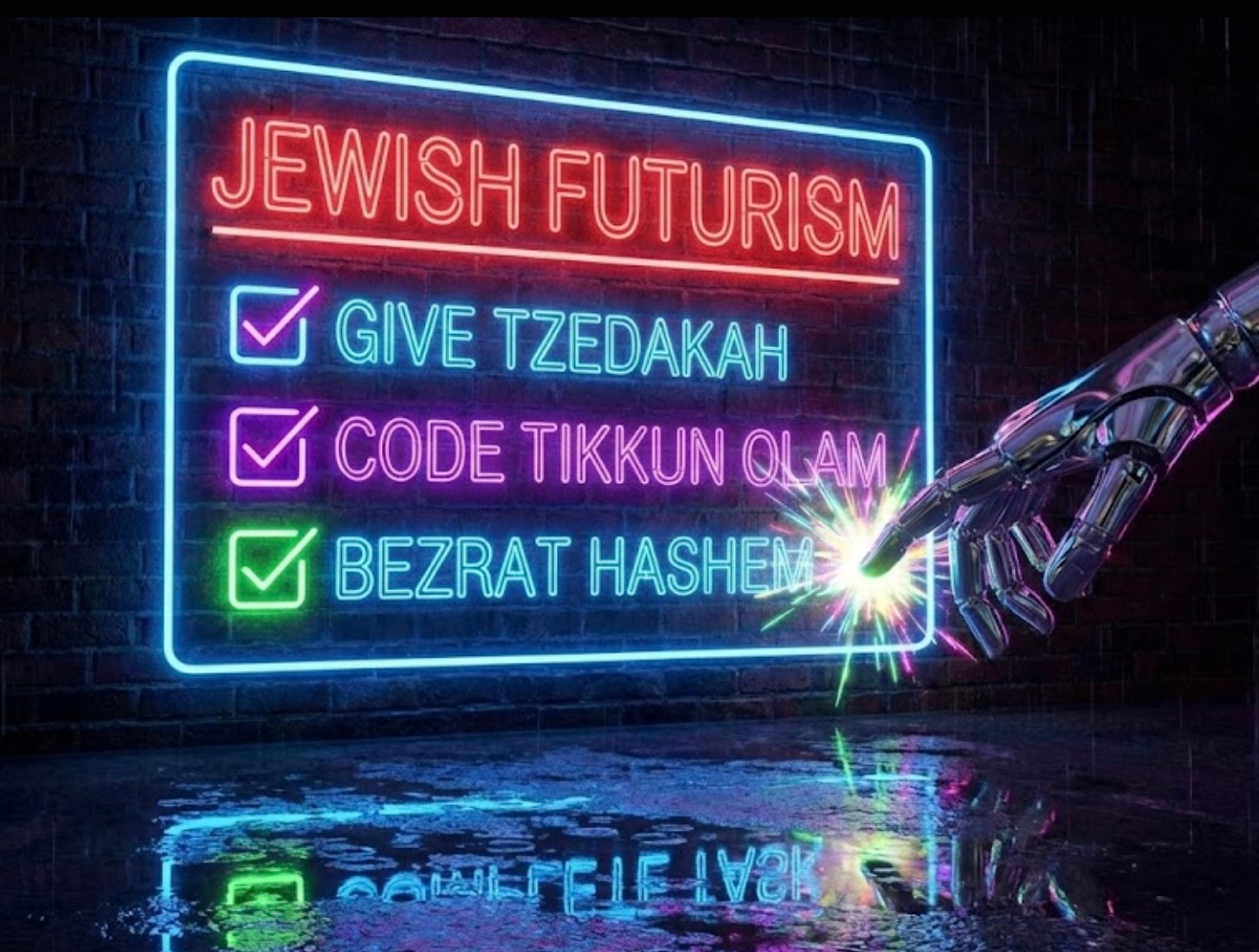
My working conversation about Jewish futurism
Let me start by saying what Jewish futurism is not, at least for me.
It is not putting a Star of David on a sleek sci-fi object and calling it a day. It is not “Jewish, but make it cyberpunk.” And it is definitely not about predicting the future like some kind of techno-prophet.
For me, Jewish futurism feels more like a reunion of kindred spirits.
A pulling back together of a long, messy line of prophets, mystics, cartoonists, coders, muralists, and weird uncles who stayed up too late arguing midrash. A line that runs from Torah and golems to comics and game engines. Not to escape history, but to carry it forward with intention.
When I build something under this banner, I try to remember that I am plugging into that line. And I need a way to check myself while I’m doing it.
So think of this not as a manifesto, but as a conversation. Something you can keep open next to your sketchbook, your code editor, or your half-finished ritual prototype.
Before you make anything, pause
Before the fancy shaders.
Before the slick prompts.
Before the paint flies.
Ask a simple question: What am I actually doing here, and who does it impact?
I come back again and again to this tension.
Am I sanctifying technology, or am I just showing off?
Tech is a utensil. It is not the main character. So I ask myself: what am I trying to elevate? Where is the kavannah? Where is the hiddur mitzvah, the moment where something becomes more beautiful, more meaningful, more reachable for someone else?
If the honest answer is “it’s just cool,” that’s not a failure. But it is a cue to slow down and look again.
Every golem needs an off switch
This part matters more than we like to admit.
The Golem story is our original dev-ops parable. The impressive part is not that the creature walks or lifts heavy things. The Jewish part is the letter you can erase to stop it.
When you’re working with powerful systems, AI, networks, social platforms, feedback loops, you have to ask:
What is the kill switch?
What are the limits, the norms, the literal or metaphorical buttons that stop this if it starts causing harm?
If there is no answer, you may be building the wrong kind of golem. Or at least one that needs more thought before it leaves the workshop.
And while we’re here, I try to be suspicious of the word “disruption.” Disruption is easy. Repair is harder.
So I ask: what does this actually repair? A dead corner of ritual? A missing story? A lack of joy? A pattern of exclusion?
If I cannot name the repair, I might just be speeding up something that was already broken.
The future does not work without memory
Jewish futurism is obsessed with what comes next, but it refuses to get there by burning the archive.
I try to ask myself: am I innovating with memory, or without it?
Innovation without memory is another version of a golem. Powerful, impressive, and hollow.
So I name my sources. Texts, stories, communities, teachers. I try to let at least one move in the work be a reply to someone who is not in the room anymore.
And I think about time differently.
Jewish time loops. We return to the same holidays, the same readings, the same traumas, but never in quite the same way. There is always another layer.
Does my work do that? Does it circle, repeat, echo, or sync to rhythms larger than me? Or is it just a straight rocket out of history?
I think of this as visual midrash
Midrash is not commentary. It is argument. It is wrestling.
Visual midrash just uses different tools.
Pixels. Lines. Sound. Code. Motion.
So I ask: which story am I arguing with? Which verse am I stretching, healing, poking at, or refusing to let go of?
If I am using generative systems or futuristic aesthetics, can I actually point to the Torah, prophet, or folktale that is in the room with me while I work?
If I cannot, that is information worth listening to.
If it costs nothing, it might not be finished yet
This is the uncomfortable part.
Good Jewish futurist work usually carries some tension. Between me and my community. Between hope and fear. Between what feels safe and what feels honest.
I think about Asher Lev painting the crucifixion. Not because I want to shock anyone, but because he showed what it looks like to take your tradition seriously enough to struggle with it in public.
If everything in the work feels pleasant and agreeable, I pause. I ask what I am avoiding.
And I try to practice anavah, humility, especially when working with big ideas and powerful tools.
Where do I admit I do not know?
Where do I invite critique?
Where do I let uncertainty live inside the work instead of editing it out?
Jewish stories are full of vessels that shatter when they hold too much light. That warning is still relevant.
Speed is not the same thing as light
Early Futurism loved speed for its own sake. Jewish futurism is more interested in illumination.
So I ask: does this actually help someone see something? A wound. An injustice. A joy. A strange truth that needed a frame.
If I am accelerating things, is it in service of understanding and empathy, or just adrenaline?
That distinction matters.
This is not a solo practice
Jewish futurism is a team sport. No lone techno-messiahs.
I try to ask: who is the “we” in this project?
Every healthy Jewish creative space I admire, from the Bezalel workshop to Vitebsk to the beit midrash, includes peers, elders, skeptics, and students. If I am making in a vacuum, I want to know what that protects me from, and what it costs the work.
This is where areyvut, mutual responsibility, shows up.
Does the project open doors for others? Share tools? Offer access or visibility? Leave the landscape more generous than it found it?
And when I step away, can anyone carry something forward? A format. A method. A story. A set of instructions.
Jewish futurism often moves like a relay baton. If everything ends with me, I might be breaking the chain.
Finally, I listen to the feel of it
Jewish futurism has a particular emotional texture.
Not “does it include a Jewish symbol,” but does it feel like it belongs to our long, strange story?
Could it sit next to a page of Talmud? A Chagall window? A Jack Kirby spread? A poem written in exile?
Is there any trace of the desert, the shtetl, the city, the bus stop, the protest, the beit midrash?
And is there a move here that only I could have made?
The future is full of generic chrome. Jewish futurism gets specific. It brings in accents, neighborhoods, family stories, and uncomfortable details. That specificity is what makes the work feel like a real chapter in the Jewish story, not a reskinned sci-fi asset pack.
I keep this list nearby when I work. Sometimes taped to the wall. Sometimes scribbled in the margins.
I do not try to hit every point every time. That would freeze the process.
But if I cannot hit any of them, that is usually a sign. What I am making might be about the future, just not yet operating in the Jewish futurist key.