
How Jewish Futurism Connects Our Past to the Worlds We Have Yet to Build through Creative Action
By: Mike Wirth
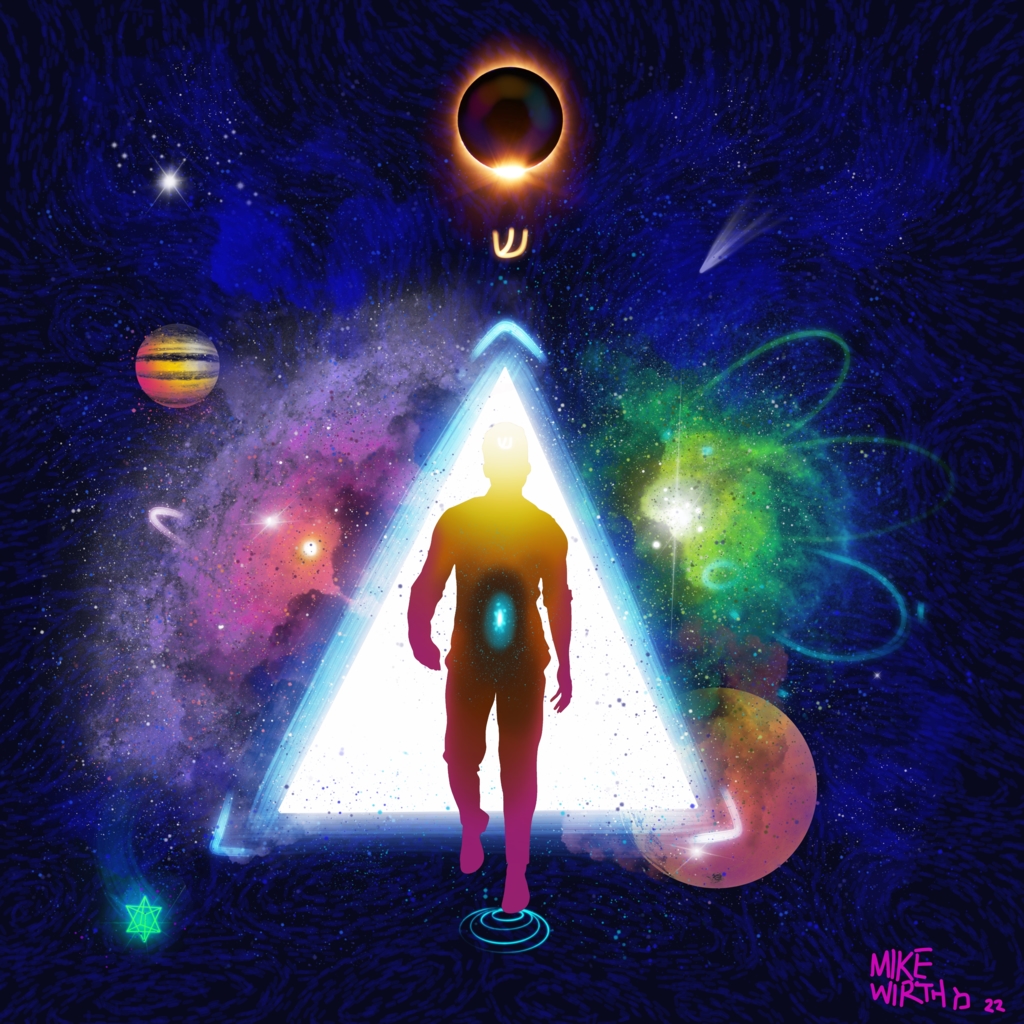
I often say that I found my Jewish spirituality on the bridge of the Enterprise. In 2019, my love for sci-fi and the many amazing stories, myths and legends in the Jewish canon inspired me to begin making Jewish Futurist artwork and stories. Initially, I approached my Jewish Futurism project as something entirely new to me and was an artistic frontier I felt empowered to explore and innovate. Yet, the deeper I ventured into its history, the clearer it became that I wasn’t inventing anything novel but reconnecting with a visionary legacy deeply embedded within Jewish thought and creativity. Recognizing this heritage has profoundly empowered me as an artist and designer. It has also shown me that the future, like design itself, is fundamentally a team sport, thriving when we create collectively and collaboratively. As I journey boldly into new creative worlds, I continually ask: how might emerging technologies and speculative storytelling expand our sense of what it means to be Jewish?
Recognizing Futurism as inherently Jewish matters deeply today. In a world experiencing rapid technological advancement and cultural shifts, understanding that Futurism is deeply rooted in Judaism is essential. Realizing innovation and speculative thought aren’t new but are foundational to Jewish identity gives us powerful tools to navigate contemporary challenges. I’ve learned that Jewish identity has always been a continuous process of reinterpretation and reinvention. Traditions evolve, stories adapt, and rituals transform. In my artistic practice, I actively engage with this tradition of innovation by creating neon-infused aesthetics, speculative narratives, and AI-integrated rituals that explore contemporary Jewish life and spirituality.

The contemporary wave of Jewish Futurism, evident in neon aesthetics and bold imaginative storytelling, represents the latest chapter in an ancient story of reinvention and visionary thinking. It’s deeply connected to broader cultural Futurisms, including Afrofuturism and Indigenous Futurism, which reclaim historical narratives while envisioning new futures. A powerful example of cross-cultural futurist collaboration is Wakanda, the Afrofuturist society in Marvel’s Black Panther, created in 1966 by Jewish comic writers Stan Lee and Jack Kirby. Later expanded asynchronously by Black creators like Marvel artist Billy Graham in 1974, though asynchronously in method, the development of Wakanda highlights the transformative power of collaboration and cultural exchange—principles central to my approach to Jewish Futurism. I envision Jewish Futurism similarly flourishing through dialogue, learning from, and uplifting other futurist movements to build a collective, visionary future. Just as Afrofuturism reclaims history through sci-fi and technology, Jewish Futurism draws on Jewish history and spirituality to construct new speculative identities. That clearly makes me wonder what a synchronous or intentional futurist collaboration between the two movements looks like?
Jewish tradition treats time as cyclical rather than linear, an approach distinctly aligned with futurist thinking, where past, present, and future dynamically interact. I’ve always found this cyclical concept of time particularly inspiring: it isn’t merely memory-based, but anticipatory. The Jewish calendar intertwines historical remembrance with a continuous vision of the Messianic Age, guiding ethical decisions across generations. Every Shabbat offers a glimpse of the ideal world we aim to build. This way of thinking about time aligns closely with my creative work and the speculative fiction, digital media, and futurist designs I admire.
Architects of the Unseen: Jewish Artists and the Futurist Mindset
Jewish creativity has embodied futurist thought throughout history, particularly during artistic and intellectual breakthroughs. Learning about El Lissitzky’s (1890–1941) Had Gadya series (1919), which transformed a traditional Passover song into abstract Suprematism, deeply influenced me. His work wasn’t just artistic experimentation—it was visionary, imagining a liberated Jewish future through visual language. Similarly, Marc Chagall’s (1887–1985) surrealistic paintings like I and the Village (1911) weren’t just nostalgic; they projected mystical futures. The innovative designs of Bauhaus architect Erich Mendelsohn (1887–1953), including the Einstein Tower (1921), similarly anticipate new Jewish identities through dynamic, visionary architecture.

The Golem legend associated with Rabbi Judah Loew of 16th-century Prague provides an early exploration of artificial intelligence and ethical creation, echoing contemporary discussions in my own work and research around AI ethics. Similarly, the Sar Torah tradition in Kabbalah, in which letters of the Torah are endlessly recombined to generate new insights, resonates strongly with my contemporary experiments with AI-driven Torah study. The legend speaks of summoning an angel to teach Torah on demand, an idea akin to algorithmic knowledge generation in modern AI tools. I’ve seen some attempts on OpenAI’s website, but imagining a self-aware “HashemGPT” is exciting and terrifying.
Jewish intellectuals significantly shaped avant-garde movements through innovative methodologies deeply rooted in abstraction and adaptation. When El Lissitzky designed his “prouns,” he wasn’t simply creating abstract forms; he was actively shaping new visions of spatial possibilities. Erich Mendelsohn’s architecture similarly embodied dynamic motion, symbolizing Jewish resilience. Studying these artists has profoundly impacted how I approach my own speculative design practice, encouraging me to envision meaningful and adaptable futures. These forms and aesthetics successfully connected to the “universal,” acting as gateways into Jewish thought for the wider world.
Much like the supernatural adventures of Moses and Ezekiel, the realm of science fiction and superheroes has been profoundly influenced by themes and symbols from Jewish stories. Hugo Gernsback (1884–1967), founder of Amazing Stories (1926), coined the term “science fiction,” profoundly shaping the genre. Isaac Asimov’s Foundation series (1951–1993) directly engaged with the preservation of knowledge, influencing modern thought on technology and ethics. William Tenn’s On Venus, Have We Got a Rabbi (1974) playfully merged Jewish identity with extraterrestrial society, highlighting how speculative fiction uniquely addresses identity and existential questions.
Jewish creators have left a profound legacy in speculative fiction. Stanley Kubrick’s 2001: A Space Odyssey (1968) and A Clockwork Orange (1971) deeply explored human morality and existential questions through futurist storytelling. Jerry Siegel and Joe Shuster’s Superman (1938) reshaped storytelling, directly connecting Jewish themes of exile and sanctuary with futurist imagination through Superman’s Fortress of Solitude, a symbol of refuge and transformation.

Partners in the work of creation: Going forward
Today, Jewish Futurism continues these historical legacies within global speculative culture. In my own practice, I utilize AI-generated imagery and digital tools to conceptualize futuristic Jewish spaces and rituals. This process mirrors traditional midrashic reinterpretations—making Jewish narratives relevant and resonant for contemporary generations. Experimental art, VR storytelling by the TorahVR project, neon Hebrew typography by artists like Hillel Smith, and innovative biomaterials by designers like Neri Oxman demonstrate how traditional Jewish practices meaningfully evolve. Core Jewish values of Tikkun Olam (repairing the world), Kavanah (focused intention), and L’Dor V’Dor (generational knowledge transfer) guide my futurist creativity, emphasizing ethical engagement, meaningful innovation, and continual adaptation.
Understanding Futurism as a deeply Jewish impulse doesn’t merely enrich our historical perspective—it empowers us as contemporary creators, thinkers, and innovators. The Talmud says we are to partner with Hashem in the work of creation and equipped with this knowledge, we can confidently shape our future, build meaningful new traditions, and actively collaborate with diverse communities. Our shared futures depend on our courage to dream out loud, innovate collectively, and proudly carry forward the visionary spirit at the heart of Jewish identity.
