
Back in 2014, when I first started to create my Jewish futurist art and stories, I thought that my character, the Wanderer should live a few hundred years into the future, so my spiritual technology objects could just “work” as he travels through time to different Jewish moments in history. But not everything in the Jewish cannon of stories are historical, so that became a narrative issue for my characters extraterrestrial abilities to be believable. I shifted to think about what if the character existed not in the “future” based on time, but in a liminal space built entirely out of the Jewish cannon of stories. This is the first thing to understand when thinking about Jewish futurism as a creative practice. We’ve learned to think of thresholds as thin lines, transitional moments you pass through quickly on your way from one stable state to another. But Jewish textual tradition suggests something different: the threshold itself can be a world, a zone of variable width where multiple versions of the same story coexist without resolution.
This is where Jewish futurism lives and works.
The Wilderness Prototype
The Book of Numbers, Bamidbar in Hebrew, literally means “in the wilderness.” Rabbi Jonathan Sacks identified this wilderness period as Israel’s formative liminal experience, a space “between Egypt and the Promised Land” where the people transformed from “escaping slaves” into “a kingdom of priests and a holy nation”. The wilderness wasn’t just a route to somewhere else. It was the place where identity formed, where law was given, where the impossible work of becoming happened.
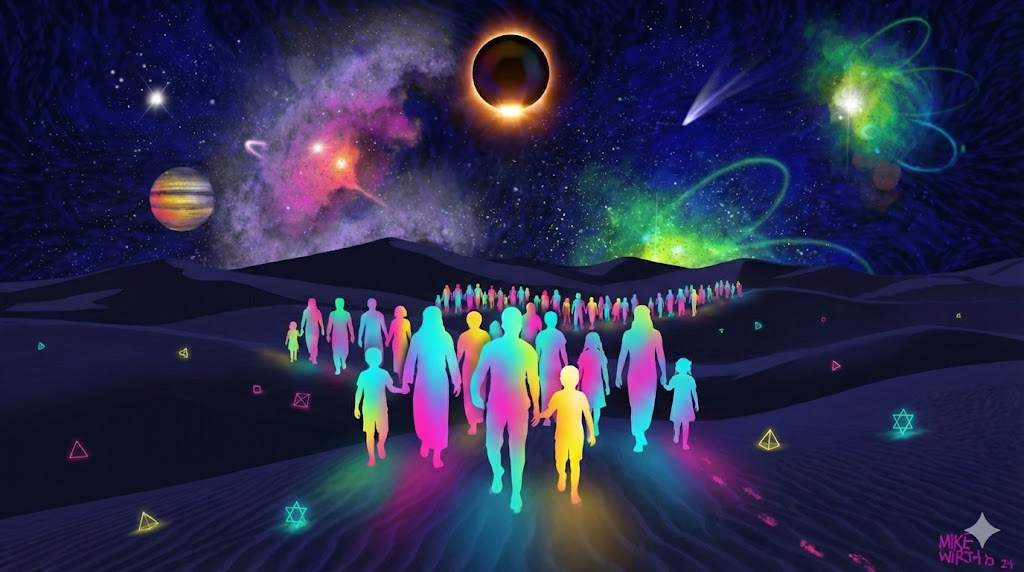
Jewish futurism inherits this structure. It positions itself in a wilderness between deep tradition and speculative futures, refusing to resolve that tension into either pure preservation or pure innovation. The creative power comes from staying in the threshold.
Multiformity: When Stories Refuse to Collapse
Jewish textual tradition demonstrates something unusual: it preserves multiple versions of the same story without declaring one correct and the others false. The Talmud includes the story of how Jewish children survived Pharaoh’s decree in two different midrashim, Exodus Rabba 1:12 and Exodus Rabba 23:8, telling “essentially the same story” with different details and emphases. Both remain authoritative. Both are studied. Neither cancels the other out.
This happens again with the creation narratives in Genesis, which offer two distinct accounts that the rabbis never harmonized. When Genesis 2:23 has Adam declare “this time (zot hapa’am) bone of my bone,” the rabbis read the phrase “this time” as evidence there must have been a first time, another woman before Eve. This reading generates the Lilith tradition, which itself exists in radically different versions across texts. Sometimes she’s a Mesopotamian demon, sometimes Adam’s first wife who refused subordination, sometimes multiple Liliths entirely (the Matron Lilith mated with Samael, the Lesser Lilith with Asmodeus). The tradition never consolidates these into one coherent mythology.
This is what I mean by calling liminal space a “storehouse of options.” All these versions exist together, not as rough drafts leading to a final text, but as a permanent multiplicity. The creative work happens in the space between versions, where meaning emerges from juxtaposition and contradiction rather than resolution.
Metamodernism and the Jewish futurist Oscillation
Jewish futurism operates through what contemporary theory calls metamodernism, an approach that “oscillates between a modern enthusiasm and a postmodern irony, between hope and melancholy, between naivete and knowingness, empathy and apathy, unity and plurality, totality and fragmentation”. This isn’t confusion or inconsistency. It’s a deliberate method of holding contradictions in productive tension.
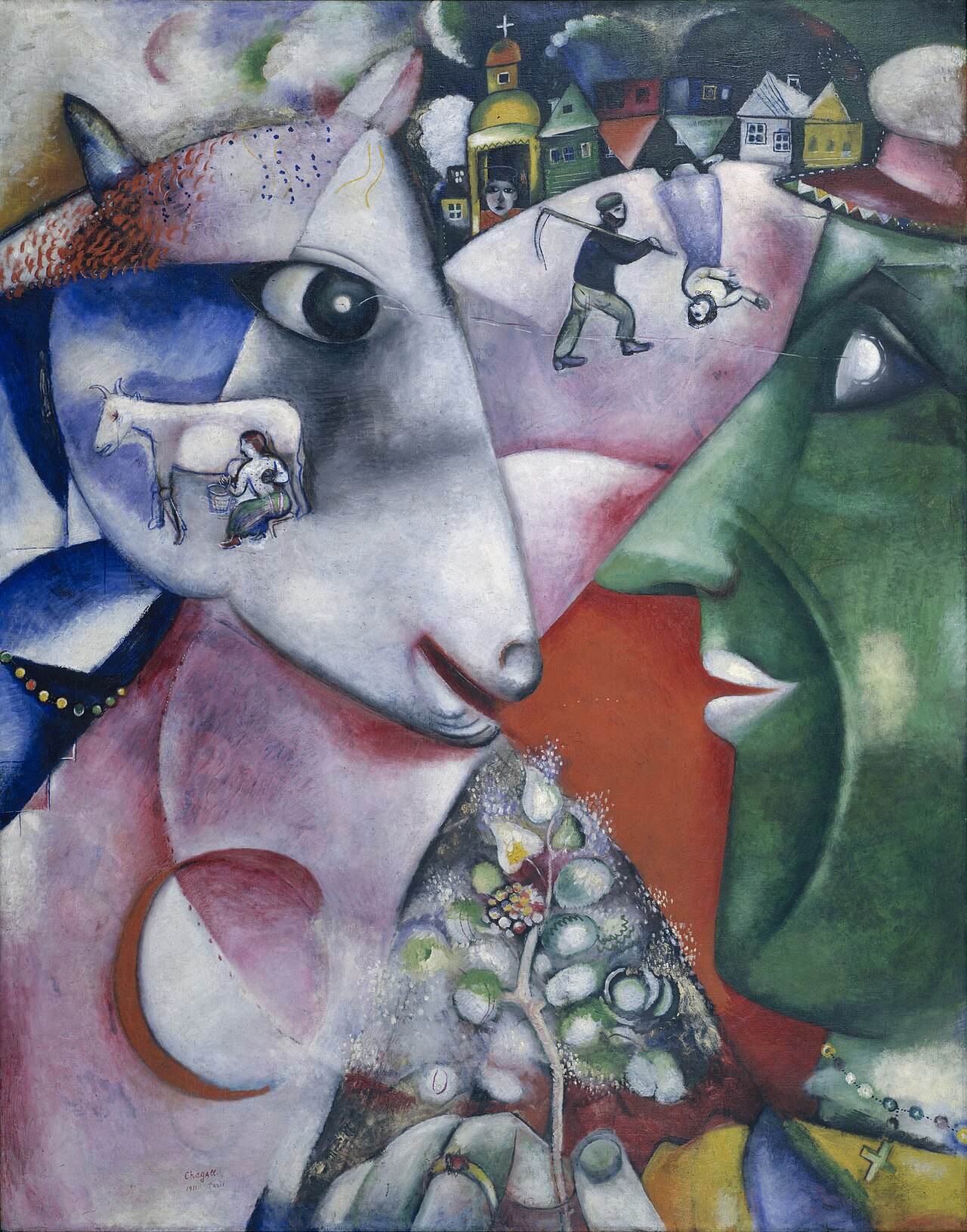
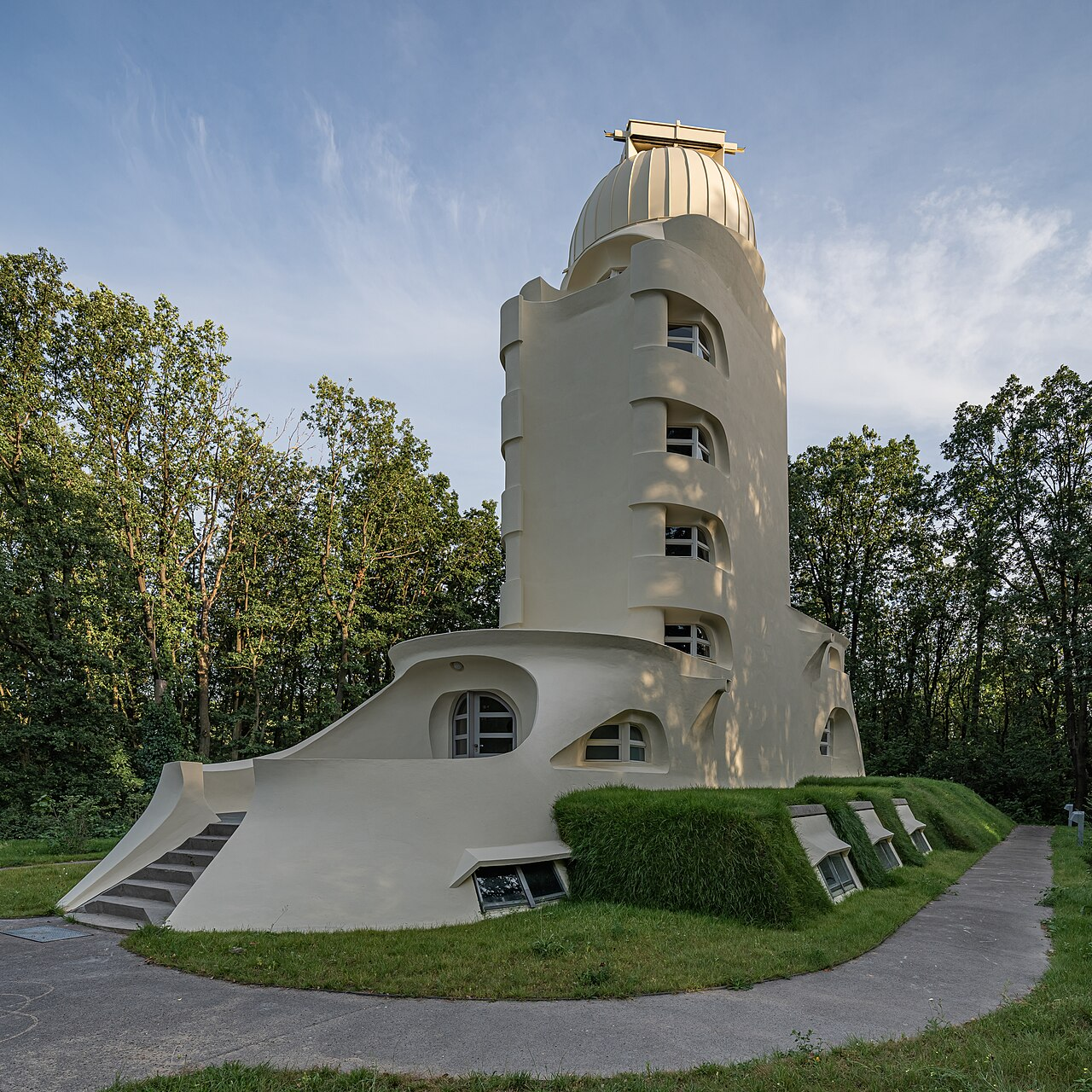
Consider Marc Chagall’s I and the Village (1911), which projected “mystical futures” while remaining rooted in shtetl imagery, or Erich Mendelsohn’s Einstein Tower (1921), which used “dynamic, visionary architecture” to anticipate “new Jewish identities” while drawing on Jewish cultural memory. Both works refuse to choose between past and future. They exist in the oscillation itself.
My own practice with neon aesthetics, AI-integrated rituals, and speculative spiritual objects tries to inhabit this same oscillating space. The work is simultaneously reverent toward tradition and radically speculative about Jewish futures. It takes the midrashic impulse (interpreting and expanding upon existing texts) and applies it to material culture, visual art, and interactive experience. The question isn’t whether to look backward or forward, but how to create in the charged space where both directions exist at once.
The Danger of Over-Explanation
Here’s where methodology becomes crucial. The liminal space has power precisely because it resists total systematization. When you map everything, explain all the connections, resolve all the contradictions into a coherent world, you destroy the liminal quality you were trying to work with.
The internet phenomenon of The Backrooms demonstrates this perfectly. In 2019, someone posted a single unsettling image on 4chan: an empty office space with yellowed lighting that evoked uncanny familiarity and wrongness. Its power came from mystery and minimalism. You could project your own dread onto that space. It remained undefined.
But as one analysis explains, “the internet tends to reject simplicity. A mere image cannot suffice; it demands depth, a narrative, characters, and intricate worldbuilding”. Within months, The Backrooms “transformed from a strange setting into an entire alternate dimension, complete with its own physical laws and terrifying creatures. There are countless levels, each featuring unique themes, ecosystems, backstories, and factions”. A commenter captured what was lost: “Modern Fandom kills that feeling of liminality and making up your own interpretations. You’re never just ‘alone’ with a game or story giving you fractured information”.
The lesson for Jewish futurism is clear. The moment you turn the “storehouse of options” into a fully mapped shared universe (like the Marvel Cinematic Universe or an RPG sourcebook), you’ve left liminal space behind. You’re no longer working with multiformity but with a single systematized world that happens to contain variety.
Dwelling in the Threshold
Jewish futurism as creative practice means learning to dwell in the threshold rather than passing through it. It means producing work that operates like midrash, creating new versions that coexist with rather than replace existing ones. It means embracing the metamodern oscillation between tradition and speculation, between melancholy and hope, between the archive and the unknown.
Most importantly, it means resisting the urge to explain everything, to make it all cohere. The wilderness between Egypt and the Promised Land was where transformation happened precisely because it was undefined space, liminal territory where old certainties no longer held but new ones hadn’t yet solidified. That’s the space where Jewish futurism works.
The magic is in the mystery. Once the mystery is gone, so is the magic.