What does it mean to make creativity a sacred practice, and how can art transform Jewish life? For me, becoming a Jewish artist wasn’t a career move. It was a spiritual awakening. This article traces how I came to see the creative process not only as a personal path to the divine but as a communal tool for connection, healing, and evolving Jewish tradition. Through murals, rituals, digital artwork, and collaborative design, I’ve learned that creativity can be one of the most powerful forms of Jewish practice we have today.
“Why would you become a Jewish artist?” people used to ask me. “Isn’t that limiting your market to a very small sliver?” It’s true, I wasn’t always a Jewish artist. In fact, for a long time, I rarely made Jewish art. I was unsure. Afraid. Happy to be an assimilated American. Unaware of how essential it would become for me and for my community.
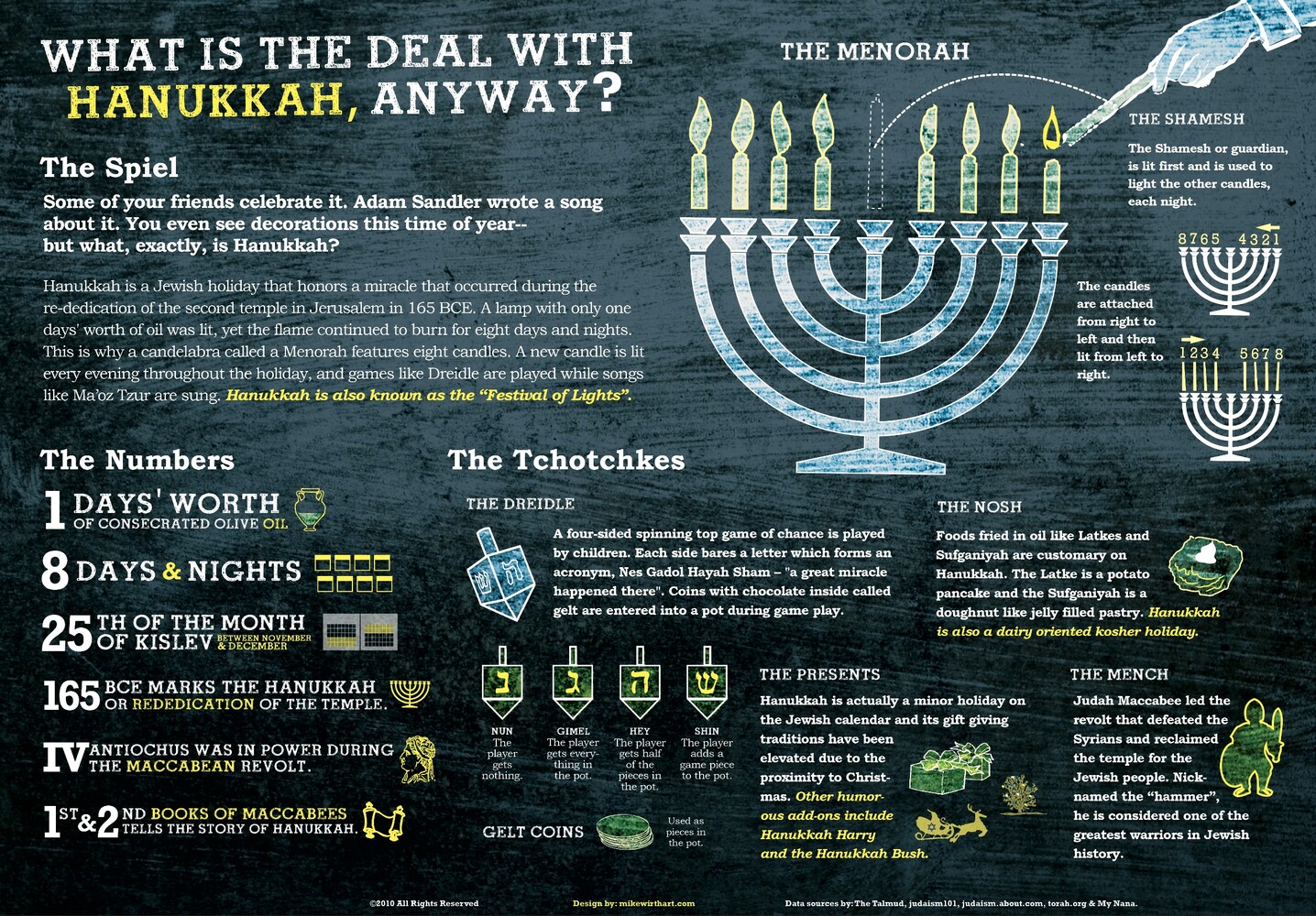
I flirted with Jewish-themed projects years ago. Between 2008 and 2010, I worked with Hillel International and Manischewitz to create Jewish holiday infographic posters for social media. In 2014, I collaborated with the JDC (Joint Distribution Committee) to visualize their financial data and annual reports. I was illuminating the divine, even though I didn’t call it that yet.
It wasn’t until 2015 that I truly made my first Jewish artwork: a portrait of Anne Frank for a mural exhibition called Renegades. Other artists were painting their own cultural heroes. Selecting figures who had gone against the grain. I realized it was time to seek my own. Anne Frank became my entry point into this work, a symbol to me of resilience and a powerful voice against erasure.
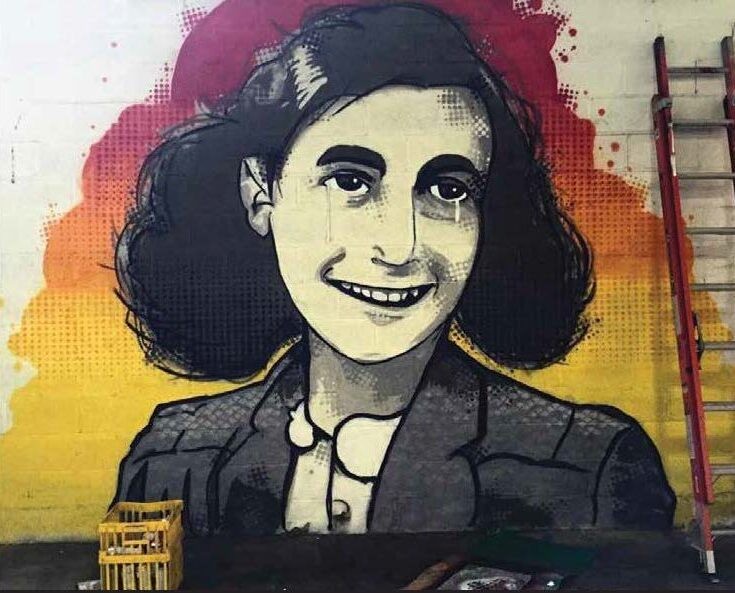
That act of painting her opened a door. Slowly, I began to turn toward the sacred in my own tradition. The power of a large, colorful, public mural amplified the song I wanted to play during the process of making this artwork. My art-making became a form of prayer, my studio transformed into a sacred space, and my creativity evolved into an intentional spiritual practice.
This shift happened when I read the Art of Jewish Prayer by Yitzhock Kirzner, Aryeh Kaplan’s Sefer Yetzirah: The Book of Creation, and My Name is Asher Lev by Chaim Potok, that I consciously directed my art towards sacred purposes, rooted in the Jewish tradition of Hiddur Mitzvah, the beautification of commandments. These texts provided context, examples, and permission to dive deep into creation with the Creator. Creating art that explicitly engaged Jewish symbols, rituals, and values was transformative. It connected my creative spirit directly to my Jewish heritage, deepening my understanding of who I was as both an artist and a Jew.
Seeking Spirituality Beyond Home
For years, spirituality felt elusive. I searched widely through books, traditions, and practices that were not native to me. They were meaningful, somewhat familiar, but not quite mine. The connection I sought remained just out of reach, inauthentic because it lacked resonance with my core identity.
But art always felt different. Unlike anything else, the creative process opened a space where I felt fully present, deeply focused, and yet somehow expanded beyond myself. When I was in the flow of making, I experienced peace, clarity, and a sense of connection to something ineffable. Creativity became a spiritual threshold where my ego dissolved, time softened, and I encountered what I can only describe as spirit.
Much like prayer or meditation, creativity required me to slow down, listen, and surrender. There was kavannah or intention and there was surrender to something unfolding through me, not just from me. The act of making was mirroring sacred ritual: there were preparations, gestures, rhythms, and moments of revelation. I realized I was building altars out of paper, light, pigment, and symbol.
In those moments, my studio wasn’t just a workspace, but it was a mikdash me’at, a small sanctuary. Making became prayer. Not metaphorically, but truly: a way of communing with the Divine, of processing the world, and of seeking wholeness through acts of beauty and imagination.
Turning Toward the Divine
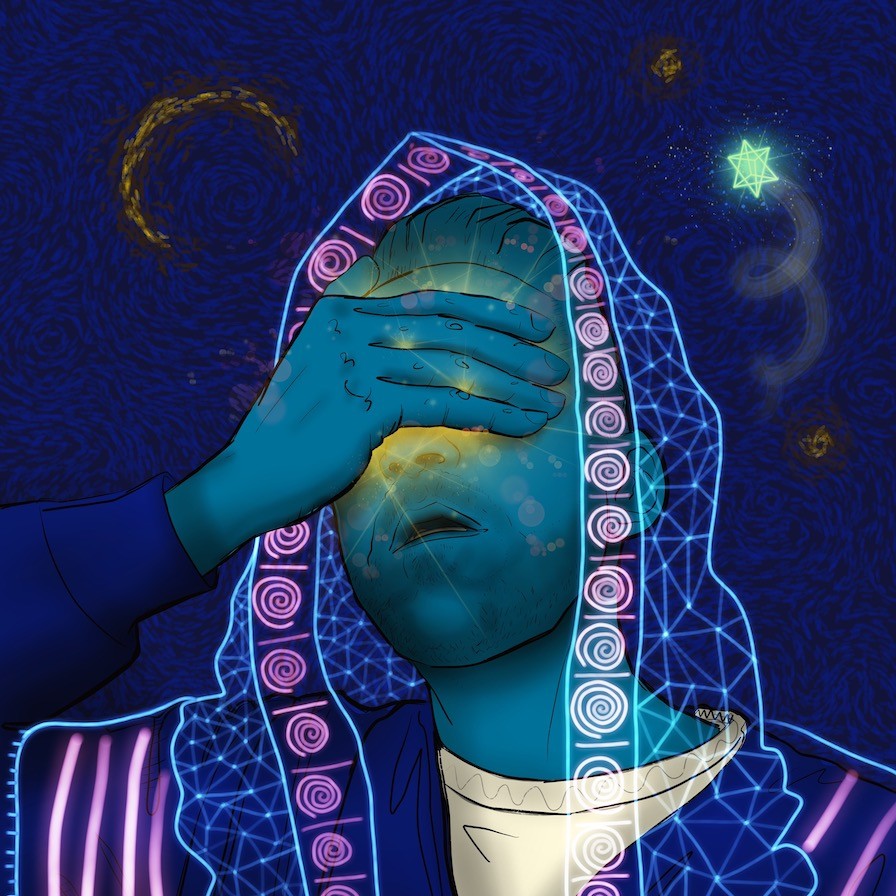
Everything shifted when I began to turn that creative intention toward the divine. Through Jewish themes, symbols, and rituals, I discovered a channel between my artistic life and my spiritual heritage. I wasn’t just illustrating ideas anymore, I was beginning to create images of the supernatural sensations I experienced in prayer and meditation. My imagination was filled with light, energy, movement, and meaning that felt deeply sacred and alive. I longed to capture the invisible. To make visible the ineffable sparks, flows, and forces that surged through ritual, study, and spiritual presence. I began to see the hidden energy encoded in the stories of the Torah. Figures like Moses, Miriam, and Elijah took on a new presence in my mind and not just as biblical characters, but as spiritual superheroes, carriers of divine power and transformation. Suddenly, creativity was no longer a separate mode of expression; it became my way of connecting, of serving, of sanctifying.
Deepening Jewish Knowledge and Art
That epiphany led to study. I immersed myself in Jewish art, theology, and spiritual traditions: Betzalel, Kabbalah, Hiddur Mitzvah, Mussar. I found ancient frameworks that affirmed what I had already intuited that art could be holy. That beauty was not frivolous. That creativity could be a form of moral and spiritual refinement.
At a certain point, I realized I didn’t just want to explore this for myself and I wanted to help build a new creative-spiritual system that other Jews could use in practice. A framework that would invite both artists and non-artists to access spirituality through creative intention. A system rooted in Jewish values but expansive enough to meet people where they are in their community centers, schools, studios, or synagogues. A new pathway for sacred practice that could evolve alongside Jewish life itself.
Design and the Sacred Creative Process
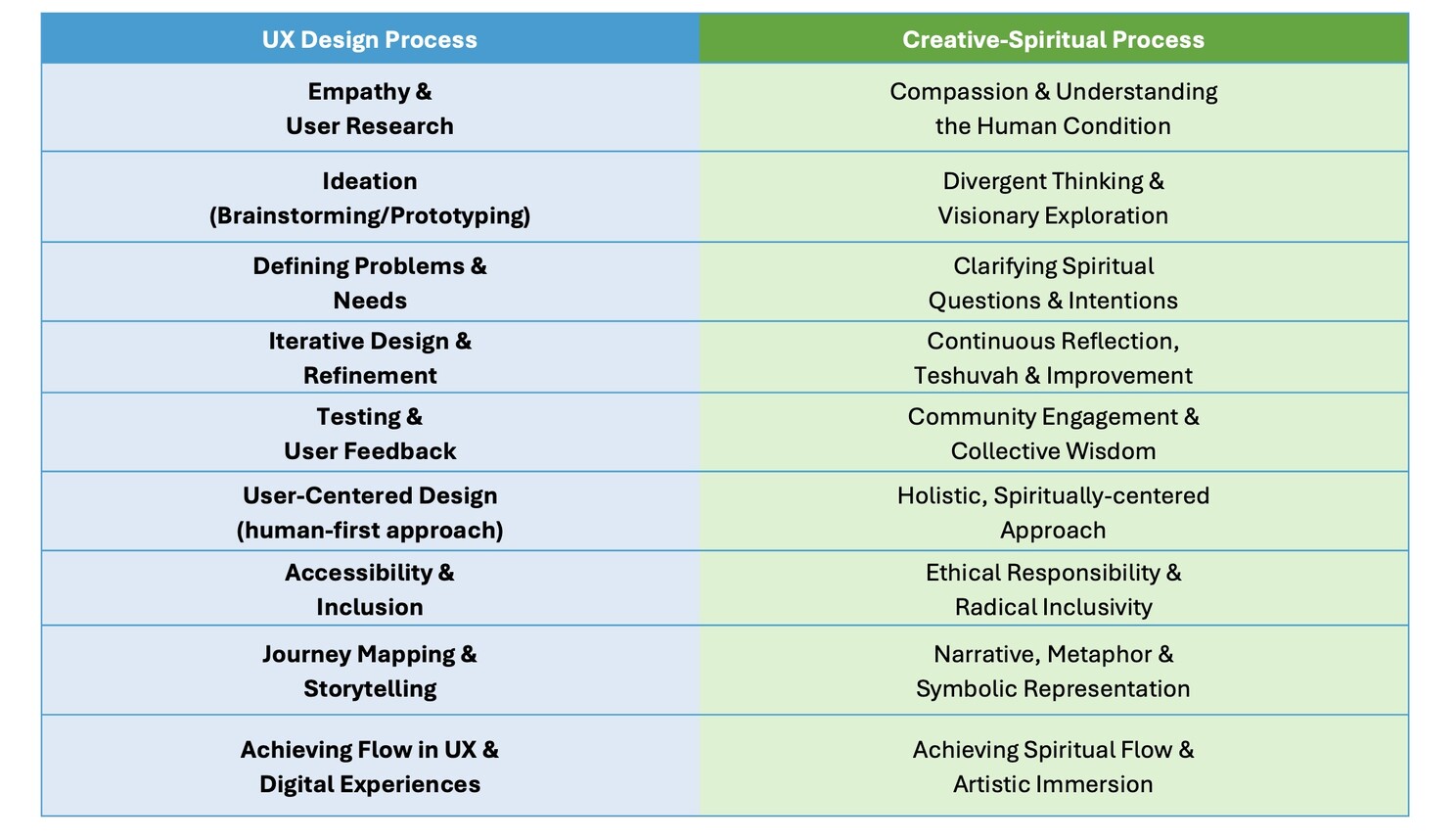
As a designer and artist, I began to notice profound overlaps between the spiritual frameworks I was studying in Judaism and the design methodologies I used professionally. Both begin with empathy and intention. Both evolve through cycles. Both aim to make meaning. When I merged these systems, they each became more accessible, emotional, and impactful, not only for myself, but for others engaging with my work.
This led me to develop a process I now use in both personal practice and community workshops. It blends design thinking, Jewish intentionality, and artistic exploration. I begin by identifying a question or tension. Something personal or communal. I respond with sketches, writing, or prototypes, then reflect on what resonates. I refine or rework the ideas in cycles, grounding the process in kavannah (spiritual intention) and humility. Over time, it becomes more than a finished piece, it becomes a tool for spiritual insight and connection. Here’s how it typically unfolds:
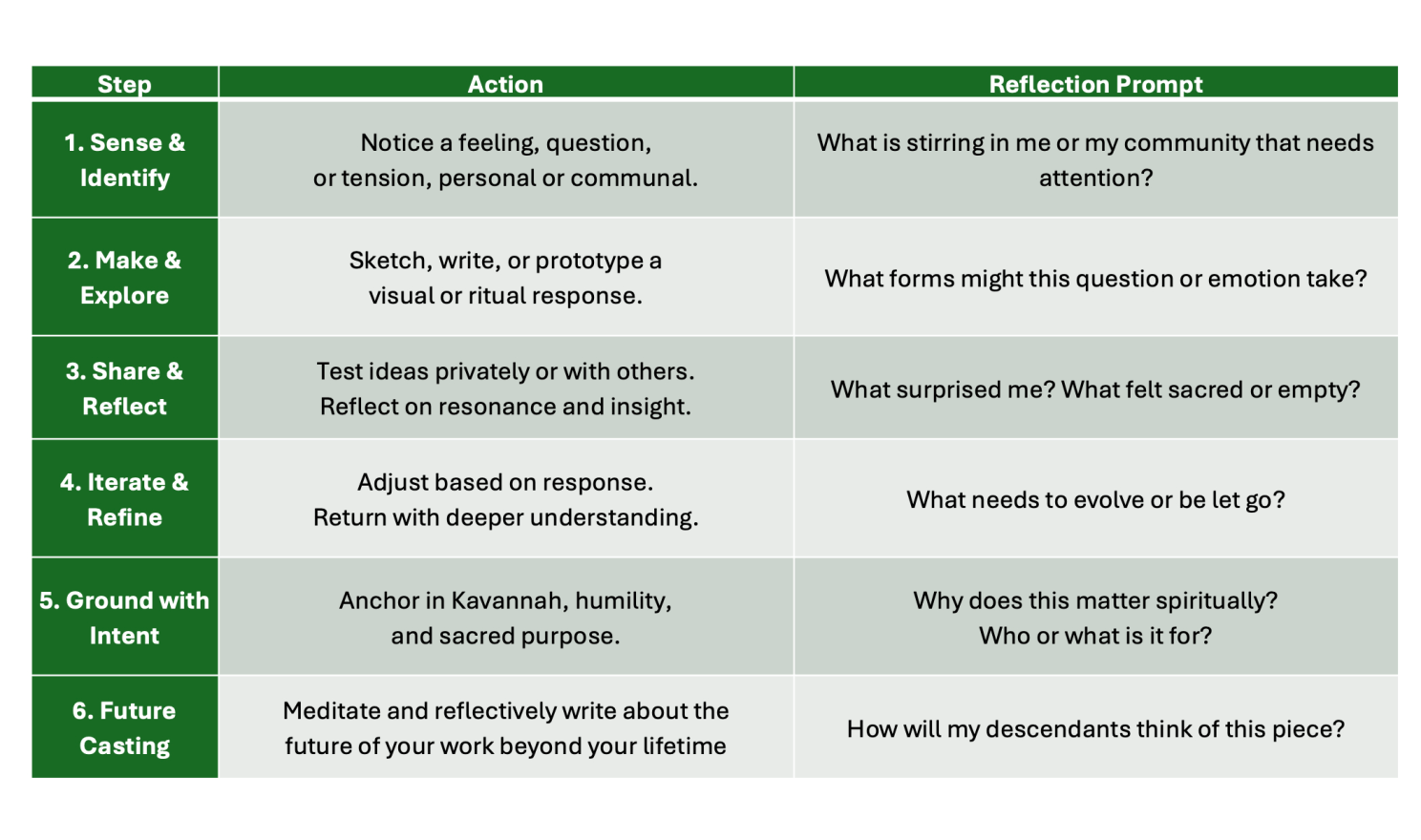
One of the most powerful connectors between these two worlds is iteration. In design, iteration means we test, revise, and revisit ideas. We are always improving through cycles of feedback. In Judaism, iteration is baked into everything: we revisit the same Torah portions each year with new eyes, we refine rituals through lived experience, and we continually return to core questions through study and prayer. This cyclical, reflective approach makes the sacred creative process feel alive. It becomes responsive to both tradition and change of the practice of ritual, liturgy, Torah cycles and compared them to the creative frameworks I used as a designer, I began to notice deep resonances. Jewish time is iterative. Rituals are prototypes refined over generations. Sacred texts are living documents engaged by communities in cycles. These are not just religious structures they are deeply creative systems.
Merging the frameworks of UX design from sources like IDEO, Interaction Design Foundation and Jewish spiritual practice not only clarified both for me, but it made them more accessible, emotional, and human. Suddenly, design became prayerful. And Judaism became a beautifully designed user experience for living with meaning. In that synthesis, I found a personal theology of creativity, one that invites others in regardless of artistic background.
Witnessing Community Transformation
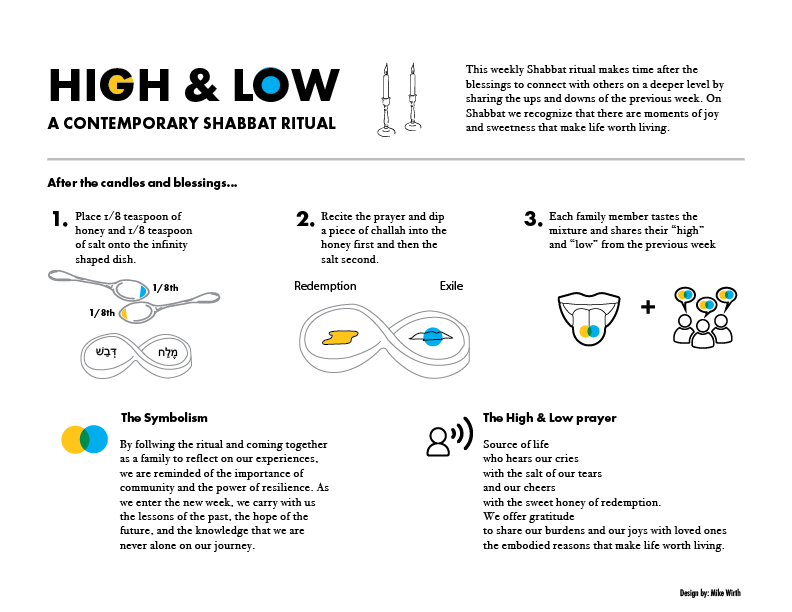
In 2023, I was part of the inaugural Social Practice Institute hosted by the Greensboro Jewish Museum. Over a 10-day intensive, my cohort of Jewish creatives explored the intersections of Social Practice theory and Judaism. As our capstone project, we were invited to create a social practice artwork grounded in Jewish values. I chose to design a ritual rooted in my family’s Shabbat practice by formalizing a simple yet powerful question that my non-Jewish partner asks each week: “What was your high and low?” Working with Rabbi Judy Schindler, I wrote a prayer and developed a ritual element that involved dipping salt and honey, symbolizing the sweet and bitter aspects of the week. This gesture transformed an informal tradition into a shared, sacred moment that felt authentically Jewish to our whole family.
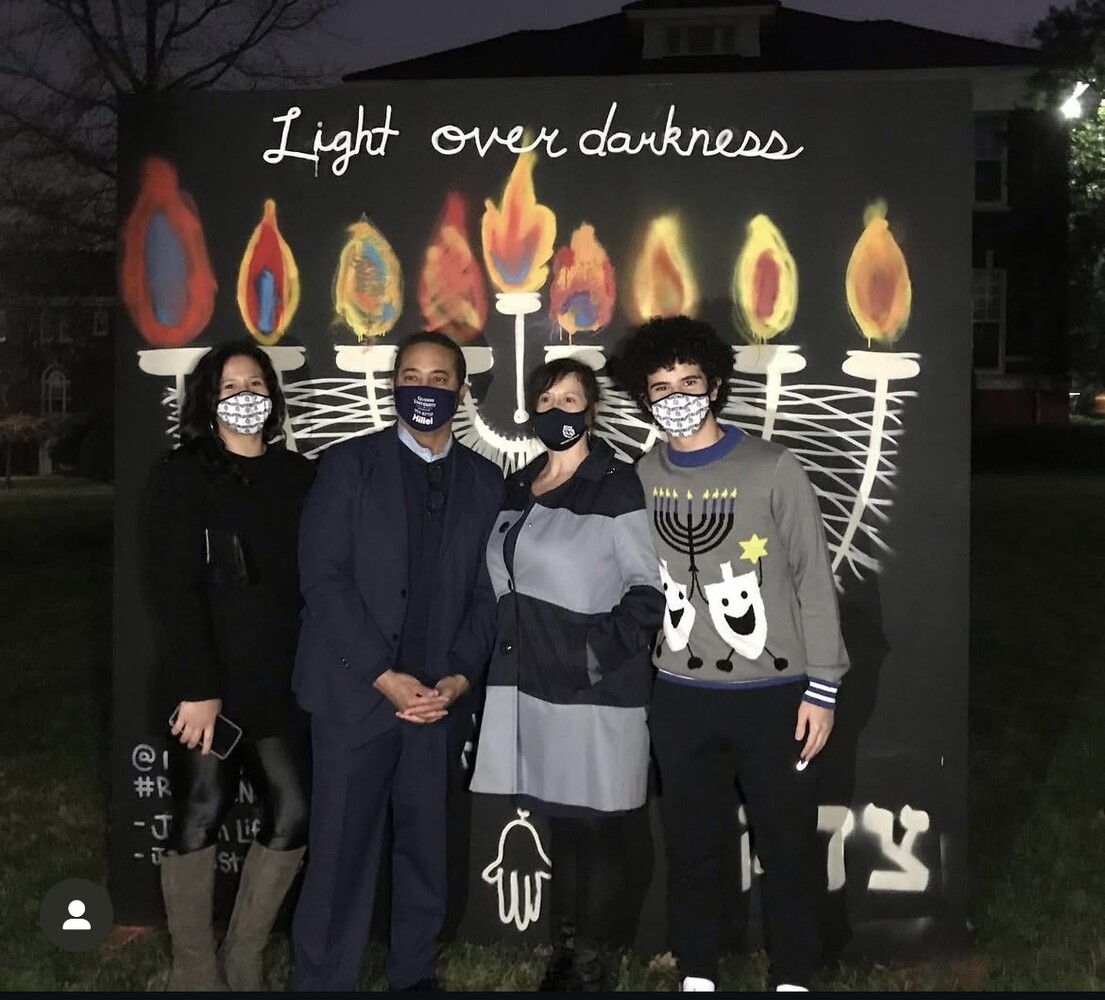
At Queens University of Charlotte, I created a Hanukkah mural project that brought together a diverse and pluralistic group of students and community members. This included Jews from many backgrounds across the Charlotte community, including Orthodox, Reform, interfaith families, and cultural Jews working side-by-side. Each night, a community leader would light our real menorah and then spray paint the flame for that night on our mural menorah. It was a rare, joyous, and profound moment of connection, anchored in creativity and shared ritual.
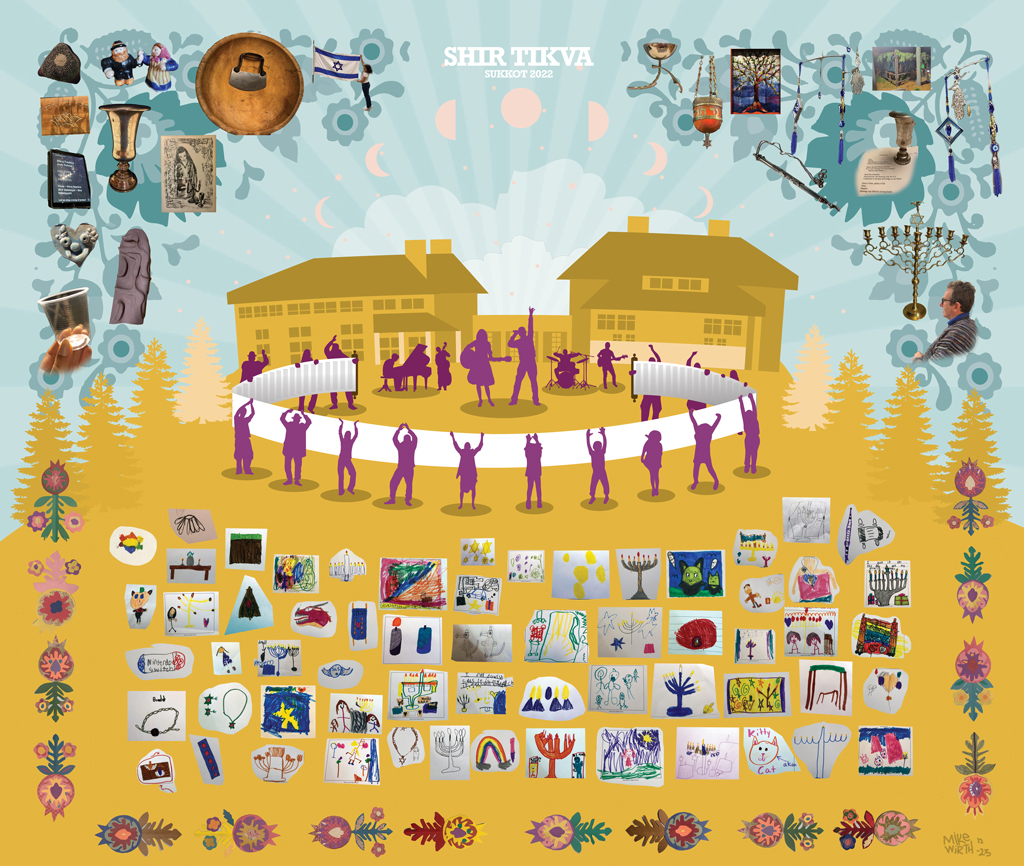
In 2024, at Temple Shir Tikvah in Wayland, MA, I worked with the congregation during a 3-day residency to collect hundreds of photos, drawings, and stories of each member of the community’s “sacred Jewish objects.” We meditate on what it means for objects to be “Jewish” and “sacred”. Some gave Judaica while others gave images of a stuffed animal, because it reminded them of a recently deceased loved one. This exercise transformed these individual intimate artifacts into a collective community digital collage of a “time tapestry” of meaning that forged personal connections and bridged generations and practice. The final artwork became a visual record of personal memory and shared identity. We printed the 9 ’ x 9’ on archival fabric, and it currently hangs in the synagogue.
In 2025, I will be participating in the Jewish Street Art Festival in collaboration with UC Irvine Hillel. That community has experienced deep pain. From campus protests disrupting life for Jewish students to student council boycott votes targeting Israel. Our art will be a form of public healing and spiritual resistance, a sacred reclamation of space through color, symbol, and story.
Even online, I see how creativity becomes a sacred connector. When I post new Jewish-themed artwork for my upcoming Parshat guidebook, the response is immediate and profound. The comment threads and DMs often skip small talk entirely and dive straight into deep conversation about grief, joy, interpretation, and belonging. With just one image, we’re able to arrive at a spiritual place together. And that, to me, is sacred.
Personal Revelation and Commitment
What I’ve learned is simple and profound: creativity is not just for individual enlightenment. It is a communal force. It brings us into dialogue, into presence, and into the work of building something sacred together. My commitment is to continue creating in this way and not just to beautify our tradition, but to actively evolve it with care, joy, and intention.
If this story resonates with you and if you’re looking to bring creative spiritual practice to your synagogue, school, museum, or campus, then I’d love to connect. I’m available for lectures, workshops, and collaborative art projects that help communities deepen their relationship with creativity, tradition, and each other.